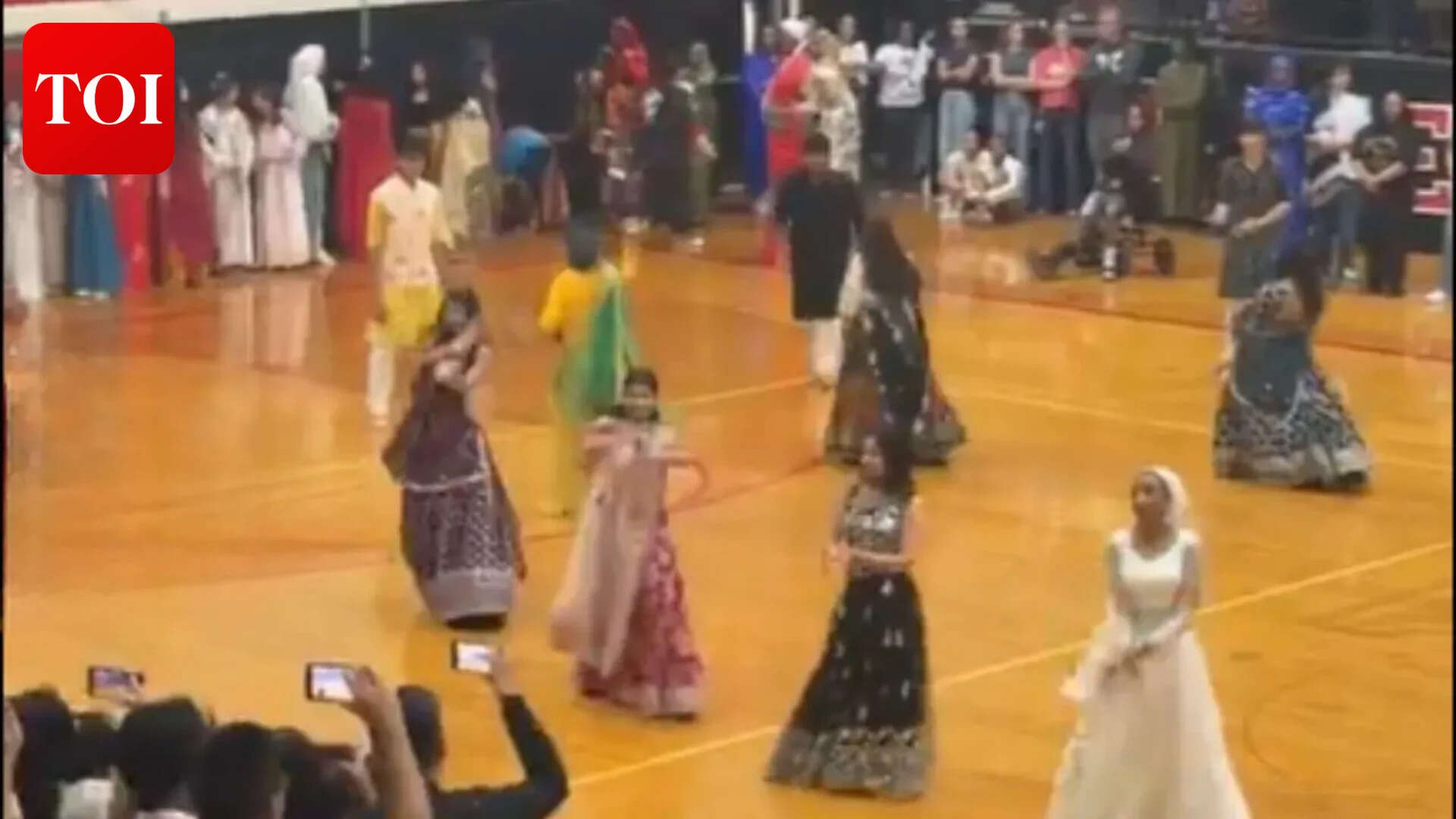
A viral video of a Bollywood dance performance at a Texas high school pep rally has done more than just rack up millions of views. It has exposed a raw nerve in the American suburban psyche. While the footage shows students of various backgrounds synchronized in a high-energy routine, the digital response has been anything but harmonious. On one side, the performance is hailed as a masterclass in modern inclusion. On the other, it is being weaponized as evidence of a "Texas values" crisis. The friction isn't just about dance moves. It’s about who owns the local identity when the demographics of the neighborhood change faster than the school curriculum can adapt.
This specific flashpoint occurred in a district that has seen a massive influx of South Asian professionals over the last decade. These families aren't just passing through. They are buying homes, paying property taxes, and filling the seats of school boards. When their children bring their culture to the center of the gymnasium floor, it isn't an accident or a "woke" imposition from the top down. It is a reflection of the current tax base. Yet, for a vocal segment of the population, seeing a traditional pep rally—an American institution as sacred as Friday night football—reconfigured through a global lens feels like a loss of ground.
The Suburban Demographic Shift No One Wants to Talk About
Texas is no longer a monolithic entity of cowboy boots and ranching history. The reality on the ground is far more complex. In counties like Collin, Denton, and Fort Bend, the transformation has been swift and driven primarily by the tech and medical sectors. These are high-income, highly educated communities where the "Texas value" of hard work is being practiced by people who grew up thousands of miles away from the Lone Star State.
The tension arises when the physical landscape of a town remains the same—the same strip malls, the same high school stadiums—but the cultural output shifts. To the critic, the Bollywood dance is a symptom of displacement. To the student on the floor, it is simply their life. This disconnect creates a vacuum where political influencers can step in and frame a school assembly as a battlefield for the soul of the country.
Why Pep Rallies Became the New Front Line
High school sports and the rituals surrounding them have long served as the glue for small-town and suburban America. They are the primary way a community defines itself to its neighbors. For generations, the formula was simple: cheerleaders, the marching band, and maybe a hip-hop routine for variety.
By introducing a Bollywood segment, the school administration is acknowledging that the "community" has fundamentally changed. This isn't just about "celebrating diversity" in a vague, feel-good sense. It is a pragmatic acknowledgment of the students who actually walk the halls. When a significant portion of the student body identifies with a different cultural heritage, the school must decide whether to remain a museum of 20th-century Americana or a mirror of its current inhabitants.
The Viral Outrage Machine
The speed at which a thirty-second clip can go from a local school's Instagram page to a national talking point is a testament to the modern outrage economy. Digital platforms are designed to reward conflict. A video of kids dancing is "boring" until it is captioned with a warning about the decline of Western civilization. Once that frame is applied, the content is no longer about the skill of the dancers or the joy in the room. It becomes a data point in a larger narrative of grievance.
Most of the people commenting on these videos have no connection to the school in question. They don't have children in the district. They don't pay the local taxes that fund the gym lights. Yet, they feel a proprietary ownership over what a "Texas high school" should look like. This creates an environment where local educators are forced to defend their programming against a national audience that is looking for a fight.
The Myth of the Zero Sum Culture
There is a persistent belief among some circles that culture is a zero-sum game. The logic suggests that if you add a Bollywood dance, you must be subtracting something "American." This is a fundamental misunderstanding of how culture actually functions in a melting pot. Adding a new element doesn't inherently delete the old one; it creates a layered identity.
In these Texas schools, the same kids performing Indian folk dances are often the same kids in AP US History and the same kids cheering at the football game later that night. They are navigating multiple worlds simultaneously. The adults watching from the sidelines are the ones struggling with the binary choice of "us versus them." For the students, the integration is already a lived reality.
The Economic Engine Behind the Change
If you want to understand why a Texas high school looks different today, look at the job boards. The "Texas Miracle"—the state’s period of explosive economic growth—was built on attracting global talent. Companies like Toyota, Tesla, and Oracle didn't move to Texas to maintain a 1950s social structure. They moved for the business climate, and they brought a global workforce with them.
This workforce demands high-performing schools. They prioritize STEM education, extracurricular variety, and a global outlook. The very schools now being criticized for "losing their values" are often the highest-rated in the state, precisely because of the families who have moved there. There is a deep irony in celebrating the economic boom of the Sun Belt while complaining about the cultural byproduct of that same growth. You cannot have the tech hubs and the corporate headquarters without the people who run them.
Real Stakes for Local School Boards
The noise on social media eventually filters down to school board meetings. This is where the abstract debate over "values" becomes a concrete struggle over policy. Administrators are increasingly caught between a rock and a hard place. If they ignore the changing demographics, they alienate the families driving the district's success. If they embrace them, they face a backlash from residents who feel their heritage is being erased.
This isn't a hypothetical problem. We are seeing school board elections turned into proxy wars for national politics. Budgets are being scrutinized not for their educational efficacy, but for their perceived alignment with one side of the culture war. The casualty in this process is the student experience. When every school event is a potential PR disaster, the natural instinct for administrators is to retreat into the safest, most bland version of education possible.
Beyond the Screen
The viral video of the Bollywood dance will eventually be replaced by the next controversy. The underlying tension, however, isn't going anywhere. Texas is a preview of what the rest of the country will look like as the suburban-urban divide continues to shift.
Understanding this requires looking past the 280-character outbursts and the heated Facebook threads. It requires an honest assessment of what it means to be a "Texan" in 2026. If the definition is stuck in a static past, it will inevitably clash with a dynamic present. The students in that video aren't trying to destroy a culture. They are trying to build one that includes them.
Texas has always been a state defined by its frontiers. In the past, those frontiers were geographical. Today, the frontier is cultural. The schools are simply the places where that new territory is being mapped out in real-time. Whether that process is viewed as a loss or an evolution depends entirely on who is doing the looking.
Stop looking at the dance as a political statement and start looking at it as a demographic fact. The census data told us this was coming twenty years ago. The high school gym is just where the data finally found a beat.