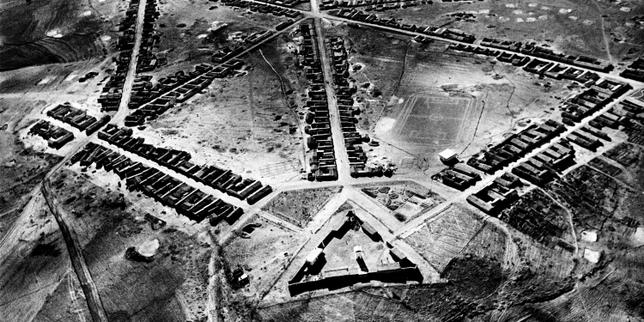
The dust in the Highlands of Algeria does not just settle; it buries. If you stand on the windswept plateaus of Médéa or the rugged slopes of the Aurès today, you might see rows of crumbling stone or the skeletal remains of grid-like settlements. To a passing traveler, they look like failed urban planning or perhaps the remnants of a harsh agricultural experiment.
They are neither. They are the scars of a "regroupement"—a polite, bureaucratic term for one of the largest forced displacements in modern history.
Between 1954 and 1962, the French military uprooted nearly Joseph-level numbers of civilians. Two million people. That was one-fourth of the entire Algerian population at the time. They were moved from their ancestral mountain hamlets into barbed-wire enclosures. The logic was cold, surgical, and military: to isolate the National Liberation Front (FLN) from the people, the "sea" in which the "fish" swam. But when you move two million souls into "camps," you don't just change a map. You shatter a civilization.
The Architecture of Rupture
Imagine a farmer named Ahmed. For generations, his family’s identity was tied to a specific patch of soil, a specific set of olive trees, and the seasonal rhythm of the mountains. One morning, the trucks arrive. He is told he has two hours to pack what he can carry. His home is declared a "forbidden zone." Anyone found there after sunset is shot on sight.
Ahmed is taken to a plateau where the wind never stops. There is no wood for fire. There are no stones for building. Instead, he is handed a few corrugated iron sheets and told to build a life. This was the reality for millions. The French army called these "Centres de Regroupement." The inmates—and they were inmates, despite the lack of formal charges—called them le camp.
The spatial shift was psychological warfare. Traditional Algerian life was centered around the dachar, a village of winding paths and intimate spaces. The camps were built on a colonial grid. Straight lines. Open sightlines. No privacy. The French officers could stand on a watchtower and see into every "street." It was a panopticon made of mud and tin.
The impact was immediate and devastating. In the mountains, you lived off the land. In the camp, you lived off the "charity" of the colonial administration or you starved. By 1959, the French administration's own reports—notably the one suppressed by Michel Rocard—admitted that five hundred children were dying in these camps every single day. Not from bullets. From hunger. From cold. From the sheer, crushing weight of displacement.
The Invisible Stakes of Memory
Why does this matter now, sixty years later? Because the geography of Algeria was permanently altered. Most of these people never went home. Their original villages were burned, their wells poisoned, their forests napalmed to prevent the "rebels" from hiding. When the war ended in 1962, the "forbidden zones" remained scars.
The people stayed in the camps. The camps became villages. The villages became towns.
This created a massive, forced urbanization that the country was never prepared to handle. It broke the back of traditional Algerian agriculture. More importantly, it created a generation of "uprooted" people. When you strip a person of their land, you strip them of their history. The stories of these camps are rarely found in textbooks. They live in the nightmares of grandmothers who still keep the rusted keys to houses that no longer exist.
There is a specific kind of silence in these places. It is the silence of a witness who was told their suffering was a "military necessity." Even today, as you drive through the countryside, you see the difference. The old villages feel like they grew out of the earth. The regroupment towns feel like they were dropped from the sky—stiff, uncomfortable, and forever at odds with the landscape.
The Ghost in the Statistics
Statistics are often used to hide the human face of tragedy. We hear "two million displaced" and the brain glitches; the number is too big to feel. To understand the stakes, we have to look at the small things.
- The loss of the "Common": In the mountains, land was often held collectively. In the camps, land was a commodity.
- The collapse of Social Hierarchy: Elders who held authority in the dachar became just another number in the ration line.
- The Gender Shift: Women, previously shielded by the private nature of the mountain home, were suddenly exposed to the gaze of foreign soldiers in the open camp grid.
The French military believed they were winning hearts and minds by providing "modern" housing and medical clinics. They failed to realize that a clinic is a poor substitute for dignity. You cannot heal a man with a bandage while you are holding his family behind a fence.
The Persistence of the Camp
The trauma did not vanish when the French flags were lowered. The post-colonial state inherited these "grid towns." The socialist experiments of the 1970s often doubled down on this centralized, controlled architecture. The camp became the blueprint for the modern Algerian suburb.
This is the hidden cost of the war. It isn't just the dead; it's the way the living were forced to exist. The "regroupement" was an attempt to domesticate a revolution, to turn a defiant rural population into a manageable, legible urban one. In many ways, the colonial ghost won that battle. The mountains emptied, and the spirit of the dachar was buried under the weight of concrete and corrugated steel.
Walking through these sites today is a haunting experience. In places like the Ouarsenis mountains, you can find the ruins of the original villages. They are beautiful, haunting piles of stone reclaimed by wild herbs and stunted trees. Then, you look down into the valley at the "new" town. It is gray. It is dusty. It is loud.
One is a corpse; the other is a ghost.
The history of these camps is the history of a people forced to forget who they were so they could be counted by an empire. It is a story of resilience, yes, but also of a profound, lingering ache. When a person is moved, they lose a house. When a people is moved, they lose their soul.
The wind still howls across the plateaus of Médéa, kicking up the fine, red dust of the Highlands. If you listen closely, it doesn't sound like nature. It sounds like the collective breath of two million people waiting for a permission slip to go home that will never come. The barbed wire is gone, but the grid remains, etched into the earth and the minds of those who still call the camp their only home.