The air changes the moment you descend. Upstairs, the Haifa sun is relentless, glinting off the Mediterranean and baking the asphalt of the Rambam Health Care Campus. But as the heavy steel doors seal behind you, the temperature drops. The humidity vanishes. You are no longer in a hospital; you are in the belly of a whale made of reinforced concrete.
Everything here smells of fresh paint and industrial-grade air filtration. It is too quiet.
In any other city, a three-level underground parking garage is a place of oil stains and forgotten shopping carts. Here, it is the most sophisticated fortress of healing on the planet. This is the Sammy Ofer Fortified Underground Emergency Hospital. It was built because, in this part of the world, the sky sometimes falls.
The Architecture of Anxiety
Consider a nurse named Sarah. She has worked at Rambam for fifteen years. She remembers 2006, when rockets blurred the line between the front line and the front ward. Back then, moving patients was a chaotic scramble to the safest interior corridors, away from glass, away from the exterior walls that suddenly felt like paper.
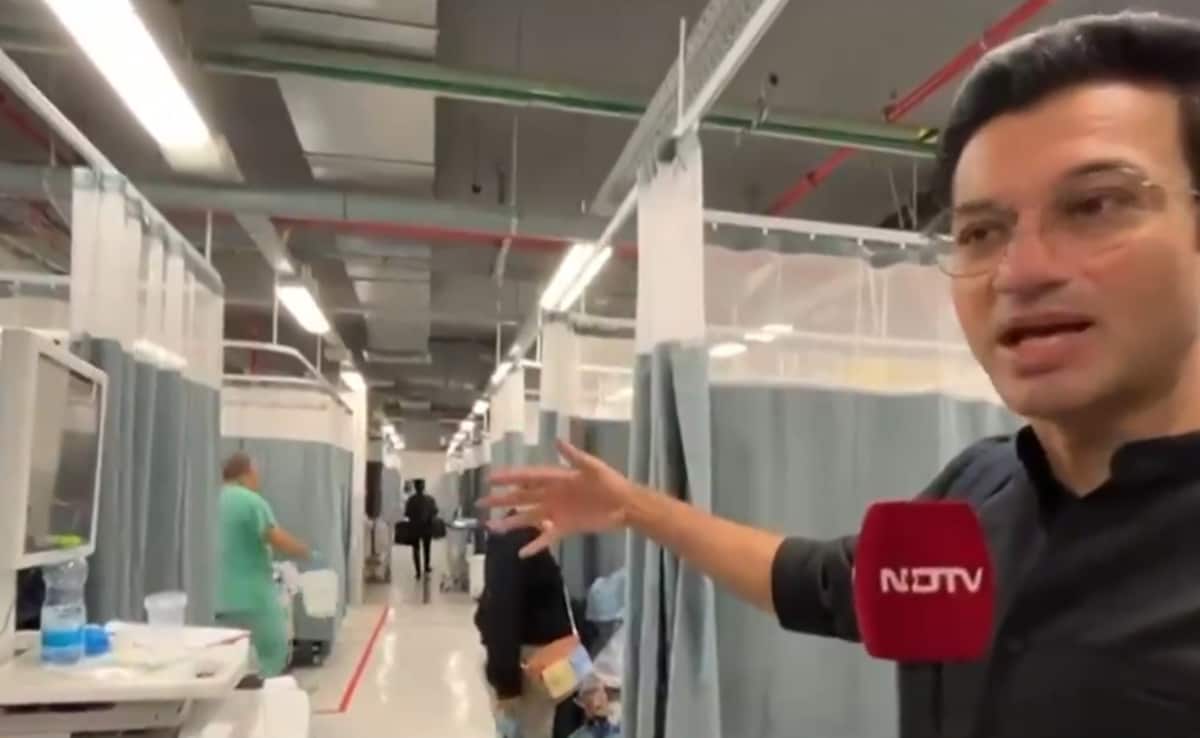
Now, Sarah walks through Level -2. Where there should be a white line for a Volvo, there is a headboard equipped with oxygen outlets, vacuum suction, and data ports. They are tucked behind unassuming metal panels, hidden in plain sight during peacetime.
This isn’t a makeshift tent city. It is a $140 million insurance policy against the unthinkable. When the sirens wail and the "Red Alert" echoes through the hills of northern Galilee, the transformation begins. It is surgical. Thousands of cars are cleared out in a matter of hours. The floors are scrubbed with clinical precision. Then, the beds arrive.
Two thousand of them.
The logistical math is staggering. How do you provide pressurized air to 2,000 people thirty feet underground? How do you manage the waste of a small city when the municipal sewers might be compromised? The engineers solved this by turning the garage into a self-contained ecosystem. It has its own power generators, its own massive water reservoirs, and an air filtration system designed to scrub out chemical and biological agents.
The Weight of the Ceiling
There is a specific psychological weight to standing beneath several meters of high-density concrete. You feel small. You feel protected. But you also feel the terrifying reality of why such a place must exist.
The hospital isn't just a shell; it’s a living machine. On the lowest level, there are fully equipped operating rooms. These aren't "field" theaters. They are sterile environments where a neurosurgeon can perform a craniotomy while a barrage happens directly overhead. The surgeon wouldn't even feel the vibration.
But the real story isn't the concrete. It’s the transition.
Imagine being a dialysis patient. You are tethered to a machine that keeps you alive, your blood cycling through a filter three times a week. Suddenly, the world turns upside down. You are wheeled into an elevator, down into the earth, and placed in a row of hundreds of others. The ceiling is low. The lights are fluorescent. The familiar view of the sea is replaced by the grey geometry of a support pillar.
The fear in that room is thick, but it is countered by a strange, communal defiance. In the underground ward, there is no "us" and "them." There are just patients and the people keeping them breathing. When the rockets start to land above, the staff doesn't leave. They can't. They are the heartbeat of the bunker.
The Invisible Stakes
We often talk about "emergency preparedness" in clinical terms—response times, bed counts, cubic centimeters of oxygen. But those terms fail to capture the human cost of waiting.
Living in a fortified hospital is an exercise in suspended animation. You are safe from the blast, but you are not safe from the stress. The doctors here talk about "war-time medicine" not just as trauma surgery, but as the management of a collective nervous system.
The facility is designed to withstand a direct hit from a conventional missile. It is sealed against gas. It is a masterpiece of 21st-century defense. Yet, every doctor at Rambam tells you the same thing: they hope the oxygen ports behind the parking signs never have to stay open for long.
A hospital is supposed to be a place of light and recovery. Moving it underground is a reversal of the natural order. It is a concession to a violent reality. Yet, when you see the dialysis machines humming in a space that was meant for a Ford Focus, the ingenuity is breathtaking.
The engineering challenges were immense. Water pressure has to be maintained upward. Carbon dioxide has to be scrubbed out. The sheer heat generated by 2,000 human bodies and thousands of pieces of medical equipment would cook the occupants if not for a massive, hidden cooling infrastructure.
The Silence of the Bunker
What stays with you is the silence.
If you stand in the center of Level -3 when it is empty, the scale of the preparation hits you. It is a cathedral of "just in case." It represents a society that has decided that the life of a single patient is worth 140 million dollars and a mountain of concrete.
It is easy to look at the beds in the parking lot and see a dystopia. You see a world where we have failed to find peace. But look closer. Look at the nurse checking the seal on an underground oxygen tank. Look at the technician testing the backup-to-the-backup generator.
You aren't looking at a tomb. You are looking at a testament to the stubborn, unyielding will to survive.
The world above is loud and unpredictable. The world below is controlled, sterile, and safe. It is a sanctuary built of necessity, a place where the most vulnerable members of society are tucked into the earth like seeds, waiting for the storm to pass so they can be brought back into the light.
When the sirens eventually stop and the last patient is wheeled back to the upper floors, the beds are folded. The oxygen panels are clicked shut. The medical equipment is sterilized and stored in pressurized rooms. The floors are hosed down once more.
Then, the cars return.
Commuters drive in, looking for a spot near the elevator, complaining about the tight turns or the cost of parking. They turn off their engines and walk away, rarely glancing at the metal plates on the pillars. They don't think about the fact that they are standing in a room that can hold the breath of a nation. They don't have to. And that, perhaps, is the greatest success of the entire endeavor.
The fortress disappears back into the mundane. It waits in the dark, a silent guardian of 2,000 lives, hoping to remain nothing more than a place to park a car.
The steel doors remain oiled. The oxygen flows in the pipes, invisible and ready. The concrete holds its breath.