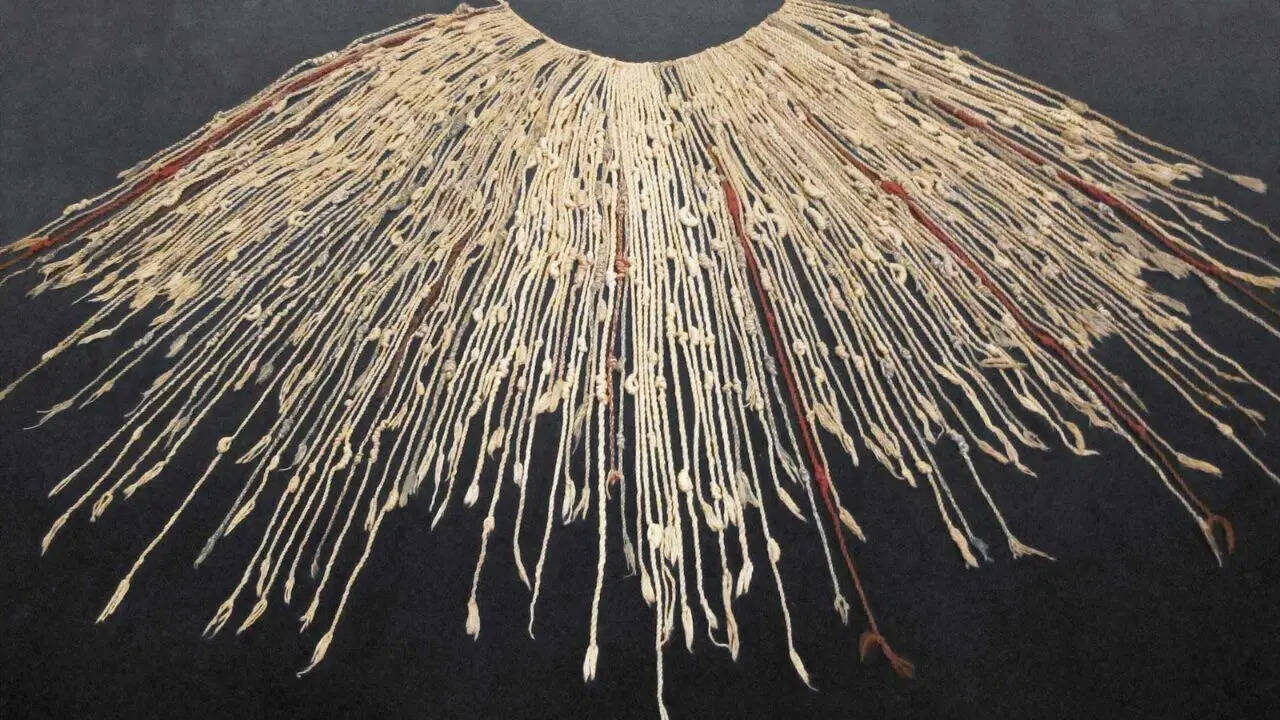
The Inka Empire managed a population of 12 million people spanning 2,500 miles of diverse Andean terrain without a phonetic writing system. This logistical feat was not achieved through primitive mnemonic aids, but through the khipu: a sophisticated, tactile information technology utilizing a base-10 positional system and binary coding. Recent structural analysis reveals that khipus functioned as a distributed ledger system, capable of storing complex relational data, performing high-speed accounting, and employing early forms of cryptographic security to ensure data integrity across the state.
The Three Pillars of Khipu Information Theory
To understand the khipu as a computational tool rather than a mere "counting string," one must deconstruct its architecture into three distinct layers of data encoding. These layers allowed the khipukamayuq (knot keepers) to record both quantitative values and qualitative metadata simultaneously. In related updates, read about: The Hollow Classroom and the Cost of a Digital Savior.
1. The Quantitative Layer: Base-10 Positional Logic
The Inka utilized a decimal system that mirrors modern Hindu-Arabic notation in its logic, though not its form. Knots were placed in tiers along a pendant cord to represent powers of ten.
- The Lowest Tier: Represents units ($10^0$).
- The Middle Tiers: Represent tens ($10^1$), hundreds ($10^2$), and thousands ($10^3$).
- The Zero Value: Represented by the total absence of a knot in a specific positional tier. This "empty space" functioned as a functional zero, a concept many contemporary European systems had not yet fully operationalized for high-level calculations.
2. The Qualitative Layer: Binary and Multivariant Coding
Beyond the numbers, the physical construction of the cord provided the context for the data. This is where the khipu transitions from a calculator to a database. Wired has also covered this fascinating subject in extensive detail.
- Fiber Material: The choice between camelid wool (llama/alpaca) and cotton signaled the category of the data (e.g., agricultural vs. military).
- Spin and Twist (S/Z): The direction in which a cord was spun—clockwise (Z-twist) or counter-clockwise (S-twist)—acted as a binary switch. This could indicate the direction of a transaction (tax paid vs. tax owed) or distinguish between different social groups within a census.
- Color Coding: With over 50 distinct hues identified, color functioned as a high-density classification system. A red cord might signify warfare or the military, while yellow denoted corn or agricultural surpluses.
3. The Structural Layer: Relational Data Hierarchies
The khipu utilized a physical hierarchy to organize data relationships. Primary cords held pendant cords, which could in turn hold subsidiary (subsidiary) cords. This branching structure allowed for the nesting of data, much like modern file folders or JSON objects. A primary cord representing a province would have pendant cords for each village, and those village cords would have subsidiary cords for individual households.
The Cost Function of Imperial Scale
The Inka faced a classic information bottleneck: how to transmit high-fidelity data across vast distances via human runners (chasquis) without corruption. The solution was a standardized "Operating System" enforced across the Tawantinsuyu.
The efficiency of this system is measured by its Data Density. Unlike clay tablets or parchment, a khipu is lightweight, durable in high-altitude humidity, and compressible. A single khipu could hold the entire census and tax obligations of a region, yet weigh less than a few ounces. This minimized the "transportation cost" of information, allowing the central administration in Cusco to adjust resource allocation (the mit'a labor tax) in near real-time based on local surpluses or shortages.
Cryptography and Data Security Mechanisms
The khipu system possessed inherent security features that functioned as a precursor to modern encryption. Because the meaning of a khipu was derived from a combination of knot type, position, color, and spin, the data was unreadable to anyone not trained in the specific "codebook" of that administrative department.
The Khipukamayuq as a Human Processor
Information was not meant to be "read" by the public. It was decoded by a specialized class of bureaucrats. This created a layer of Access Control. If a messenger was captured, the physical khipu provided no intelligence to the enemy unless they also captured the specific khipukamayuq who knew the local coding conventions.
Structural Verification
The use of "summation cords" provided a primitive but effective checksum. A master cord would often contain the sum of all pendant cords attached to it. If the physical knots on the pendants did not match the total on the master cord, the data was flagged as corrupted or fraudulent. This prevented local officials from under-reporting harvests to skim off the top, ensuring state-level data integrity.
The Bottleneck of Tactile Literacy
The primary limitation of the khipu was not its storage capacity, but its latency in literacy. Because the system relied on physical attributes (texture and twist) that are difficult to standardize perfectly across thousands of miles, there was a high degree of "local dialect" in khipu construction.
While the decimal system was universal, the qualitative codes—the meaning of a specific shade of indigo or a specific ply of wool—often required the presence of the creator to interpret the nuances. This created a dependency on a specific bureaucratic caste. When the Spanish conquest targeted the khipukamayuqs, the "software" to run the Inka "hardware" was largely deleted, leaving thousands of khipus silent.
Reevaluating the 'Computer' Analogy
Critics often dismiss the khipu as a "mnemonic device"—a tool to jog the memory. However, current research into the "Puruchuco Accounting Hierarchy" proves that khipus were used for complex data aggregation where the final cords contained information not present in the memory of the original cord-makers. This is the definition of an externalized processing system.
If we define a computer as a system that inputs data, processes it according to set rules, and outputs a result, the khipu-human interface qualifies. The khipukamayuq used the yupana (a stone calculating board) as the CPU to perform arithmetic, then "saved" the output to the khipu "hard drive."
Strategic Implementation of Tactile Data
The Inka model suggests that high-performance governance is possible through non-alphabetic, multi-dimensional data structures. The khipu outperformed contemporary European written records in terms of portability and multi-variable indexing.
For modern systems architects, the khipu offers a masterclass in:
- Redundancy: Using color, twist, and position to encode the same data point, ensuring readability even if the cord is partially damaged.
- Compression: Utilizing the physical 3D space of the cord to represent hierarchical relationships that would require pages of linear text to describe.
- Authentication: The unique "hand" of a specific khipukamayuq served as a tactile signature, verifying the source of the data.
The transition of the khipu from a mystery to a decoded computational system changes our understanding of information history. It suggests that the "Western" path of linear, phonetic writing is only one method of managing complexity. The Inka proved that a binary-logic, tactile-based system could sustain one of the most sophisticated command economies in human history.
Investigating khipus through the lens of fiber-based computing—where the physical properties of the medium are the code—provides a roadmap for developing alternative data storage methods that do not rely on traditional screens or silicon, particularly in environments where durability and portability are the primary constraints. The focus must remain on the structural logic of the knots; the physical artifact is merely the vessel for an advanced, lost algorithm of social organization.