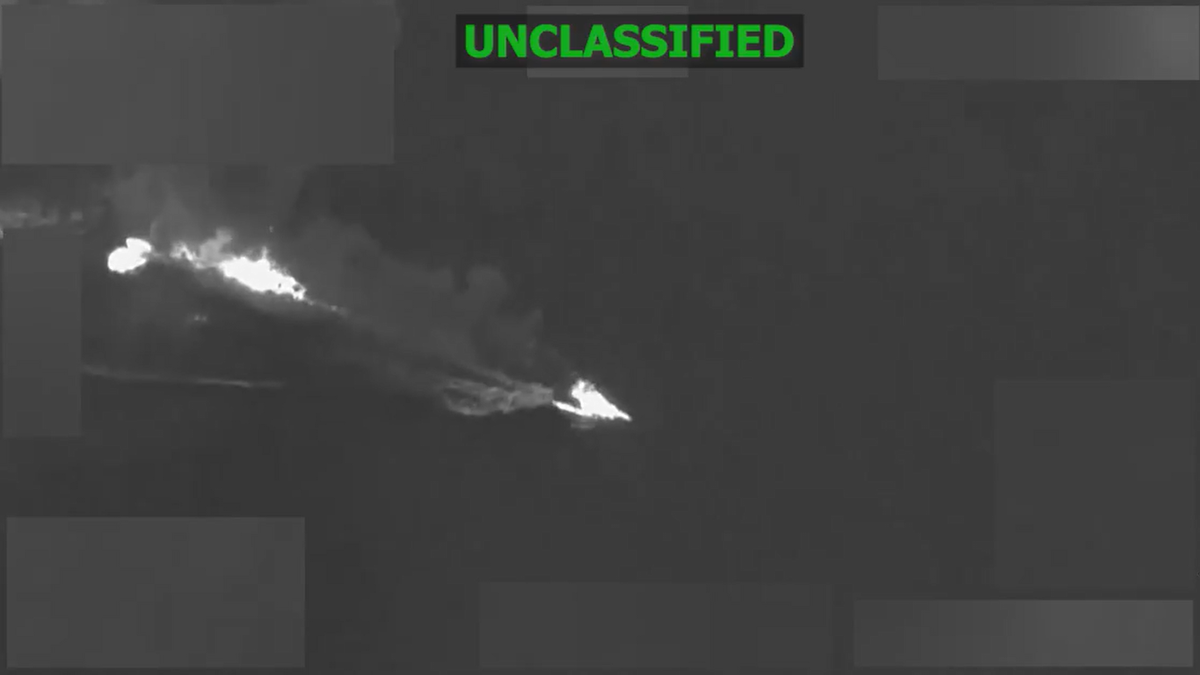
Two people are dead after a U.S. Coast Guard helicopter opened fire on a suspected drug smuggling vessel in the Eastern Pacific. It's a blunt, violent reminder that the "war on drugs" isn't just a political talking point or a series of court cases. Out on the water, it’s a high-stakes kinetic conflict where split-second decisions lead to body bags. This wasn't a routine traffic stop. This was a tactical intervention against a "go-fast" boat that refused to stop, and it highlights a massive escalation in how the U.S. handles maritime interdiction.
The incident unfolded in international waters, a vast stretch of the Pacific where law enforcement operates under a complex web of bilateral agreements and maritime law. When a Coast Guard MH-65 Dolphin helicopter deployed from a nearby cutter, the crew spotted a vessel displaying the hallmarks of a smuggling operation. These boats are built for one thing: speed. They’re low-profile, packed with outboard engines, and often carry thousands of pounds of cocaine or fentanyl destined for North American shores. When the boat ignored verbal and visual warnings, the situation turned lethal.
The mechanics of a lethal use of force at sea
Most people think the Coast Guard only handles search and rescue or checking life jackets on weekend boaters. That's a mistake. They’re a military branch with a specific mandate for drug interdiction. When a vessel refuses to heave to—maritime speak for "stop your boat"—the Coast Guard follows a very specific escalation of force.
It starts with radio calls. Then blue lights and sirens. If the smugglers keep pushing, the marksman in the helicopter moves to "warning shots." These are rounds fired into the water across the bow of the boat. It’s the last chance to give up. If the boat still doesn't stop, the crew moves to "disabling fire." The goal here is to take out the engines.
In this specific case in the Eastern Pacific, something went wrong. Disabling fire is supposed to hit the machinery, not the people. But shooting from a vibrating helicopter at a bouncing boat in 10-foot swells is incredibly difficult. Two individuals on the suspected smuggling craft were hit and later died.
The gray area of international waters and jurisdiction
International law is tricky. You can't just go around shooting boats because they look suspicious. The U.S. relies on the 1988 UN Convention against Illicit Traffic in Narcotic Drugs and Psychotropic Substances. This allows nations to board vessels that aren't flying a flag or those where the "flag state" gives permission.
The Eastern Pacific is a primary corridor for cartels moving product from Colombia and Ecuador. It’s thousands of miles of open ocean. Patrolling it is like trying to guard a desert with a handful of flashlights. Because the area is so vast, the Coast Guard often uses "Law Enforcement Detachments" (LEDETs) on Navy ships or works alongside allied nations.
When a death occurs during these operations, it triggers a massive internal investigation. The Coast Guard’s specialized units, like the Hitron (Helicopter Interdiction Tactical Squadron), are trained specifically for this. They use M110 semi-automatic rifles or M107 .50-caliber sniper rifles to punch through engine blocks. If the bullets hit the crew instead, the legal and diplomatic fallout can be intense. We’ve seen this before, and it usually leads to a temporary tightening of engagement rules.
Why smuggling tactics are getting more desperate
Smugglers aren't just using old fishing boats anymore. They’re using Low Profile Vessels (LPVs) and even "narco-submarines." These are fiberglass boats that sit just inches above the waterline. They’re nearly invisible to radar.
The crews on these boats are often low-level "mules." They’re paid a pittance to risk their lives. If they get caught, the cargo gets dumped, and they go to prison. If they resist, they end up like the two individuals in this recent strike. The cartels don't care about the lives of these operators. They factor "product loss" into their business models.
The sheer volume of drugs moving through the Eastern Pacific is staggering. In 2023 and 2024, the Coast Guard intercepted tens of billions of dollars worth of cocaine. But for every boat they catch, how many get through? Experts suggest we’re only seeing a fraction of the total traffic. This creates a cycle of desperation where enforcement gets more aggressive because the stakes are so high, and smugglers get more reckless to protect their shipments.
The reality of maritime marksman training
I've looked into the training these marksmen undergo. It's grueling. They practice hitting a target the size of a dinner plate from a moving aircraft while the target itself is zigzagging at 40 knots. It is a feat of physics.
- Environmental Factors: Wind shear, sea spray, and the "downwash" from the helicopter rotors all affect bullet trajectory.
- Target Motion: Unlike a stationary target on a range, a go-fast boat moves in three dimensions—pitching, rolling, and yawing.
- Equipment Limits: Even with stabilized optics, there's a margin of error.
When the Coast Guard says they used "disabling fire," they’re stating their intent. But intent doesn't always match the outcome in the chaos of a high-speed chase at sea.
What happens next for the survivors and the investigation
The Coast Guard confirmed that other individuals on the boat were taken into custody. They'll likely face charges in U.S. federal court under the Maritime Drug Law Enforcement Act (MDLEA). This law is a powerhouse for prosecutors because it allows the U.S. to exercise jurisdiction over foreign vessels even if the drugs weren't headed directly to a U.S. port, provided there's a nexus to U.S. interests.
The bodies of the deceased will be handled according to international protocol, usually involving coordination with their home countries once identification is confirmed. Meanwhile, the Coast Guard Investigative Service (CGIS) will pick apart every second of the mission. They'll look at the camera footage from the helicopter and the cutter. They’ll analyze the flight data.
The bigger picture of border security
We talk a lot about the land border. But the maritime border is just as porous and far more dangerous to patrol. This incident in the Eastern Pacific shows that the Coast Guard is leaning heavily into its "Force Multiplier" strategy—using tech and lethal precision to compensate for a lack of total hull numbers.
If you’re following this story, don’t just look at the headlines about the deaths. Look at the logistics. Look at the fact that a helicopter had to use kinetic force because there was no other way to stop the flow of narcotics. It’s a sign that the "soft" methods of interdiction aren't working against the current generation of smuggling tactics.
If you want to understand the scale of this, keep an eye on the Southern Command (SOUTHCOM) briefings. They track these movements daily. You can also monitor the Department of Justice’s filings for MDLEA cases to see how these mid-sea arrests actually play out in court. The legal battle is often just as long and complex as the chase on the water.