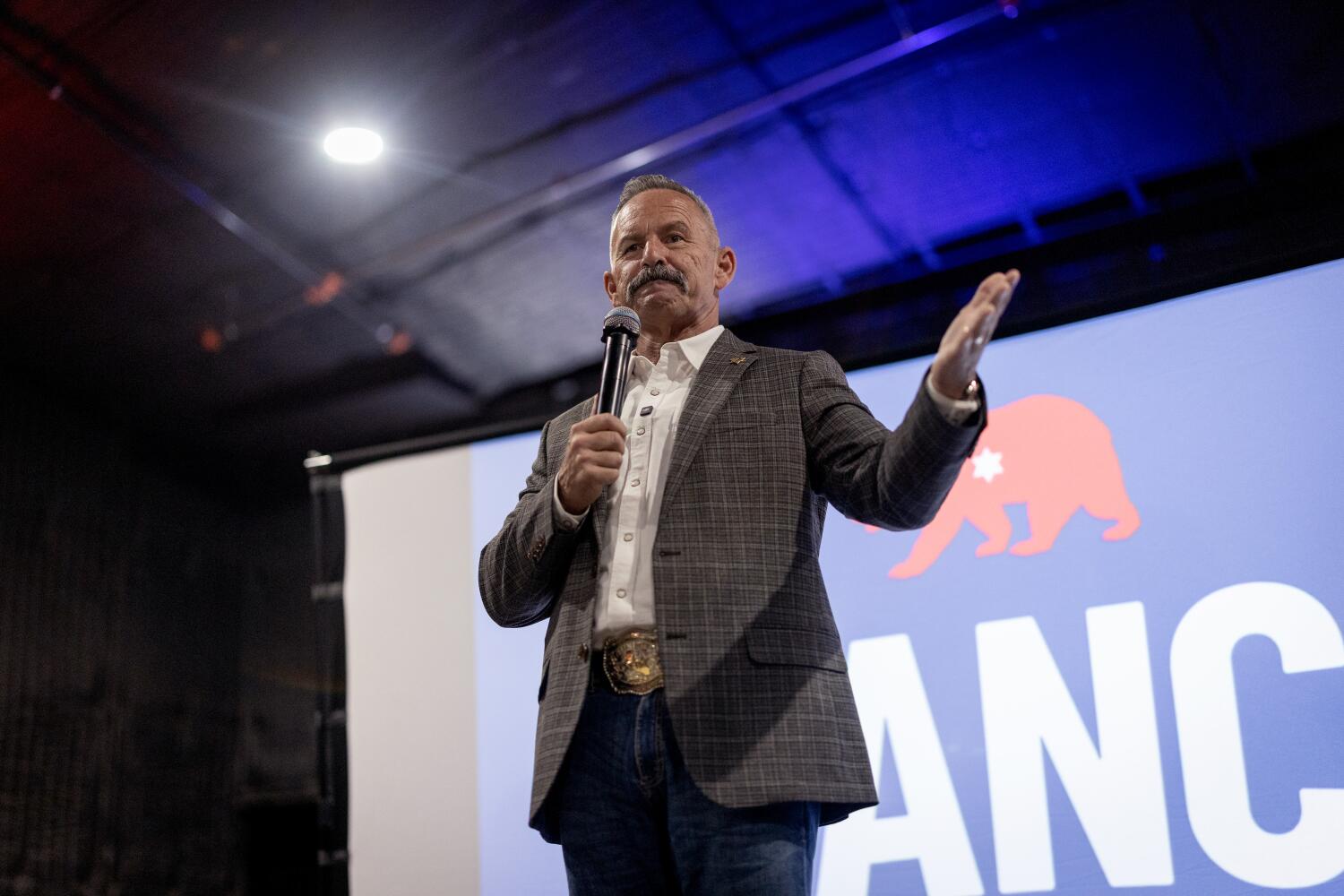
The media is obsessed with the optics of a sheriff in a cowboy hat "defying" the state. They want a simple story of a rogue lawman versus the rule of law. It makes for great TV and even better rage-bait. But if you look at the actual mechanics of the Riverside County ballot seizures, you realize the "defiance" isn't the story. The story is a catastrophic failure of chain of custody that the California Secretary of State is too embarrassed to admit.
Most people believe that once a ballot is cast, it enters a sacred, unbreakable vault of government protection. I’ve spent two decades watching how administrative systems actually function—or fail to function—when the pressure is on. The reality is that the "rules" being cited by Sacramento are often nothing more than procedural armor used to hide systemic incompetence.
The Chain of Custody Myth
The central argument against Sheriff Chad Bianco is that he is interfering with the "official" process. This assumes the process was functioning correctly in the first place. When Bianco’s office stepped in to seize ballots, they weren't disrupting a pristine system; they were responding to reports of irregularities that the Registrar of Voters couldn't—or wouldn't—explain.
In any high-stakes logistics operation, whether it’s moving $50 million in bullion or 50,000 ballots, "Chain of Custody" is the only thing that matters.
$$C = \sum_{i=1}^{n} (H_i + V_i)$$
Where $C$ is the integrity of the chain, $H$ is the verified holder at stage $i$, and $V$ is the verification of the handoff. If $V$ equals zero at any point, the entire equation collapses. California officials are demanding we trust the sum while ignoring the fact that several $V$ variables are missing.
Why the Secretary of State is Wrong
Sacramento’s legal threats rely on the idea that the Secretary of State has absolute, unquestionable jurisdiction over election materials. They cite California Elections Code sections that supposedly prohibit law enforcement from touching ballots.
They are wrong.
A Sheriff is the chief law enforcement officer of the county. Under the California Constitution, specifically Article XI, Section 1(b), the Sheriff has a broad mandate to investigate potential crimes. If there is a "reasonable suspicion" of election fraud or a violation of the penal code regarding the handling of sensitive documents, the Sheriff doesn't just have the right to intervene—he has a sworn duty.
The "lazy consensus" here is that election law supersedes criminal law. It doesn't. If I find a body in a polling place, the Secretary of State doesn't get to tell the police to stay out because "it’s an election zone." Ballots, when potentially tampered with, become evidence. And evidence belongs to the investigators, not the administrators who might be complicit in the mishandling.
The Problem with "Administrative Remedies"
Critics argue Bianco should have waited for an administrative audit. This is like telling a fire department they need to wait for a building permit before they can hook up the hoses.
Administrative audits in California are notoriously slow, performative, and designed to validate the existing system rather than find flaws. By the time an "official" inquiry reaches a conclusion, the results are certified, the winners are sworn in, and any evidence of wrongdoing is buried in a landfill of "procedural errors."
Bianco’s "seizure" is a preservation of evidence. It is a cynical but necessary play to ensure that if something went wrong, the proof doesn't evaporate under the heat of Sacramento’s "all is well" rhetoric.
The Cost of Compliance
Let's look at the downside. What happens if the Sheriff is wrong?
The ballots are counted a few days later. A few lawyers get rich arguing about it. The sun still rises over the Inland Empire.
But what happens if the Sheriff is right and he doesn't act?
The integrity of the vote is permanently compromised. Public trust—already at an all-time low—shatters. You end up with a segment of the population that believes, with some justification, that the system is a closed loop designed to protect itself from scrutiny.
I have seen departments lose millions in federal grants because they were too afraid to "step on toes" during a cross-jurisdictional investigation. In the private sector, if an auditor finds a discrepancy, they freeze the accounts. They don't ask the CEO for permission to look at the books. Bianco is acting as a forensic auditor with a badge.
The Fallacy of the "Rogue" Label
Labeling a constitutional officer "rogue" for enforcing the law is a classic gaslighting tactic. We see this in corporate turnarounds all the time. The person who points out that the accounting department is cooking the books is always called "difficult" or "not a team player."
The "team" in this case is a state government that has a vested interest in the appearance of a flawless election. Any deviation from that narrative is treated as an insurrection. But true authority doesn't come from a memo sent from a high-rise in Sacramento. It comes from the ability to provide transparency when the system refuses to provide it itself.
People Also Ask: Isn't this just a political stunt?
Maybe. But a political stunt can still be legally sound. In fact, the most effective political stunts are the ones that expose a genuine vulnerability in the opposition’s armor. Even if you hate Bianco’s politics, you should be terrified of a state government that claims its processes are above the reach of local law enforcement.
People Also Ask: Can a Sheriff really override the Governor?
In their own county, on matters of criminal investigation? Yes. The Sheriff is an elected official, not an appointee. He answers to the voters of Riverside County, not the Governor's office. This is the "separation of powers" that your high school civics teacher glossed over because it makes the map look messy.
The Nuance of the Seizure
If you read the actual reports, Bianco’s deputies didn't just kick down doors and grab boxes. They served warrants based on specific complaints.
A warrant requires a judge's signature.
A judge's signature requires probable cause.
If the seizure was truly "illegal" and "defiant," why hasn't a superior court judge quashed the warrants? Why hasn't the Attorney General filed an immediate injunction that actually holds up? Because they know that, on a technical level, the Sheriff is standing on solid ground. They are fighting him in the court of public opinion because they are losing in the court of law.
The Inevitability of Conflict
This tension was always going to happen. California’s move toward universal mail-in voting and decentralized drop-boxes has created a massive surface area for logistical failure.
Imagine a scenario where 10% of all mail-in ballots are handled by third-party "contractors" with zero law enforcement background check. In any other industry, that would be considered a security nightmare. When a Sheriff tries to apply basic security protocols to that mess, the state calls it "voter intimidation."
It isn't intimidation to ask for a receipt. It isn't a coup to ensure that the box of ballots in the back of a generic SUV actually contains what the manifest says it contains.
Stop Asking if it's Legal and Start Asking Why They're Afraid
The real question isn't whether Bianco had the authority to seize the ballots. The question is: What is in those boxes that the California Secretary of State is so desperate to keep away from a local sheriff’s forensic team?
If the process is as "robust" and "secure" as they claim, an extra set of eyes—even skeptical, hostile eyes—shouldn't be a threat. It should be a validation. The fact that Sacramento is melting down suggests that the "process" is far more fragile than they want us to believe.
Sheriff Bianco isn't breaking the system. He’s showing you where it’s already broken.
Would you like me to analyze the specific California Elections Code sections that the Secretary of State claims were violated to see if their legal argument holds water?