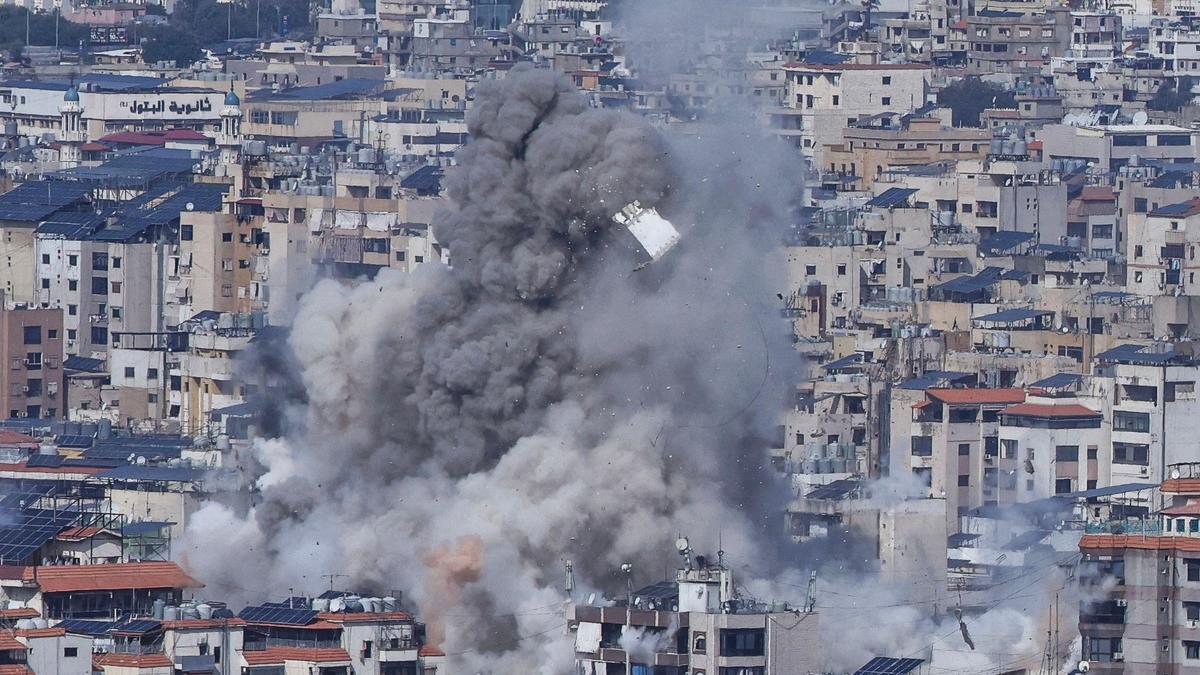
The International Atomic Energy Agency (IAEA) recently confirmed that Iran’s nuclear infrastructure remains physically intact following a series of precision strikes in the region. Satellite imagery reviewed by inspectors in Vienna shows no structural breaches at key facilities like Natanz or Isfahan, and ground sensors have reported zero spikes in radiological activity. On the surface, the story is one of a crisis averted—a technical verification that the world is not currently facing a localized Chernobyl. But for those who have spent decades tracking the nuclear cat-and-mouse game in the Middle East, the lack of physical debris is the least interesting part of the story.
The "no damage" verdict is a superficial metric. It addresses the immediate fear of radioactive fallout while ignoring the deeper, more corrosive reality of modern shadow warfare. We are no longer in an era where a destroyed cooling tower is the only measure of a successful operation. By focusing strictly on concrete and rebar, the international community is missing the psychological and strategic recalibration happening behind the scenes. The sites are standing, but the security assumptions protecting them have been shattered.
The Mirage of Structural Integrity
Satellite imagery is a blunt instrument. While it can identify a hole in a roof or a blackened scorch mark on a tarmac, it tells us nothing about the internal state of a centrifuges’ digital nervous system or the morale of the scientists working three stories underground. The IAEA’s report confirms that the shells of these buildings are intact. That is all it confirms.
In the world of high-stakes proliferation, a facility doesn't need to be leveled to be neutralized. If an adversary demonstrates the ability to put a kinetic or electronic "finger" on the map exactly where your most sensitive assets are located, the deterrence value of that site drops to zero. Iran’s nuclear program relies heavily on the "mountain fortress" strategy—burying enrichment halls deep under layers of rock and anti-aircraft batteries. When strikes occur in the vicinity and the IAEA is forced to check the "all clear" box, it highlights a terrifying proximity.
The real story isn't that the missiles missed. The story is how close they were allowed to get before the "no damage" assessment was even necessary. This creates a state of permanent tension that degrades operational efficiency. You cannot run a world-class enrichment program at peak performance when your staff is constantly looking at the ceiling, waiting for the one strike that the satellites won't be able to dismiss as "no radiological risk."
The Invisible Battle for the Centrifuge Halls
Modern sabotage has moved beyond the era of the suitcase bomb. We saw this with Stuxnet, and we are seeing the evolution of that philosophy today. If you can disrupt the power grid feeding a facility or compromise the supply chain for the carbon-fiber rotors used in IR-6 centrifuges, you have done more damage than a 500-pound gravity bomb could ever dream of.
The IAEA’s mandate is strictly defined by the Treaty on the Non-Proliferation of Nuclear Weapons (NPT). They are accountants of atoms. They count canisters of uranium hexafluoride and check seals on heavy water reactors. They are not a counter-intelligence agency. This creates a massive blind spot in their reporting. When they state there is "no damage," they are speaking in the context of their specific, narrow safeguards. They are not accounting for:
- Cyber-Kinetic Degradation: The subtle slowing of enrichment cycles due to compromised software.
- Personnel Attrition: The flight of top-tier talent who no longer feel safe in "hardened" facilities.
- Logistical Paralysis: The inability to move sensitive materials because transport routes are under constant surveillance.
To report that a site is "undamaged" because the roof is still there is like saying a computer is fine because the monitor isn't cracked. It is a fundamental misunderstanding of how 21st-century warfare works.
The Geopolitics of the All Clear
There is a political utility to the IAEA’s "no damage" findings that serves almost every player in the region, albeit for different reasons. For Tehran, it is a chance to project resilience. It allows them to claim that their defenses are impenetrable and that their "strategic patience" is a sign of strength rather than a lack of options.
For the West, the IAEA’s report provides a much-needed de-escalation off-ramp. As long as there is no "radiological risk," there is no immediate pressure to trigger the "snapback" sanctions or initiate a full-scale military intervention. The report acts as a sedative for the global oil markets and a reprieve for diplomats who are desperate to keep the dying embers of the JCPOA (Joint Comprehensive Plan of Action) from being completely extinguished.
However, this comfort is a trap. By accepting a "no damage" report as a return to the status quo, we ignore the fact that the baseline for "normal" has shifted. Each time a strike occurs and the IAEA verifies that the buildings are still standing, the threshold for what constitutes an act of war is pushed higher. We are witnessing the normalization of kinetic operations against nuclear-adjacent infrastructure.
Technical Limits of Satellite Verification
We must also confront the reality of what satellite review actually entails in the year 2026. While commercial and military-grade resolution has reached the point where you can identify the make and model of a car from orbit, many of Iran’s most critical nuclear activities happen in the "blind spot" of the earth.
At Fordow, the enrichment halls are buried so deep within a mountain that even the most advanced bunker-busters struggle to reach them. A satellite looking at the top of that mountain will see nothing but rock and scrubland, even if the machinery inside has been rattled off its mounts by nearby tremors. The IAEA’s reliance on these visual checks, supplemented by remote monitoring station data, is a compromise of necessity.
The agency is often denied real-time, "anywhere, anytime" access. They are operating on a delay, often negotiating for days before inspectors are allowed on-site to verify what the satellites claim to see. In that window, a lot of "tidying up" can happen. To present a satellite review as a definitive forensic audit is a stretch of the imagination that only a diplomat could love.
The High Cost of the Shadow War
The real damage being done to the global non-proliferation regime isn't measured in Becquerels or Sieverts. It is measured in the erosion of the IAEA's own authority. When the agency is used as a tool to calm markets rather than a rigorous investigative body, its credibility takes a hit.
The industry is currently obsessed with the "breakout time"—the theoretical window Iran would need to produce enough weapons-grade uranium for a single nuclear device. Current estimates put this at a matter of weeks, if not days. In that context, a report about "no structural damage" feels like an exercise in irrelevance. If the material is there, and the knowledge is there, the state of the building is secondary.
The focus should be on the purity of the stockpile and the number of advanced centrifuges spinning in those undamaged halls. Iran has already breached the 60% enrichment mark at various points, a level that has no credible civilian application. Whether the facility housing that 60% material has a scratched paint job from a nearby drone strike is a distraction from the fundamental shift in the regional power balance.
The Radiological Risk Fallacy
The IAEA's insistence that no "radiological risk" was detected is a technical truth used to mask a strategic lie. It suggests that as long as the sensors stay quiet, the situation is under control. But the risk of a nuclear-armed Iran is not a radiological risk in the sense of a leaking pipe; it is an existential risk in the sense of a restructured global order.
If a strike had hit a cooling pond or a waste storage area, the outcry would be immediate. Because it didn't, we are told to move on. This creates a perverse incentive for "near-miss" warfare, where the goal is to terrorize the opponent without triggering the international protocols associated with a nuclear disaster. It is a high-wire act performed over a pit of fire.
The Architecture of Escalation
The facilities at Isfahan and Natanz are not just industrial sites; they are symbols of national identity. Every time they are targeted, even unsuccessfully, it reinforces the hardline narrative within the Iranian leadership that the only way to ensure the survival of the state is to achieve a "threshold" capability—the ability to assemble a weapon so quickly that any strike becomes a moot point.
The "no damage" reports may actually be accelerating this process. If Tehran realizes that their facilities are being mapped and targeted with such precision, their logical move is to further decentralize, further bury, and further accelerate the enrichment process before the "lucky" strike eventually happens.
We are seeing the birth of a new doctrine where "undamaged" facilities become the justification for more aggressive pursuit of the very weapons those facilities were built to create. It is a feedback loop that the IAEA is not equipped to break.
The Missing Perspective in the Current Narrative
What is missing from the competitor's reporting—and the general media discourse—is the realization that we are watching a live-fire laboratory for the future of counter-proliferation.
- Cyber-physical integration: How do you prove a site is "undamaged" when its internal logic has been rewritten?
- The failure of traditional monitoring: When the "monitors" are only allowed to see what the host wants them to see, the report is a curated reality.
- The myth of the "clean" strike: There is no such thing as a strike on a nuclear facility that doesn't have a long-term impact on the diplomatic framework, regardless of what the Geiger counters say.
The IAEA is doing the best it can with the access it has. But we must stop treating their reports as a clean bill of health. They are, at best, a snapshot of a moment in time—a moment that has likely already passed by the time the PDF is uploaded to the agency's server in Vienna.
The sites are standing. The centrifuges are spinning. The uranium is being enriched. To call this "no damage" is a failure of imagination that the world cannot afford to maintain.
Review the data again, not through the lens of a satellite, but through the lens of a historian. The most significant damage is often the kind that doesn't show up on a photograph. It is the damage to the idea that this crisis can be managed through technical inspections alone.
Stop looking for holes in the roof and start looking at the numbers on the enrichment logs. That is where the real explosion is happening.