The decades-old "shadow war" between Israel and Iran has finally stepped out of the darkness, abandoning the plausible deniability that once kept a regional conflagration at bay. What started as a proxy-driven chess match has morphed into a direct, high-stakes ballistic exchange that threatens to rewrite the security architecture of the entire globe. This is no longer a series of isolated skirmishes; it is a fundamental shift in how sovereign states interact in the most volatile corridor on earth.
The shift happened because the old rules of engagement—where Iran used its "Ring of Fire" proxies and Israel responded with targeted assassinations and cyber sabotage—collapsed under the weight of the October 7 attacks. When Israel struck an Iranian diplomatic building in Damascus in April 2024, it didn't just kill high-ranking IRGC officials. It shattered the unwritten agreement that diplomatic outposts were off-limits. Iran’s massive drone and missile retaliation shortly after signaled that the era of "strategic patience" was over. Now, every strike demands a visible, state-on-state response, creating a feedback loop of escalation that neither side seems able to exit without losing face or deterrent power. Meanwhile, you can explore other events here: The Calculated Silence Behind the June Strikes on Iran.
The Death of Deterrence through Proxies
For years, the Islamic Republic of Iran operated on a doctrine of forward defense. By funding and arming Hezbollah in Lebanon, Hamas in Gaza, and the Houthis in Yemen, Tehran ensured that any conflict would be fought on Arab soil rather than Iranian ground. This kept the Iranian civilian population and infrastructure insulated from the direct consequences of their government's foreign policy.
Israel, conversely, perfected the "Campaign Between Wars." This strategy involved hundreds of kinetic strikes against shipments of precision-guided munitions and drone components intended for Hezbollah. It was a surgical approach designed to mow the grass without starting a forest fire. Both sides knew the limits. Both sides respected the fence. To see the complete picture, check out the detailed analysis by The Guardian.
That fence is gone.
The current crisis proves that proxies are no longer enough to satisfy the domestic or regional demands for "victory." When Israel dismantled the senior leadership of Hezbollah in a matter of weeks—culminating in the assassination of Hassan Nasrallah—Tehran found its most potent shield shattered. Without Hezbollah’s 150,000 rockets acting as a primary deterrent against an Israeli strike on Iranian soil, the IRGC felt compelled to launch its own missiles to prove it wasn't a paper tiger. This is the core of the danger. Iran is now exposed, and an exposed regime is often a desperate one.
The Ballistic Math of a New Era
We have moved beyond the age of suicide vests and IEDs. The modern battlefield is defined by the physics of hypersonic travel and the capacity of air defense systems like the Arrow-3 and David’s Sling. During the recent direct exchanges, we saw a volume of ballistic fire that has few historical parallels outside of full-scale world wars.
During the April 13 attack, Iran launched over 300 projectiles. The sheer cost of intercepting this many targets is staggering. While Israel and a coalition of Western and Arab allies intercepted 99% of the threats, the economic reality is lopsided. A single interceptor missile can cost upwards of $2 million, while the "suicide drones" used to swarm defenses cost as little as $20,000.
This is attrition warfare masquerading as a standoff.
The Intelligence Gap and the Hubris of Silence
A major factor in this escalation is the failure of intelligence—not in gathering data, but in interpreting intent. Israel’s security establishment long believed that Hamas was deterred by economic incentives and that Iran would never risk its own infrastructure for its proxies. This hubris led to a systemic underestimation of the adversary's willingness to suffer.
Iran made a similar mistake. They believed Israel was too fractured by internal political protests and constitutional crises to fight a multi-front war. They saw the massive street demonstrations in Tel Aviv as a sign of terminal weakness. They were wrong. External threats have a historical tendency to unify Israeli society, and the military response has been far more aggressive and sustained than Tehran’s war games suggested.
The Specter of the Nuclear Threshold
Behind every missile launch and every F-35 sortie lies the "Great Question": When does Iran decide that the only way to ensure its survival is to cross the nuclear finish line?
For years, the West used a mix of sanctions and diplomacy to keep Iran's enrichment levels below the 90% weapons-grade threshold. However, as Israel continues to degrade Iran’s conventional deterrents—specifically Hezbollah—the internal debate in Tehran is shifting. Hardliners are now arguing openly that the lack of a nuclear umbrella is exactly why Israel feels emboldened to strike Iranian soil.
If Israel decides to target Iran's oil refineries or nuclear sites in response to ballistic attacks, they risk triggering the very thing they seek to prevent. A regime that perceives an existential threat will use every tool at its disposal to survive. This is the paradox of the current war. The more successful Israel is at destroying Iran’s conventional proxies, the more attractive the nuclear option becomes for the Supreme Leader.
The Arab Neutrality Myth
It is a mistake to view this as a binary conflict between two nations. The Gulf monarchies—Saudi Arabia, the UAE, and Jordan—are caught in a terrifying middle ground. While they share Israel’s concern over Iranian hegemony, they have no desire to be the battlefield where this war is settled.
Jordan’s decision to intercept Iranian drones over its airspace was not necessarily a gesture of support for Israel. It was an assertion of sovereignty. No nation wants flaming debris falling on its capital because two neighboring powers are settling a score. The "Abraham Accords" are being tested like never before. The quiet cooperation between Israeli and Arab intelligence remains functional, but the public optics are toxic as the civilian death toll in Gaza and Lebanon rises.
Redefining the Regional Order
The map of the Middle East is being redrawn in real-time, not by diplomats with pens, but by commanders with coordinates. The "Shiite Crescent" that Iran spent forty years building is under immense pressure. In Iraq, militias are wary of being the next targets. In Syria, Bashar al-Assad is trying to distance himself from the chaos to ensure his own survival.
Israel is also facing a redefined reality. The era of feeling secure within its borders is over. The psychological impact of thousands of displaced citizens from the northern border and the constant threat of long-range fire has created a permanent state of emergency. This is not a situation that can be solved with a ceasefire. It requires a new security paradigm that addresses the root of the Iranian-Israeli enmity.
The Failure of International Mediators
The United States and European powers find themselves in a reactive cycle. Each time a strike occurs, the "de-escalation" playbook is dusted off, but the words carry less weight every month. Washington’s influence is hampered by an election cycle and a deep-seated desire to avoid another "forever war" in the region.
Tehran knows this. They use the threat of regional instability to keep the West at arm's length. Israel, meanwhile, feels that the West doesn't fully grasp the existential nature of the threat. This disconnect leads to a lack of a unified strategy. Sanctions are leaked, red lines are blurred, and the cycle continues.
The Role of Technological Asymmetry
We are seeing the first major war where AI-driven targeting and autonomous systems play a central role. Israel’s ability to process massive amounts of data to identify targets in urban environments is unprecedented. Conversely, Iran’s mastery of low-cost, mass-produced drone technology has democratized air power. You no longer need a billion-dollar air force to strike a capital city. You just need a few hundred fiberglass wings and a GPS guidance chip.
This technological parity in specific niches has leveled the playing field in ways that traditional military planners didn't anticipate. It allows a mid-tier power like Iran to hold a sophisticated military like Israel’s at risk, despite the massive gap in overall military spending.
The Human Cost of Strategic Miscalculation
While the world watches the flight paths of missiles, the ground reality for millions is one of permanent instability. In Lebanon, the economy was already in a death spiral before the latest rounds of bombardment began. In Israel, the constant mobilization of reserves is putting an unbearable strain on the high-tech economy that fuels the nation.
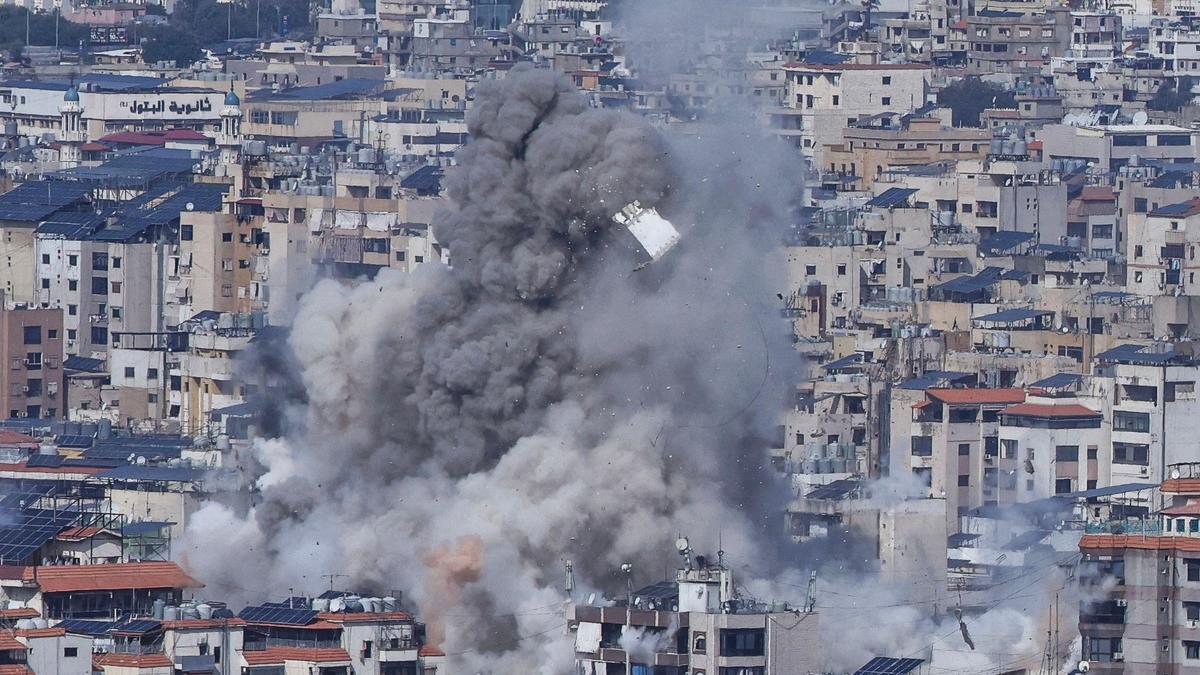
The danger of a "limited" war is that it rarely stays limited. A single errant missile hitting a school or a high-occupancy apartment block could be the trigger that moves this from a series of strikes to a total war. Both sides claim they don't want a full-scale invasion, yet both sides continue to take actions that make it almost inevitable.
The Intelligence Value of Disruption
One of the most overlooked factors in the recent escalation is how much Israel has benefited from "disruption" operations. The paging device explosions in Lebanon and the assassination of Ismail Haniyeh in the heart of Tehran were more than just tactical wins. They were psychological operations designed to show the adversary that nowhere is safe.
This creates a climate of paranoia within the Iranian command structure. When you can’t trust your communications or your safe houses, your ability to plan complex operations is severely hampered. However, paranoia also leads to twitchy trigger fingers. If the IRGC believes their command and control is about to be decapitated, they may be tempted to "use it or lose it" regarding their missile stockpiles.
Navigating the Unpredictable
We are currently in a period of high-intensity volatility where the "status quo" changes every 48 hours. The traditional metrics of success—territory gained or lost—don't apply here. This is a war of attrition, perception, and technological will.
The path forward is not found in a return to the 2015 nuclear deal or a simple "two-state solution" rhetoric. The fundamental issue is the clash between a revolutionary regime in Tehran that views the destruction of the "Zionist entity" as a religious and strategic necessity, and an Israeli state that sees any Iranian presence on its borders as a precursor to a second Holocaust.
Until one of those foundational views changes, or until the cost of maintaining them becomes high enough to cause an internal collapse, the cycle of escalation will continue. The red lines have been erased. The world is now watching to see who draws the next one, and what they are willing to sacrifice to defend it.
The immediate challenge for global powers is no longer preventing a war—it is managing the one that has already begun. This requires a cold-eyed assessment of the new reality: a Middle East where the old rules of deterrence are dead, and the new ones are being written in fire and steel. Every miscalculation now carries the weight of a regional catastrophe.