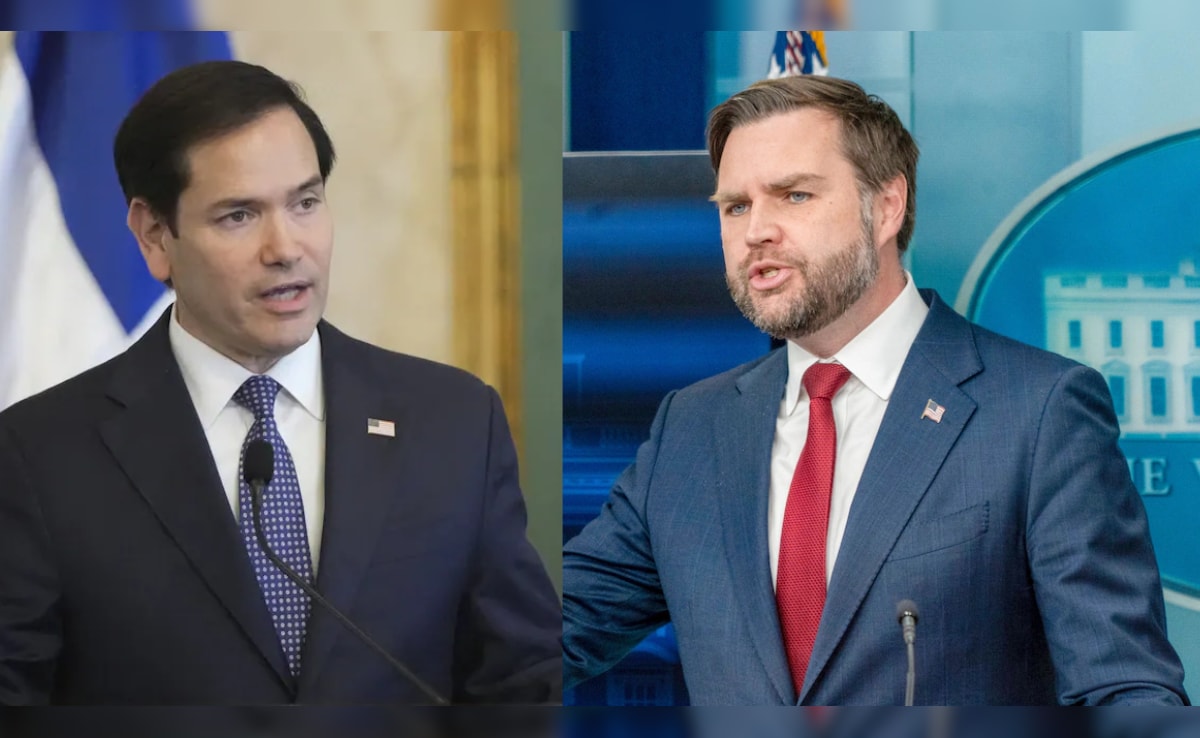
The question is no longer if Donald Trump will leave a vacuum, but who will be standing in the center of it when the 2028 primary begins. In the marbled corridors of the West Wing and the high-stakes donor retreats of Mar-a-Lago, a cold war has solidified between two men who represent the divergent futures of the Republican Party. Vice President JD Vance and Secretary of State Marco Rubio are currently locked in a struggle for the "heir apparent" mantle, a fight that is less about policy and more about the soul of a movement that has rewritten the rules of American power.
While the public sees a united front, the internal data reveals a fractured base. Vance holds the early polling lead among the populist faithful, but Rubio is currently enjoying a surge in credibility among the donor class and the traditional wing of the party. This is not a simple personality clash. It is a fundamental disagreement over whether the party should double down on isolationist populism or return to a "civilizational" version of American leadership.
The Vice Presidential Fortress
JD Vance has spent the last year transforming the office of the Vice Presidency into a bunker for the MAGA faithful. He is the undisputed champion of the "New Right," a faction that views traditional institutions—universities, the media, and even the FBI—as the "enemy."
His strategy is one of total ideological immersion. He has moved beyond the rhetoric of 2016, positioning himself as a post-liberal thinker who values "strategic restraint" abroad and aggressive "de-woke-ification" at home. For the base, Vance is the bridge to a future without Trump, offering a more intellectualized version of the same pugnacious energy. His background as a Marine and a venture capitalist gives him a unique "outsider-insider" status that resonates with a base that feels abandoned by the coastal elite.
However, the Vice Presidency is a double-edged sword. Vance is tethered to the President’s every whim. When the administration’s messaging shifts—as it has recently regarding Iran—Vance is the one forced to reconcile the contradictions. He must play the loyal deputy while trying to maintain his own identity as a non-interventionist. This tension is the primary risk to his 2028 ambitions. If he stays too close to Trump, he risks being seen as a "toady"; if he drifts too far, he loses the very base that sustains him.
The Secretary’s Global Gambit
While Vance secures the domestic perimeter, Marco Rubio is playing a much larger game on the world stage. As Secretary of State, Rubio has successfully rebranded his old-school "neocon" reputation into something he calls "Civilizational Atlanticism."
He isn't just a diplomat; he is a salesman for a version of America First that keeps the United States at the center of a global alliance of ethno-nationalist and right-wing populist movements. In Munich and Davos, he has managed a remarkable feat: reassuring European allies with "reassuring" language while simultaneously signaling that American support is contingent on their ideological alignment with the MAGA movement.
- The Donor Pivot: Rubio’s performance has made him the favorite of the billionaire class. They see in him a "safe" version of Trumpism—one that protects American interests and markets without the unpredictability of a 2:00 AM social media post.
- The Kissinger Path: By serving as both Secretary of State and a de facto National Security Advisor, Rubio has built a profile of gravitas that Vance simply cannot match. He is the only modern figure to successfully bridge the gap between the Tea Party roots of the GOP and the current populist era.
The Mar-a-Lago Polling Room
The real power broker remains the man in the Oval Office. Reports from Mar-a-Lago suggest that Trump has already begun "polling" rooms of wealthy donors on who they prefer for 2028. This isn't just idle curiosity. Trump is testing the loyalty of his own Cabinet.
For Rubio to win the nomination, he needs more than just the donors; he needs a "massive force" to intervene and break Vance’s hold on the grassroots. That force is Trump’s endorsement. But Trump’s history suggests he enjoys the competition between his subordinates. By keeping both men in play, he ensures that neither becomes too powerful while he is still in office.
A Precarious Balance
The 2026 midterms will be the first real test of this delicate equilibrium. If Republicans lose control of either house of Congress, the blame game will begin immediately. Vance will likely be seen as the messenger for an unpopular administration, while Rubio may try to distance himself from any failures by focusing on foreign policy.
The ultimate question is: Can a sitting Vice President ever truly break out of the President’s shadow? History says it’s difficult. But the current MAGA era is not typical history. Whether the future belongs to Vance’s populist "de-woke" crusade or Rubio’s "civilizational" diplomatic strategy will depend on the final two years of the Trump presidency.
Wait and see if the Vice President continues to mirror the President's shifting goals or if he begins to carve out a distinct lane.