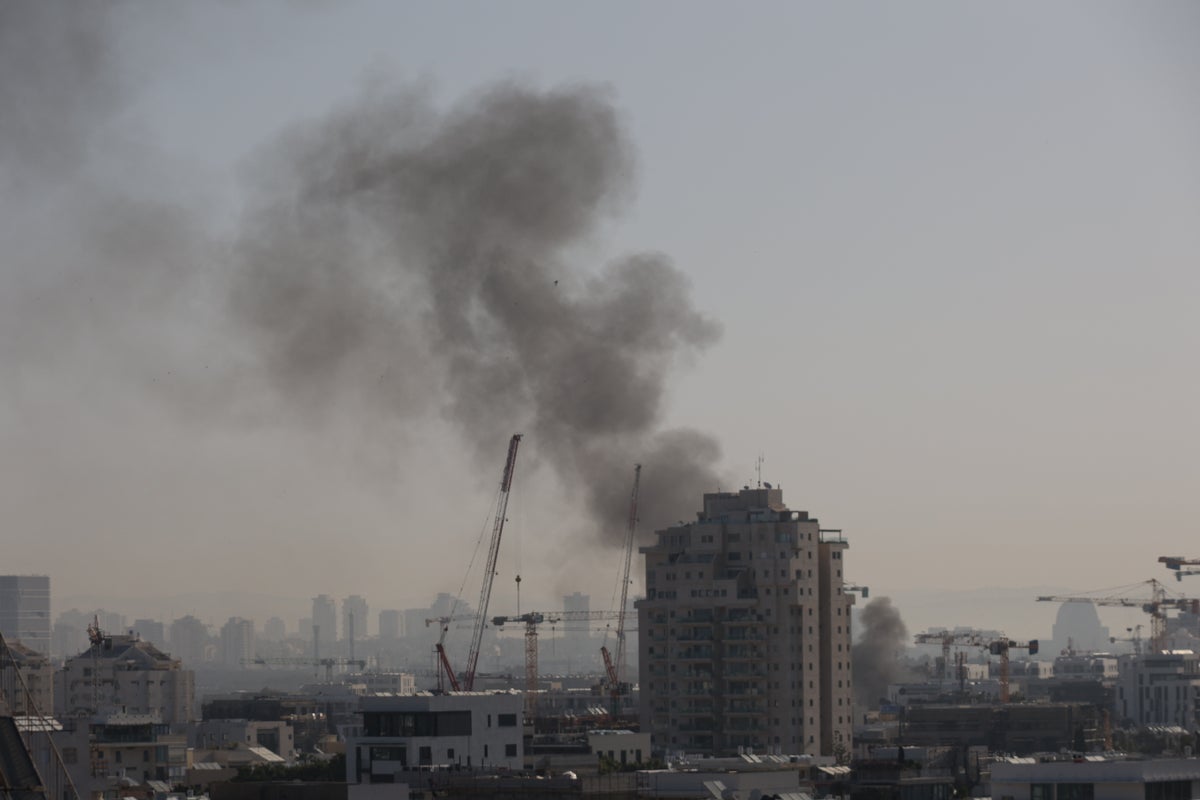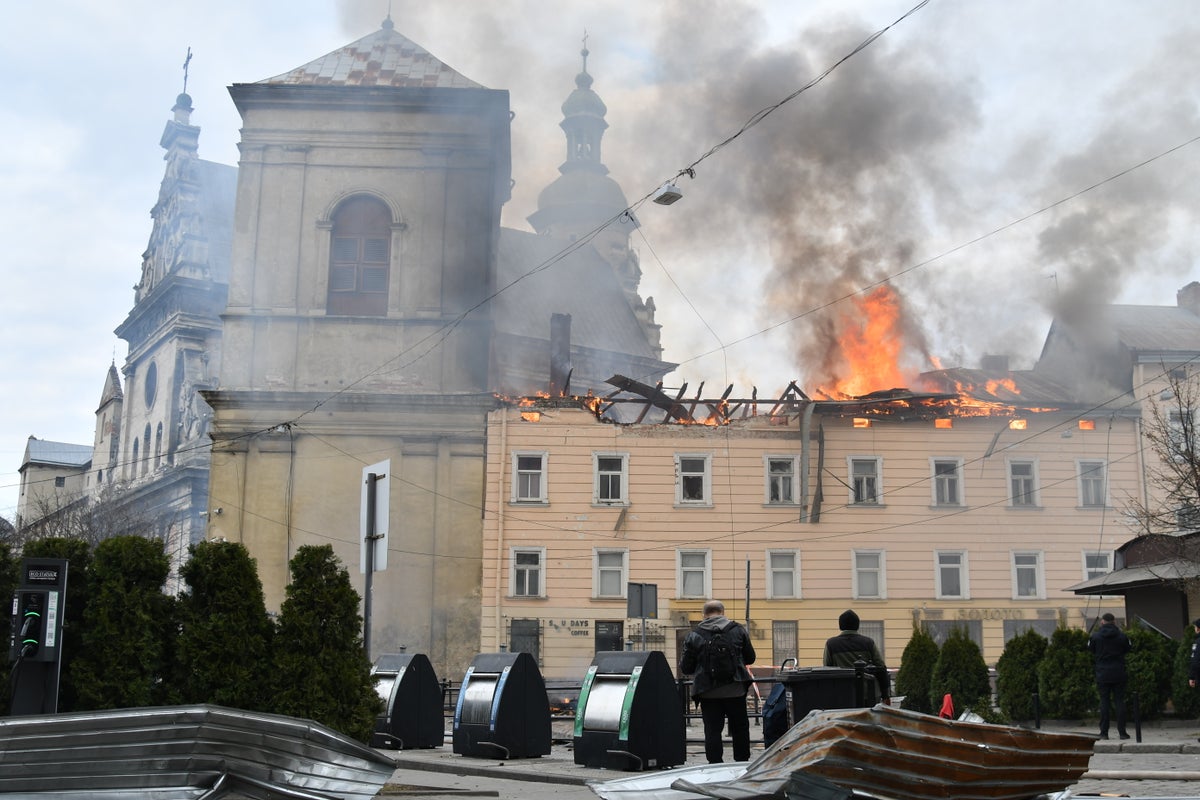
Russia shattered the relative peace of Western Ukraine on Tuesday, launching a massive swarm of nearly 1,000 drones in a 24-hour period that specifically targeted the cultural and civilian heart of Lviv. The assault, which included an unprecedented daylight wave of over 550 drones, killed at least eight people across the country and left the 17th-century Bernardine Monastery—a crown jewel of Lviv’s UNESCO-protected historic center—smoldering under a blackened roof. This was not a stray hit or a secondary explosion. It was a calculated demonstration of force designed to prove that nowhere in Ukraine remains beyond the reach of Moscow’s reaching shadow.
The sheer volume of the attack tells a story of a shift in Kremlin strategy. For four years, Lviv served as a sanctuary for displaced families and a logistics hub for Western aid, shielded by its distance from the eastern trenches. That shield is thinning. By launching hundreds of drones in broad daylight, Russia forced Ukrainian air defenses into a grueling, high-stakes math problem: how to prioritize targets when the sky is thick with "columns" of low-cost suicide drones moving toward schools, hospitals, and heritage sites simultaneously.
The Strategy of Daylight Attrition
Most drone barrages occur under the cover of darkness to evade visual detection. This Tuesday was different. Starting in the early afternoon, waves of Shahed, Gerbera, and Italmas drones entered Ukrainian airspace from the north. They didn't drift in; they moved in coordinated columns. This tactic is a direct response to Ukraine’s increasingly effective mobile fire groups, which use spotlights and thermal optics to hunt drones at night. By attacking in the afternoon, Russia negates the advantage of thermal imaging and forces defenders to rely on visual tracking against the glare of the sun.
Military analysts see this as a deliberate attempt to deplete Ukraine’s dwindling stockpile of surface-to-air missiles. When 550 drones are in the air at once, a commander has seconds to decide whether to launch a million-dollar interceptor at a $20,000 drone or let it strike a civilian apartment block. On Tuesday, the math failed in several locations. In Lviv, the Bernardine Monastery and St. Andrew’s Church became the focal point of the carnage. A drone slammed into a residential building directly adjacent to the monastery, sending a column of fire into the sky that threatened one of the most significant architectural ensembles in Central Europe.
A Heritage Site in the Crosshairs
The Bernardine Monastery is not just a building. It houses the Central State Historical Archive of Ukraine, a repository of centuries of European history. It is a site under "Enhanced Protection" by UNESCO, a legal status intended to shield it from the ravages of war. That status proved irrelevant.
Maksym Kozytskyi, head of the Lviv Regional Military Administration, confirmed that while the monastery’s thick stone walls held, the surrounding structures and the monastery’s own outbuildings were engulfed in flames.
"Russia brutally struck the central part of Lviv, a city of exceptional cultural value," stated Ukrainian Foreign Minister Andrii Sybiha. "I urge UNESCO to respond to this crime in the strongest terms."
But statements from Paris or New York do little to stop the fire. The damage to the UNESCO site is symbolic of a broader "de-culturation" campaign. By hitting the historic center during the evening rush hour, the Kremlin sends a message to the residents of Lviv: your history cannot protect you, and your city is no longer a rear-guard safe zone.
The Toll Beyond the Architecture
The human cost of this 24-hour blitz was spread across the map. In Ivano-Frankivsk, another western city often considered safe, two people were killed when a drone struck near a maternity hospital. A six-year-old child was among the injured. In Vinnytsia, a 59-year-old man lost his life. In Lviv alone, at least 22 people were wounded, many of them commuters caught in the open during the "unusual" daytime strikes.
Air force spokesperson Yuriy Ignat noted that this was likely the largest daytime drone attack since the full-scale invasion began in 2022. The drones were not just hitting energy infrastructure—though those hits were reported in the Komarniv and Dobrosyn-Maheriv communities—they were hitting the social fabric of the west.
The Air Defense Gap
Why did so many get through? Ukraine claimed to have neutralized over 540 drones during the day, but with a total of nearly 1,000 launched within 24 hours, the saturation point was reached.
There is a growing realization that Russia has scaled up its domestic drone production to a level that outpaces Ukraine’s current interceptor replenishment. Throughout early 2026, the pace of these attacks has doubled. While Ukraine has had success in hunting down Russian "Pantsir" air defense systems on the front lines, the defensive burden in the rear has become unsustainable.
The Western regions are protected by a patchwork of older Soviet systems and a few high-end Western platforms like the Patriot or IRIS-T. However, these are often moved to the front or to Kyiv to protect the capital's power grid. This leaves cities like Lviv relying on mobile units—trucks with mounted machine guns. These units are effective, but they cannot stop a swarm of 400 drones entering the airspace simultaneously from multiple vectors.
No More Rear Guard
For the people of Lviv, the "rare" nature of this attack is cold comfort. The city has spent years as the "soul" of the Ukrainian resistance, a place where coffee shops remained open and the arts flourished even as the East burned. That era is over. The March 24th attack proves that the Kremlin views Lviv’s cultural heritage not as a treasure to be spared, but as a high-value target for psychological warfare.
The use of the "Oreshnik" ballistic missile in recent months, combined with this massive drone saturation, suggests a spring offensive that is not confined to the mud of the Donbas. It is a total war aimed at the systematic exhaustion of the Ukrainian state.
The fire at the Bernardine Monastery was eventually contained by first responders who worked under the threat of "double-tap" strikes—a common Russian tactic where a second drone hits the same location minutes after the first to kill rescue workers. This time, the walls stood. But as the frequency of these "unusual" daytime raids increases, the question is no longer if Lviv will be hit again, but how much of its history will be left when the sirens finally stop.
Would you like me to analyze the specific types of drones used in this daylight swarm to understand how they bypassed Lviv's radar?