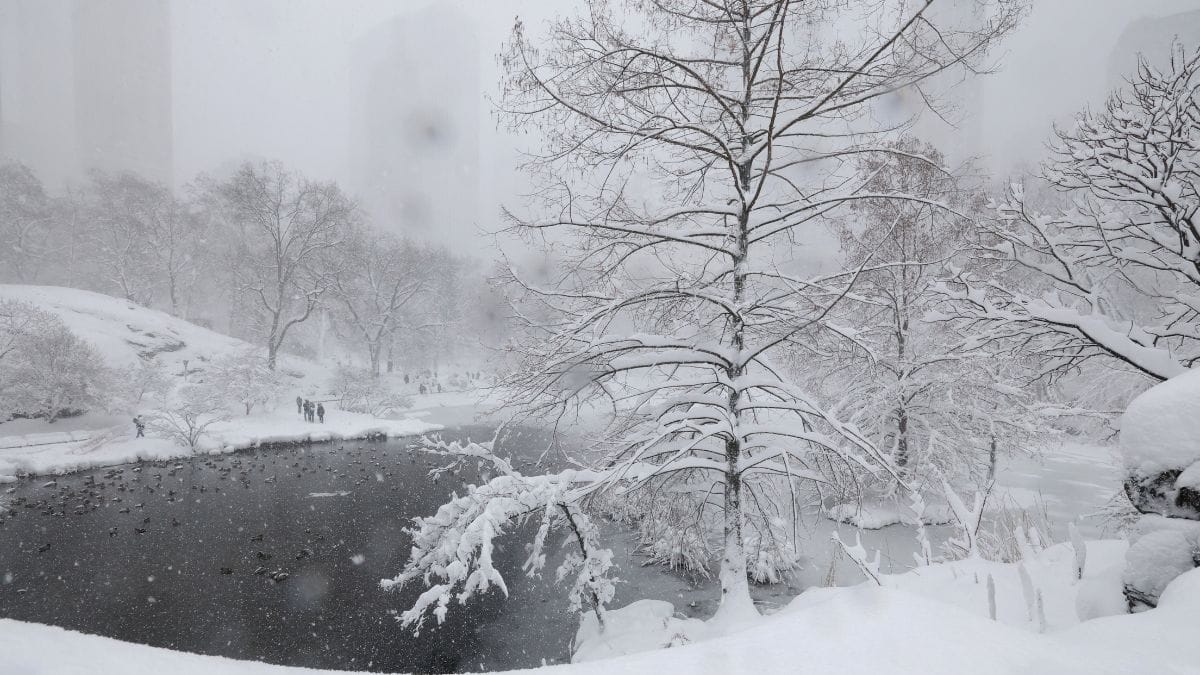
A massive atmospheric collision is currently carving a path of destruction across the central and eastern United States, threatening to paralyze the nation's primary transit arteries. While standard weather reporting focuses on snowfall totals and wind speeds, the true story lies in the systemic fragility of the American infrastructure under extreme pressure. This is not just a storm. It is a stress test for a supply chain and a power grid that were never designed to handle the intensifying frequency of these "once-in-a-generation" events.
The immediate impact is undeniable. Heavy snow, freezing rain, and hurricane-force gusts are converging to create a corridor of chaos from the Rockies to the Atlantic coast. Airlines have already scrapped thousands of flights, and interstate highways are transforming into impassable graveyards for long-haul trucking. For the millions of people caught in the path, the danger isn't just the cold—it’s the failure of the systems they rely on for survival. You might also find this similar article insightful: Strategic Asymmetry and the Kinetic Deconstruction of Iranian Integrated Air Defense.
The Physics of a Modern Weather Catastrophe
To understand why this specific storm is more than a routine winter blast, one must look at the mechanics of the "bomb cyclone" phenomenon. Meteorologists are tracking a rapid drop in atmospheric pressure, a process known as explosive cyclogenesis. When cold Canadian air slams into warm, moist air pulling up from the Gulf of Mexico, the atmosphere reacts with violent energy.
This isn't a slow build. The transition from a gray afternoon to a whiteout happens in minutes. This suddenness is what catches travelers off guard. When visibility drops to zero on a highway where vehicles are moving at 70 miles per hour, the result is the massive multi-car pileups that have become a grim staple of modern winter news. As discussed in latest coverage by BBC News, the results are significant.
The moisture content in this system is also unusually high. Warmer atmospheric temperatures allow the air to hold more water, meaning that when it does freeze, the resulting snow is heavy, wet, and destructive. This "concrete snow" is what brings down power lines and snaps oak trees like toothpicks. It is the primary reason that a forecast of ten inches of snow in 2026 carries much more risk than the same forecast did thirty years ago.
The Airline Shell Game
The aviation industry is currently in a state of controlled retreat. When a storm of this magnitude hits hubs like Chicago O'Hare, Atlanta Hartsfield-Jackson, or New York’s JFK, the ripple effects are felt globally. However, the narrative that these delays are purely "acts of God" misses a more cynical reality of airline economics.
Major carriers often use weather events as a shield to mask staffing shortages and operational inefficiencies. By canceling flights early—often days before the first snowflake falls—airlines avoid the massive fines and passenger compensation requirements associated with mechanical delays. It is a preemptive strike against their own balance sheets.
For the traveler, this means being stranded in a terminal with a voucher that doesn't cover the cost of a nearby hotel. The "hub and spoke" system, while efficient for profit margins during clear skies, is a catastrophic point of failure during a blizzard. If the hub is choked, the entire network dies. We are seeing the limits of a system that prioritizes lean operations over resilient ones.
The Hidden Cost of Just in Time Logistics
It isn't just passengers who are stuck. The central U.S. serves as the nation's logistical spine. When Interstate 80 or Interstate 95 shuts down, the "just-in-time" delivery model that stocks our grocery stores and pharmacies begins to crumble.
- Perishable Goods: Trucks carrying fresh produce or temperature-sensitive medication cannot idle for 48 hours in sub-zero temperatures without risking total loss of cargo.
- Fuel Delivery: Heating oil and propane deliveries to rural areas are often the first things cut off, creating a secondary health crisis as homes lose their primary heat source.
- E-commerce Backlogs: The delay of a single day in a major sorting hub can take two weeks to resolve, creating a backlog that stunts regional economic activity.
The Power Grid’s Breaking Point
The most terrifying aspect of these storms is the threat to the electrical grid. Much of the American power infrastructure is aging, with some transformers and transmission lines dating back to the mid-20th century. These components were built for a climate that no longer exists.
When high winds combine with ice accumulation, the physical weight on the lines becomes unbearable. But the real danger is the surge in demand. As tens of millions of people crank their heaters simultaneously, the load on the grid reaches peak levels. If a major power plant goes offline due to frozen equipment—as seen during the Texas freeze of 2021—the result is a cascading failure that can leave entire states in the dark.
We are currently watching a slow-motion collision between a 1950s grid and a 2020s climate. Utilities have been slow to invest in "hardening" the grid—burying lines underground or upgrading to smart-grid technology—because those costs are difficult to pass on to shareholders. Instead, we rely on a patchwork of emergency repairs and the heroism of lineworkers who risk their lives in the teeth of the storm to patch a system that is fundamentally broken.
Misinformation and the Weather Hype Machine
There is a dangerous trend in how these storms are communicated to the public. In an era of click-driven media, every low-pressure system is branded as a "historic" event. This "cry wolf" effect leads to public apathy. When people are told every winter storm is the end of the world, they eventually stop preparing for the ones that actually are.
The data shows a widening gap between meteorology and public perception. While the science of forecasting has improved significantly, the communication of risk remains primitive. We focus on "inches of snow" because it’s a simple metric, but "impact hours" or "recovery time" would be far more useful for the average person trying to decide whether to risk a drive to work.
We need to stop treating these events as surprises. They are predictable, recurring features of our new environment. The fact that a winter storm can still bring the world’s largest economy to a grinding halt is an indictment of our refusal to adapt.
Essential Survival Realities
If you are currently in the path of this system, the window for preparation has likely closed, and the focus must shift to tactical survival.
- Micro-Climates in the Home: If the power fails, do not try to heat the entire house. Pick one room, seal the doors with towels, and stay together. Body heat is a finite resource; don't waste it on empty hallways.
- The Carbon Monoxide Trap: Every year, more people die from improper generator use or charcoal grills indoors than from the cold itself. If it burns fuel, it stays outside. Period.
- The Digital Fallacy: Do not rely on your smartphone as your sole source of information. Cell towers lose power too. A battery-powered or hand-crank radio is the only reliable way to receive emergency broadcasts when the digital world goes dark.
The Policy Failure Behind the Frost
Why are we still here? Why, in 2026, does a predictable weather pattern still result in "travel chaos" and "massive threats"?
The answer is a chronic lack of investment in redundant systems. We have built a society that is highly optimized for "normal" conditions but has zero margin for error. Our trains can't run on iced tracks because we haven't invested in heated rail switches. Our planes are grounded because we don't have enough de-icing fluid or the staff to apply it. Our people are cold because we haven't mandated that the grid be winterized.
This storm will eventually pass. The snow will melt, the flights will eventually take off, and the headlines will move on to the next crisis. But the underlying vulnerability remains. We are living on borrowed time, operating a high-speed society on a crumbling foundation.
Until we move past the "disaster-and-recovery" cycle and into a "resilience-by-design" mindset, every winter will bring the same predictable headlines. We don't have a weather problem; we have an engineering and political will problem.
The storm outside your window is just a reminder of the price we pay for pretending otherwise. Check your supplies, stay off the roads, and stop expecting a fragile system to save you when the mercury drops.