The death of two more individuals in the freezing waters of the English Channel is not a freak accident or a sudden lapse in maritime safety. It is the predictable outcome of a multibillion-dollar logistical machine that has successfully outpaced every legislative and physical barrier thrown in its path. While headlines focus on the immediate tragedy of the shipwreck, the mechanics of this crisis are rooted in a sophisticated supply chain that spans from the manufacturing hubs of industrial China to the shoreline of northern France.
Each time a small boat deflates or capsizes, the public discourse cycles through the same scripts of "broken borders" or "smuggler greed." But focusing on the smugglers alone ignores the broader infrastructure. This is a high-volume, low-margin business model that relies on cheap, disposable equipment and a bottomless pool of desperate human capital. The two lives lost this week are part of a grim statistical certainty. When you push more people into lower-quality vessels to evade detection, the mortality rate is a fixed cost of doing business. If you found value in this piece, you might want to check out: this related article.
The Logistics of a Lethal Crossing
The modern Channel crossing is no longer a clandestine operation involving a handful of people in a stolen dinghy. It has evolved into a standardized industrial process. Intelligence reports and ground-level tracking reveal a supply chain that begins with the bulk purchase of inflatable boats and outboard motors, often sourced through front companies in Turkey or directly from Asian marketplaces.
These boats are not designed for the open sea. They are "death traps" by design—mass-produced inflatables with thin skins and plywood floorboards that cannot withstand the structural stress of carrying fifty to seventy people. The engines are frequently underpowered, 20-horsepower units meant for calm lake fishing, not for fighting the complex tidal flows of the world’s busiest shipping lane. For another angle on this event, see the recent update from Associated Press.
Smugglers have moved toward a high-occupancy strategy. By packing more people onto a single vessel, they maximize the profit per launch while minimizing the number of drivers they need to recruit. This overcrowding creates a secondary danger: the "center of gravity" problem. In a standard inflatable, if the engine fails or a wave hits the side, the panicked movement of seventy people causes the boat to fold in on itself or flip instantly. There is no recovery once the structural integrity of a cheap PVC tube is compromised.
The Failure of Deterrence Politics
For years, the British and French governments have leaned heavily on the "deterrence" model. The logic suggests that by making the crossing more difficult, more dangerous, or more legally punishing, the flow of people will stop. This theory has collapsed under the weight of reality.
Data shows that as shore-side security increases—thermal cameras, drones, and heavy police presence on the dunes—smugglers simply shift their launch points. They move further away from the narrowest part of the Channel, forcing smaller, less seaworthy boats to travel longer distances through even more treacherous waters.
The increased risk does not lower the number of attempts; it merely increases the price of the ticket and the likelihood of a mass-casualty event. This is basic market dynamics. When the risk of the operation goes up, the price of the service rises, and the quality of the "product" (the boat) drops to preserve profit margins. The migrants are not consumers with bargaining power; they are a captive market with nowhere else to go.
The Financial Engine
To understand why this continues, follow the money. A single successful launch can gross upwards of $250,000. With overheads for the boat, motor, and "beach crew" totaling less than $15,000, the ROI is staggering. This wealth buys more than just luxury goods for gang leaders; it buys information.
- Scouts: Local networks in northern France monitor police patrol patterns in real-time.
- Encrypted Communication: Using apps like Telegram, smugglers coordinate launches down to the minute, often launching multiple boats simultaneously to overwhelm search and rescue assets.
- Decoy Tactics: Empty boats are sometimes launched to draw police away from the primary departure zone.
The Intelligence Gap in Coastal Surveillance
Despite the millions spent on high-tech surveillance, there remains a massive "blind spot" in the early detection of these vessels. Many of these boats are launched from deep within the treelines or drainage canals, not the open beach. By the time a boat is spotted by a drone, it is already in the water, and the legal obligation shifts from "interdiction" to "rescue."
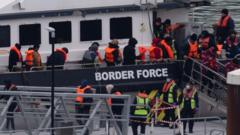
Under maritime law, once a vessel is in distress, the primary objective is to save lives. Smugglers know this. They often instruct the passengers to sabotage the engine or throw away the oars the moment a Border Force or SNSM (French rescue) vessel appears. This forces a rescue operation, which effectively completes the final leg of the journey for the smugglers.
The tragic irony is that the more "efficient" the rescue services become, the more the smugglers can afford to use even flimsier boats. If you know your passengers will likely be picked up halfway across, you don’t need a boat that can actually make the full trip. You just need one that can float for two miles.
The Geopolitical Standoff
The Channel is not just a body of water; it is a political friction point between the UK and the EU. The lack of a comprehensive "returns agreement" means that once a person reaches British waters, they enter a legal limbo that can last for years.
France has little incentive to stop every boat if the result is thousands of migrants remaining permanently on French soil in makeshift camps like the ones in Dunkirk or Calais. Conversely, the UK cannot unilaterally return people to French beaches without a treaty. This stalemate creates a vacuum that organized crime is more than happy to fill.
We are seeing a shift in the demographics of those crossing as well. While the narrative often focuses on young men, the recent casualties included women and children. The shift indicates that the "safe" routes have become so restricted or expensive that families are now forced into the same high-risk maritime gamble previously reserved for those traveling alone.
The Infrastructure of the Camps
The camps in northern France serve as the "waiting rooms" for this industry. Conditions are intentionally kept squalid by local authorities to discourage settlement, but this only plays into the hands of the gangs. When living conditions are unbearable, the "push factor" to get on a boat—any boat—becomes overwhelming.
- Sanitation and Health: Lack of basic services leads to skin infections and respiratory issues, making passengers even more vulnerable to hypothermia if they hit the water.
- Debt Bondage: Many migrants arrive in France already owing thousands to smuggling syndicates. They are not "customers" so much as "collateral."
- Information Control: Smugglers spread misinformation about UK asylum policy, convincing people that they must cross immediately before "the door closes" forever.
Why the Current Approach is Failing
The primary failure of the current strategy is the focus on the beach rather than the boardroom. Arresting the "pilot" of a boat—who is often just a migrant given a free trip in exchange for holding the tiller—does nothing to dismantle the network.
To actually disrupt this, the focus must shift to the global procurement of maritime equipment. Just as the international community tracks the sale of precursor chemicals for drugs or components for weapons, there must be a coordinated effort to track the bulk sale of large-scale inflatables and specialized outboard motors.
Without a boat, there is no crossing. Yet, these vessels are currently bought in bulk through online marketplaces and shipped across Europe in heavy goods vehicles with minimal scrutiny. The "death ship" that sank this week was likely purchased and transported through three different countries before it ever touched the sand in France.
The Human Cost of Policy Inertia
Every time a body is pulled from the water, there is a flurry of political activity. Speeches are made, and new "tougher" measures are announced. Then the news cycle moves on, and the industry adapts.
The two individuals who died this week were not just victims of the sea. They were victims of a sophisticated, agile, and well-funded criminal enterprise that views human life as a replaceable commodity. They were also victims of a political system that prioritizes the appearance of "tough borders" over the reality of effective, coordinated management of human migration.
The Channel crossing is a solved problem from a logistical standpoint—the smugglers have solved it. They have a working model that delivers people to their destination with a high enough success rate to keep the money flowing. Until the "cost" of the business outweighs the massive profits, the launches will continue. The boats will get fuller, the materials will get cheaper, and the water will stay just as cold.
Investigate the shipping manifests of "sporting goods" wholesalers in Eastern Europe to find where the next fleet of rubber boats is coming from.