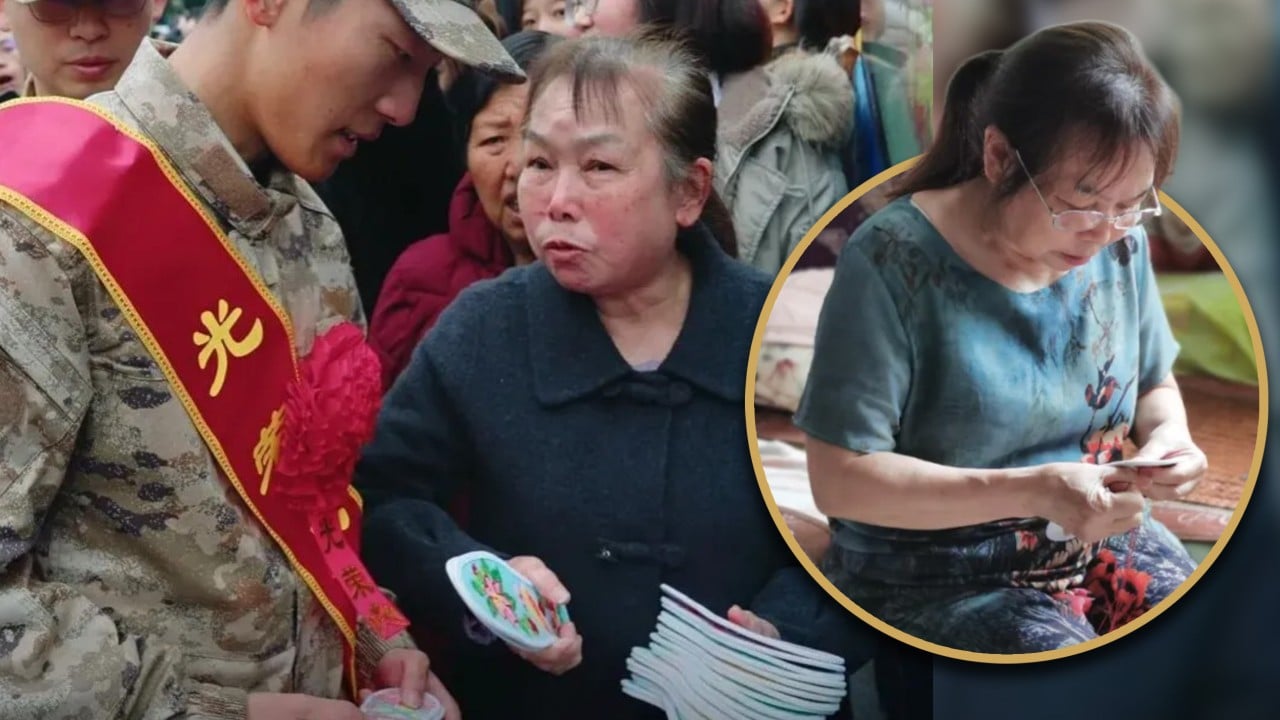
Guo Dehe does not seek the spotlight, but her hands tell a story that two decades of silence cannot hide. For twenty years, this mother from Fujian province has lived a life measured in stitches, wax-thread, and layers of fabric. She has produced thousands of pairs of handcrafted shoe pads for Chinese soldiers, a relentless output born from a singular, devastating moment of loss. While most see a quaint act of charity, the reality of Guo’s mission is a grueling, self-imposed marathon of grief transformed into a physical utility.
This is not a story about a hobby. It is a study in how a human being processes an unbearable void through repetitive, manual labor. In 2004, Guo’s son, a member of the armed police, died while saving someone from drowning. He was 21. Since that day, Guo has effectively stayed in the service alongside him, providing the one thing she knows can ease the literal walk of a soldier: comfort underfoot.
The Physical Toll of Memory
To understand the scale of this undertaking, one must look at the mechanics of the traditional chenadi or handmade quilted insole. This is not a simple DIY project. Each pad requires multiple layers of cotton cloth, often salvaged and recycled, which are then bonded with a flour-based paste. Once dried, these stiff "blanks" must be pierced by a needle.
Guo’s process is brutal on the body. Pushing a needle through several millimeters of hardened fabric thousands of times a day leads to permanent callouses, joint inflammation, and declining eyesight. Most people her age are resting. Guo spends her mornings sourcing materials and her evenings hunched over her workbench.
The "why" is often simplified by observers as "patriotism." That is a shallow reading. For Guo, every stitch is a conversation with a son who no longer speaks. By sending these pads to barracks across the country, she is mothering a ghost. She treats every young recruit who receives her work as a proxy for the man her son never got to become. It is a massive, decentralized act of maternal projection that has spanned two decades and shows no sign of stopping.
Beyond the Sentiment
There is a logistical reality to Guo’s work that many miss. Modern military footwear has advanced significantly since 2004. High-tech polymers and moisture-wicking materials are now standard issue. Yet, there remains a persistent demand for these handmade pads among soldiers stationed in humid or high-intensity environments.
Natural cotton has a breathability and sweat-absorption profile that synthetic mass-produced insoles often struggle to match over long rucks. Guo’s pads are dense. They provide a specific kind of dampening that reduces friction blisters during long marches. Soldiers often write back to her, not just out of politeness, but because the pads actually work. They offer a layer of "soft armor" against the rigid structure of a combat boot.
The cost of this production is entirely subsidized by Guo herself. She uses her modest savings and a small pension to buy the thread and the base fabrics. She refuses payment. She refuses fame. When local media occasionally finds her, she redirects the conversation to the soldiers. This creates a cycle of "re-gifting" where the military receives a tactical benefit from a woman who is essentially performing an unpaid, twenty-year service contract for the state.
The Evolution of the Craft
Over twenty years, Guo has refined her technique. Early pairs were basic. Today, her work features intricate stitching patterns that aren't just for show—they provide structural integrity.
- Radial Stitching: Prevents the fabric from bunching at the heel.
- Cross-Hatch Reinforcement: Ensures the pad doesn't delaminate when soaked with sweat or rain.
- Contoured Edging: Hand-trimmed to fit the specific curvature of standard-issue boots.
She has mastered the tension of the thread. Too tight, and the pad curls. Too loose, and it falls apart within a week of hard use. Her "quality control" is her own sense of duty. If a pair isn't perfect, it doesn't leave her house.
A Quiet Resistance to Modernity
We live in an era where "giving back" is often a performative act captured on a smartphone for instant validation. Guo Dehe represents the antithesis of this trend. Her work is slow. It is painful. It is largely invisible.
There is a tension here between the rapid industrialization of China and the persistence of these folk-labor traditions. In a world of 3D-printed soles and carbon-fiber plates, a woman in a small room with a needle is a living relic. But she is a relic with a purpose. Her refusal to automate or scale her "business" keeps the human connection intact. Every soldier knows that a person, not a machine, spent hours thinking about their feet.
The psychological weight of this cannot be overstated. For the recruits, many of whom are far from home for the first time, receiving a handmade item from a "Grandmother" figure provides a morale boost that no government-issued kit can replicate. It is a reminder of the civilian world they are sworn to protect.
The Logistics of a Twenty Year Mission
Maintaining this level of output for 7,300 days requires more than just willpower; it requires a rigid schedule. Guo’s life is dictated by the seasons of the military. She ramps up production before the new recruitment cycles and before the harsh winter months.
Her home has become a warehouse of sorts. Scraps of cloth, spools of heavy-duty thread, and finished stacks of pads occupy the spaces where family photos used to sit alone. She has turned her grief into a manufacturing line.
Critics might argue that her time could be spent more effectively through organized charity or advocacy. They misunderstand the nature of her mourning. For Guo, the effectiveness isn't found in the number of people helped, but in the hours of labor spent. The labor is the point. The exhaustion is the point. It is a penance for surviving when her son did not.
The Future of the Stitch
Guo is aging. Her hands are stiffer than they were in 2004. The question of who will take up this mantle is one she doesn't bother to answer. She isn't looking to build a legacy or a brand. She is looking to finish the next pair.
There is a grim beauty in this single-mindedness. While the world debates military budgets and geopolitical shifts, Guo Dehe sits in a chair and pulls thread. She has simplified the complexity of national service down to a single, tangible goal: making sure the next step a soldier takes is slightly less painful than the last.
She has effectively become a one-woman support wing of the infantry. Her "heroic" status is not something she claimed, but something she earned through the sheer repetition of a humble task. She doesn't need a medal; she needs more thread.
The next time you consider the "cost" of service, think of the woman in Fujian. She is still paying it, one stitch at a time, long after the funeral flowers have faded and the headlines have moved on.
Start by looking at the small, manual ways you can contribute to your own community without seeking a digital audience.