The Tremor in the Teacup
A single drone streaks across a darkened desert sky thousands of miles away. It is a tiny speck of metal and circuitry, but its wake ripples across the English Channel. In London, the air feels different. There is a specific kind of silence that descends upon a capital when the gears of global stability begin to grind and slip. It is the silence of realization.
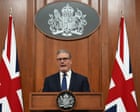
For years, the United Kingdom has attempted to stand on its own two feet, slightly apart from the continental crowd, maintaining a polite but firm distance. We called it sovereignty. We called it independence. But when the Middle East catches fire, that distance starts to feel less like freedom and more like exposure. Keir Starmer stands at a podium, not just as a politician, but as a man looking at a map that no longer makes sense. The old lines are blurring. The "volatility" he speaks of isn't just a buzzword for the evening news; it is the sound of the floorboards creaking beneath the British economy.
Energy prices aren't numbers on a spreadsheet. They are the heat that isn't turned on in a flat in Leeds. They are the reason a small bakery in Devon decides this is the year they finally lock the doors for good. When Iran and Israel trade blows, the price of flour and fuel in a British village becomes a casualty of war. Starmer knows this. He is feeling the cold draft coming through the gap in the door, and he is finally reaching for the handle to close it.
The Architecture of Loneliness
Consider the hypothetical case of a logistics manager named Sarah. Sarah doesn't care about the nuances of diplomatic protocols or the fine print of the Windsor Framework. She cares about the forty trucks she has idling at a port, waiting for paperwork that didn't exist a decade ago. Every hour those trucks sit still, her company loses money. Every time a new conflict erupts in the Gulf, her shipping routes become a chaotic puzzle of risk assessments and skyrocketing insurance premiums.
Sarah represents the hidden friction of a nation trying to navigate a stormy sea in a solo rowboat. For too long, the UK has operated on the assumption that global trade would remain a predictable, flowing river. We assumed the world would always want what we had, and that the rules of the game were fixed. The war in the Middle East has shattered that illusion. It has exposed the reality that in a world of giants, the solitary are the first to be stepped on.
Starmer’s push for a "closer partnership" with the European Union is a recognition of this vulnerability. It is an admission that the "Global Britain" brand was a fine-weather sails strategy, ill-equipped for a hurricane. By seeking a security pact and deeper cooperation, he isn't just talking about soldiers and intelligence sharing. He is talking about creating a buffer. He is looking for a way to ensure that when the next shockwave hits the global market, the UK isn't the only one vibrating.
The Ghost of 2016
There is a ghost in the room whenever a British Prime Minister mentions the EU. It is the ghost of a referendum that split families down the middle and redefined the national identity. To speak of "closer ties" is to walk through a minefield of old resentments and bruised egos. Yet, the pressure of reality is proving stronger than the weight of ideology.
The volatility sparked by the Iran conflict has acted as a catalyst. It has stripped away the luxury of political posturing. When the Strait of Hormuz becomes a flashpoint, the ideological purity of "taking back control" feels increasingly hollow if you can't control the price of a loaf of bread or the safety of your trade routes. Starmer is gambling that the British public is tired. Tired of the friction. Tired of the uncertainty.
He is positioning the EU not as a lost lover to be wooed back, but as a necessary neighbor with whom we share a fence and a common enemy: instability. This isn't a romantic return to the fold. It is a cold-eyed, pragmatic assessment of survival. The UK needs the EU’s weight to balance the scales. Without it, we are a small island tossed about by the whims of superpowers and the volatility of regions we can no longer influence alone.
The Invisible Stakes of a Security Pact
What does a "security pact" actually look like in the life of an average citizen? It sounds like something discussed in wood-panneled rooms by men in dark suits. In reality, it is the digital shield that prevents a foreign power from crashing the NHS servers. It is the coordinated intelligence that stops a shipment of illegal arms before they reach a street in Birmingham.
In a world where warfare is as much about code and commerce as it is about tanks and territory, isolation is a death sentence. The Iran-Israel escalation isn't just about missiles; it's about the global realignment of power. Russia, China, and Iran are forming an axis of disruption. Against that, a solitary UK is a target of opportunity.
Starmer’s insistence on a closer partnership is an attempt to weave the UK back into the European defensive fabric. We provide the intelligence expertise; they provide the continental depth. It is a trade-off. We give up a bit of our perceived "independence" to gain actual, tangible security. It is the realization that a fortress is useless if it has no allies to guard the supply lines.
The Language of the Realist
Watch the way the Prime Minister speaks now. The soaring rhetoric of the past few years has been replaced by a somber, almost clinical tone. He speaks of "stability," "resilience," and "partnership." These are the words of a man who has looked at the books and realized they don't add up.
There is an old saying that geography is destiny. For a brief, feverish moment, the UK tried to pretend that in the digital age, geography didn't matter. We thought we could be a floating hub, unmoored from the continent at our doorstep. The fires in the Middle East have reminded us that distance is an illusion. We are tied to Europe by more than just a tunnel; we are tied by a shared vulnerability to a world that is becoming increasingly hostile to the unprepared.
The push for a new pact isn't a white flag. It’s a compass correction. It’s the sound of a captain realizing the stars have shifted and the old charts are leading the ship toward the rocks.
The Cost of the Gap
Imagine a bridge that is missing its middle section. You can stand on either side and yell across, but you can't move goods, people, or ideas with any efficiency. For the last several years, the UK and the EU have been two sides of that broken bridge. We’ve spent so much time arguing about who should pay for the repairs that we’ve ignored the fact that the water below is rising.
The conflict in Iran is the rising water. It is the external force that makes the internal bickering look petty. When the global energy market shudders, it doesn't care about the nuances of the Northern Ireland Protocol. It only cares about who has the power to withstand the shock.
Starmer is trying to build a temporary walkway across that gap. He knows he can't rebuild the whole bridge yet—the political will isn't there, and the scars are too deep. But he can lay down the planks of security cooperation and chemical regulations and professional qualifications. He can start the slow, unglamorous work of making the UK a functional part of the European ecosystem again.
The Quiet Turning Point
History rarely happens with a bang. It happens in the quiet shifts of policy, the subtle changes in tone, and the realization that the old way of doing things is no longer sustainable. We are living through one of those shifts right now.
The volatility in the Middle East has provided the political cover Starmer needed. He can now frame his pivot toward Europe not as a betrayal of Brexit, but as a necessary response to a dangerous world. It is a masterful, if cynical, piece of political maneuvering. But beneath the politics lies a deeper truth: the UK is coming home to a reality it tried to outrun.
The world is getting smaller, louder, and more dangerous. The luxury of being a "lone wolf" is only affordable when the woods are empty. Now that the wolves are circling, the pack starts to look a lot more appealing. The UK is reaching out its hand, not out of sudden affection, but out of a stark, undeniable need for warmth in an increasingly cold world.
The drone in the desert was the alarm clock. The Prime Minister is just the first one to admit that the house is cold and the sun is still a long way from rising.