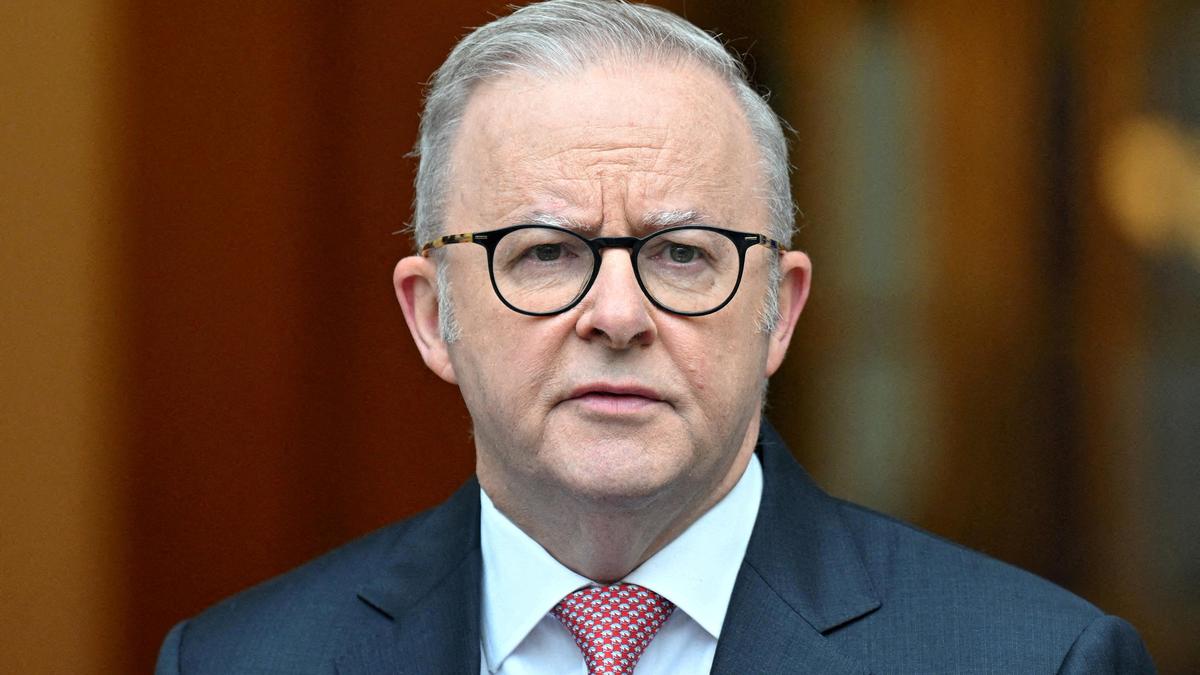
Anthony Albanese wants "clarity" from Washington. He wants a roadmap. He wants a predictable, stable set of objectives for the West Asia conflict under a Trump administration. It sounds reasonable. It sounds like mature diplomacy.
It is actually a profound misunderstanding of how the world works in 2026.
The Australian political establishment is still operating on a 1990s manual where the "Rules-Based Order" is a thick binder of procedures. They think if they just get the right briefing notes from the White House, they can manage their risks. I have spent twenty years watching middle powers try to "manage" their way through superpower volatility. It never works. Seeking clarity from a disruptor isn't diplomacy; it's a confession of strategic paralysis.
The Myth of the Strategic Objective
The competitor narrative suggests that without clear goals, the U.S. risks "mission creep" or regional instability. This assumes that clarity is the goal of a superpower. It isn’t. In the current global theater, ambiguity is a feature, not a bug.
When Albanese stands at a podium and asks for "clarity," he is effectively asking the dealer at a high-stakes poker table to show their cards before the flop. If Trump provides that clarity, he loses his leverage. If he tells the world his West Asia objectives are $A$, $B$, and $C$, he has just handed his adversaries the blueprint for his defeat.
The real "clarity" Australian leaders should be looking for is staring them in the face: The United States is no longer a predictable security guarantor.
Why the "Rules-Based Order" is a Sunk Cost
Middle powers love the phrase "rules-based order" because it lets them outsource their defense thinking to a set of pre-written norms. It’s comfortable. It’s also dead.
I’ve seen dozens of trade deals and security pacts disintegrate because one party thought the "rules" would protect them, while the other party was playing a different game entirely. In West Asia, there are no rules. There are only interests and capabilities.
- Strategic Autonomy is not a choice; it's a requirement.
- Ambiguity creates room for negotiation.
- Certainty is the enemy of leverage.
The Albanese government’s desire for a "stable" U.S. policy in West Asia is a fantasy. They are asking for a return to a version of America that hasn't existed since 2015.
The High Cost of Being a "Quiet Partner"
The standard Australian play is to stay quiet, offer rhetorical support to the U.S., and hope the bill doesn't come due. This "Quiet Partner" strategy is a disaster in a transactional world.
If you are waiting for clarity from a Trump White House, you are waiting to be told what your share of the bill is. It’s a passive, reactive posture that guarantees Australia will be an afterthought.
When you ask for a roadmap, you're asking to be a passenger. If you’re a passenger, you don't get to touch the steering wheel, but you definitely have to pay for the gas.
The False Choice of West Asia "Stability"
The media keeps asking: "How will Trump's objectives affect stability?"
This is the wrong question.
Stability in West Asia has been a failed project for three decades. The assumption that U.S. "clarity" leads to stability is factually incorrect. We had "clarity" in Iraq in 2003. We had "clarity" in Libya in 2011. Neither produced anything resembling a stable outcome.
Brutal honesty: West Asia is currently a series of cold wars that occasionally turn hot. The goal for a middle power shouldn't be "stability" in a region it cannot control; it should be resilience at home.
The Resilience Checklist
If Canberra actually wanted to protect Australian interests, they’d stop worrying about what Trump says to the media and start doing the following:
- Diversify Energy Supply: West Asia conflict only matters to Australia if it breaks the energy market. If you’re still dependent on those supply chains, you’ve already lost.
- Intelligence Independent of Five Eyes: Relying on the U.S. for "clarity" on West Asia intelligence is like asking a realtor if now is a good time to buy. Of course they’ll say yes. You need your own eyes on the ground.
- End the "Follower" Doctrine: Australia has a habit of joining every U.S.-led coalition without asking what the exit strategy is. The exit strategy should be the first thing discussed, not the last.
The Contradiction of the "Clear Objective"
Think about what "clarity" actually looks like in a West Asia war.
If Trump says, "Our objective is to dismantle the Iranian regime," Australia is then boxed in. Do they support regime change? Do they fund it? Do they send troops?
If Trump says, "Our objective is to withdraw and let the regional powers figure it out," Australia is equally boxed in. Now they have to deal with the fallout of a power vacuum they aren't prepared for.
By demanding clarity, Albanese is forcing a binary choice that Australia is not equipped to handle.
Stop Asking, Start Deciding
The common misconception is that a middle power’s job is to align its goals with its superpower ally. This is the "Subservient Strategy."
A "Sovereign Strategy" would be to stop asking Washington what their goals are and start telling Washington what Australia’s limits are.
"Mr. President, here is what Australia will not do. Here is where our support ends. Here is the red line we will not cross."
That is clarity. That is strength. Anything else is just a middle manager asking their boss for a performance review.
The Reality of the "Special Relationship"
The "Special Relationship" is often used as a shield against hard questions. "We're special, so we'll be kept in the loop."
I have seen the inside of these "special" relationships. They are usually one-way streets. The U.S. shares what it wants to share, when it wants to share it. In a Trump administration, the "Special Relationship" is explicitly transactional. If you aren't bringing something to the table—real military capability, massive economic leverage, or strategic territory—you aren't a partner. You're a client.
Albanese's call for clarity is the language of a client. It’s the sound of a government that doesn't know what its own national interests are unless they are reflected in the glow of a U.S. policy paper.
The Illusion of Control
The world is moving toward a multi-polar reality where no single power can provide a "clear objective" for a region as complex as West Asia.
Imagine a scenario where the U.S. says one thing, Israel does another, and Saudi Arabia does a third. Whose "clarity" do you follow then?
The pursuit of clarity is an attempt to reduce the terrifying complexity of modern geopolitics into a simple, manageable task. It’s a comfort blanket for bureaucrats.
Real leaders don't ask for clarity in a storm. They build a better boat.
The Brutal Truth About Middle Power Diplomacy
Most analysts will tell you that Australia needs to "balance" its relationship with the U.S. and China while keeping an eye on West Asia.
They are wrong.
You cannot balance when the ground beneath you is shifting. You have to pick a spot and defend it.
If Australia keeps waiting for the U.S. to define the "new normal," it will find itself living in a world it had no part in building. The West Asia war is just one theater in a much larger global realignment.
The Only Map That Matters
Stop looking for the roadmap from Washington. The map is being redrawn in real-time by players who don't care about "clarity." They care about results.
If the Albanese government wants to lead, it needs to stop asking questions and start making statements.
- Australia is not a global policeman.
- Australia’s national interest is not identical to U.S. regional strategy.
- The era of "blind support" is over.
The quest for clarity is a quest for permission. A sovereign nation shouldn't need permission to act in its own best interest.
Every minute spent waiting for a phone call from the White House is a minute wasted that could have been spent building a more resilient, independent nation.
Stop asking Trump what he’s going to do. Decide what you’re going to do.
That is the only clarity that matters.