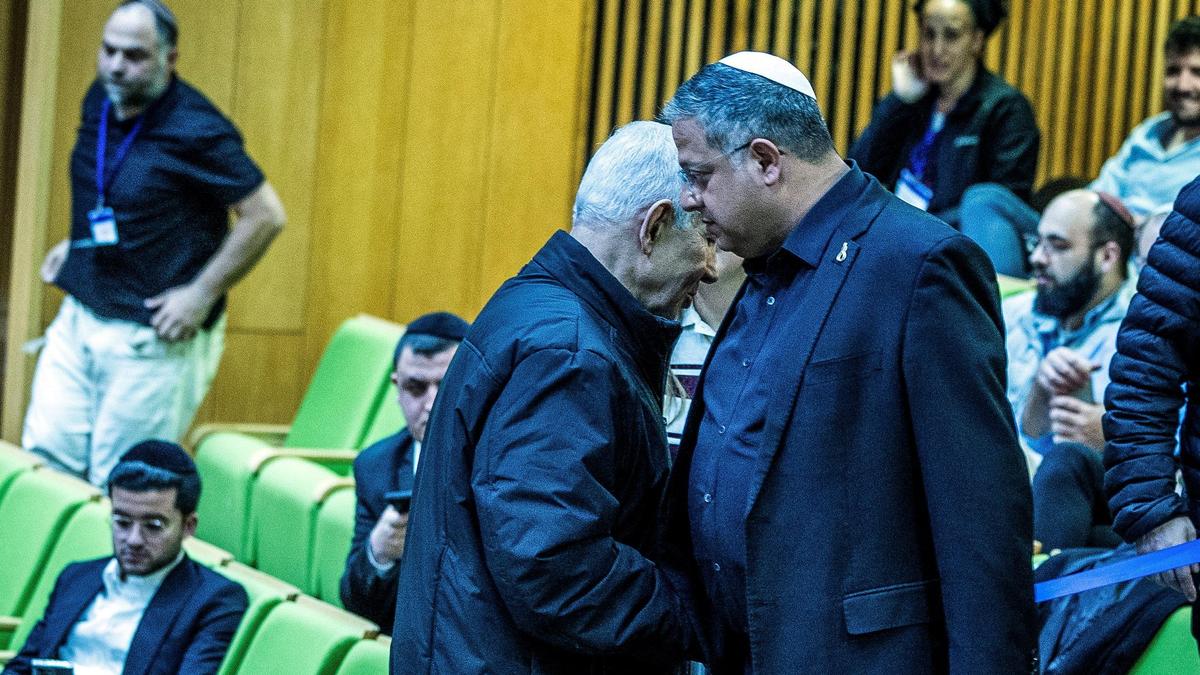
The passage of a national budget in the Israeli Knesset functions less as a fiscal roadmap and more as a high-stakes kinetic shield for a sitting prime minister. In the Israeli parliamentary system, the failure to pass a budget by a statutory deadline triggers an automatic dissolution of the Knesset and immediate snap elections. Consequently, the fiscal document is the primary mechanism of executive preservation. Benjamin Netanyahu’s successful ratification of the 2024-2025 budget represents a calculated maneuver to de-risk his coalition against internal fragmentation while neutralizing the legal "tripwire" that has historically collapsed previous governments.
The Structural Necessity of Fiscal Ratification
To understand why the budget is the ultimate survival tool, one must analyze the Basic Law: The Economy of the State. This constitutional-level legislation dictates that if a budget is not approved within the first quarter of the fiscal year (or a grace period following government formation), the mandate returns to the electorate. For a coalition trailing in various polling metrics or facing active geopolitical crises, the budget serves as a multi-year "non-aggression pact" among disparate political factions.
The 2024-2025 budget functions through three distinct operational layers:
- The Political Ransom Layer: The allocation of "coalition funds"—discretionary spending directed toward the specific interests of minority parties (e.g., Ultra-Orthodox or Nationalist factions) to ensure their 61-vote loyalty.
- The Macro-Fiscal Layer: The adjustment of the deficit target to accommodate surging defense expenditures, which currently consume a disproportionate share of the GDP.
- The Temporal Layer: By securing a two-year budget cycle, the executive branch removes the "election trigger" until the next scheduled window, effectively lengthening the government's operational horizon regardless of public approval ratings.
Deconstructing the Defense-Deficit Paradox
The primary challenge of this specific budget was the reconciliation of a war-time economy with long-term fiscal stability. The "guns vs. butter" debate in Israel is not theoretical; it is a mathematical constraint. The Israeli Ministry of Finance must navigate a reality where the Debt-to-GDP ratio is under pressure from two directions: increased military spending and a temporary contraction in the labor market due to reserve duty mobilization.
The budget addresses this through a Strategic Deficit Expansion. Rather than adhering to the traditional 2.25% deficit ceiling, the current framework allows for a significant overshoot, justified by the emergency procurement of munitions and the subsidization of displaced citizens. However, this creates a long-term interest rate risk. If the Bank of Israel perceives the budget as overly expansionary or lacking "offsets" (spending cuts elsewhere), it may maintain high interest rates to combat inflation, thereby increasing the cost of servicing the national debt.
This creates a Feedback Loop of Fiscal Stress:
- High defense spending necessitates increased borrowing.
- Increased borrowing raises the debt-to-GDP ratio.
- A higher ratio risks a credit rating downgrade (as seen in recent assessments by Moody’s and S&P).
- A downgrade increases borrowing costs, further tightening the future budget.
Coalition Funds as a Stability Mechanism
A frequent point of contention in the current budget is the allocation of billions of shekels to sectoral interests, specifically religious education and West Bank settlement infrastructure. From a pure economic efficiency standpoint, these funds are often criticized as "non-productive" because they do not necessarily correlate with increased labor force participation or high-tech innovation.
However, from a Political Game Theory perspective, these allocations are the "glue" of the coalition. The marginal cost of these funds is viewed by the Likud party as lower than the existential cost of a government collapse.
The mechanism works as follows:
- The Ultra-Orthodox (Haredi) Parties: Prioritize funding for independent school systems and stipends for Torah study.
- The Religious Zionist Factions: Prioritize funding for security and infrastructure in Area C of the West Bank.
- The Likud Core: Prioritize maintaining the Prime Minister’s office to manage the broader security and legal strategy.
By fulfilling the specific, non-negotiable demands of the wing-parties, the Prime Minister prevents "defection." In a 120-seat Knesset where the majority often rests on a razor-thin margin of 61 to 64 seats, the loss of a single four-seat faction results in immediate executive paralysis.
The Opportunity Cost of Survival
While the passage of the budget provides immediate political breathing room, it imposes an invisible tax on the Israeli middle class. The "stability" purchased through these negotiations comes at the expense of structural reforms.
For instance, the budget largely ignores the "cost of living" crisis—specifically in housing and retail—because the reforms required to lower prices would alienate key interest groups within the coalition. The refusal to cut redundant government ministries, which were created solely to provide cabinet positions to loyalists, serves as a prime example of institutional inefficiency maintained for political utility.
The Economic Drag Coefficient of this budget can be measured by:
- Labor Market Distortion: Incentivizing non-participation in the workforce through increased stipends.
- Infrastructure Stagnation: Diverting funds from national transit projects to localized sectoral projects.
- Credit Risk Premium: The additional interest Israel must pay on its debt due to perceived political instability and fiscal looseness.
Strategic Risk Assessment
The passage of this budget does not signify a return to normalcy; it signifies the hardening of a "bunker mentality" within the executive. By removing the immediate threat of a budget-triggered collapse, Netanyahu has effectively shifted the battlefield from the Knesset floor to the judicial and public spheres.
The primary threat to the government is no longer a technical fiscal deadline, but rather the Externalities of Governance:
- The High Court of Justice: Rulings on military conscription for the Haredi population could create a crisis that no amount of budget funding can solve.
- Global Credit Markets: If international investors lose confidence in the Ministry of Finance's independence, the shekel will depreciate, forcing the Bank of Israel into a restrictive monetary policy that could trigger a recession.
- Public Sentiment: While the budget keeps the MKs (Members of Knesset) in their seats, it does nothing to address the underlying social friction that fueled the 2023 protests and the current dissatisfaction with the war's management.
The strategic play here is a "Time-Arbitrage Strategy." The government is betting that by securing 12 to 24 months of guaranteed tenure through this budget, the geopolitical situation will shift favorably, or the opposition will fragment, allowing the coalition to recover in the polls before the next inevitable clash.
The immediate move for observers and analysts is to monitor the Deficit-to-Growth Ratio. If the GDP growth fails to outpace the cost of the "coalition debt," the government will be forced into an emergency "Mini-Budget" within six months, re-opening the very cycle of instability they just attempted to close. The budget has not solved the crisis; it has merely financed its extension.
Observers should watch for the mid-year fiscal review. If tax revenues from the high-tech sector—Israel's primary engine—continue to stagnate or flee to offshore jurisdictions due to perceived risk, the "stability" provided by this budget will be exposed as a hollow fiscal shell. The priority for the administration must now shift from mere survival to the restoration of the debt-to-GDP trajectory, or the next budget cycle will face a market-driven collapse that no political maneuvering can prevent.