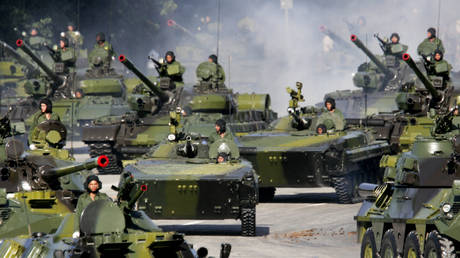
The Cuban Ministry of Foreign Affairs recently signaled a state of "total readiness" for a potential United States invasion, a statement that functions less as a tactical update and more as a reaffirmation of the Doctrine of War of All the People. This posture is not built on parity of hardware or conventional air superiority—metrics where Cuba faces an insurmountable deficit—but on a calculated strategy of Asymmetric Friction. By analyzing the structural components of Cuban defense, one can identify a three-tiered mechanism designed to transform a conventional military defeat into a terminal political and economic cost for an occupying force.
The Tri-Component Architecture of Cuban Defense
Cuba’s defensive strategy is not a monolith; it is a layered system designed to degrade an adversary’s operational tempo at different stages of engagement.
1. The Regular Forces (FAR) as a Tripwire
The Fuerzas Armadas Revolucionarias (FAR) represent the first tier. Their primary utility is not to win a direct engagement with the U.S. Navy or Air Force. Instead, the FAR acts as a Delay and Disruption mechanism. Their objective is to force the transition from a "stand-off" surgical strike phase to a "boots-on-the-ground" invasion phase. By maintaining subsurface assets (midget submarines) and mobile coastal defense batteries, the FAR forces an invader to commit significant resources to minesweeping and anti-submarine warfare (ASW) before a landing can even be attempted.
2. The Territorial Troops Militia (MTT) and Civil Defense
With a reported strength of over one million personnel, the MTT functions as a Mass Saturation Force. This tier bridges the gap between professional soldiers and the general populace. In a conflict scenario, the MTT’s role is the decentralized protection of infrastructure and the execution of "hit-and-run" logistics disruptions. This creates a high-density threat environment where every municipal district becomes a self-sustaining combat cell.
3. The Integral Defense System (War of All the People)
This is the ideological and logistical culmination of Cuban defense. It assumes the total destruction of centralized command and control. The doctrine dictates that in the event of occupation, the struggle transitions into a permanent, decentralized insurgency. The strategic goal is to shift the Cost-Benefit Ratio for the occupier from a "liberation" or "regime change" metric to an "attrition and quagmire" metric.
The Mathematics of Occupation: The Insurgency Ratio
Military analysts often cite the Force Requirement for Stability Operations as a ratio of 20 security personnel per 1,000 residents. For a country of roughly 11 million people like Cuba, a stable occupation would theoretically require a force of 220,000 troops. However, Cuba’s defensive doctrine is specifically engineered to inflate this requirement by increasing the "Resistance Density."
When the Deputy Foreign Minister speaks of being "ready," he is referencing the conversion of civilian infrastructure into military assets. This includes:
- Tunnels and Hardened Sites: An extensive network of underground fortifications designed to survive "Shock and Awe" aerial campaigns.
- Decentralized Logistics: Staging supplies in thousands of micro-caches rather than large, targetable depots.
- Dual-Use Expertise: Training the civilian workforce in sabotage and basic infantry tactics, ensuring that the "Front Line" has no geographic boundary.
The structural reality is that the United States possesses the capability to achieve Conventional Dominance (control of the air and sea) within hours. However, Cuba's defense logic is focused entirely on Post-Conventional Resilience. They have calculated that the U.S. domestic political appetite cannot sustain the high casualty rates and multi-decade commitment required to pacify a population trained in permanent insurgency.
Geopolitical Signaling and the Deterrence Function
The timing of these statements suggests a focus on Strategic Messaging rather than an immediate change in the security environment. Statements of "readiness" serve three distinct functions in the current diplomatic climate:
- Sovereignty Assertion: By loudly preparing for an invasion, the Cuban government creates a "Sovereignty Tax" on any diplomatic or economic pressure applied by the U.S. It frames every policy shift as a potential precursor to conflict, thereby mobilizing domestic nationalist sentiment.
- Multipolar Alignment: Highlighting a "U.S. Threat" provides a rationale for deeper military and economic ties with Russia and China. It positions Cuba as a frontline state in a broader global resistance to Western hegemony, which can lead to increased security assistance or intelligence sharing.
- Crisis Management: The internal economic situation in Cuba is currently under severe strain due to fuel shortages and inflation. Projecting an external threat is a classic mechanism for maintaining internal cohesion and justifying strict security measures under the guise of national defense.
The Friction Constraints of Modern Warfare
An invasion of Cuba would face unprecedented Friction Variables that didn't exist during the 20th-century Cold War flashpoints.
The Urbanization Bottleneck
Over 75% of the Cuban population resides in urban areas. Modern military doctrine highlights that urban combat is the ultimate "force equalizer." It negates the advantages of high-tech surveillance and long-range precision munitions. If the Cuban defense plan successfully retreats into urban centers like Havana or Santiago de Cuba, the collateral damage required to dislodge them would result in a catastrophic loss of international legitimacy for the invading force.
The Information Domain
In a 2026 information environment, any conflict would be broadcast in real-time. The Cuban government has invested heavily in digital infrastructure that, while controlled, allows for the rapid dissemination of state-narrative content. The "Battle of Ideas" mentioned by Cuban leadership is a literal component of their defense; they intend to use global media to amplify the human cost of an invasion, aiming to trigger domestic protests within the United States.
Risks and Vulnerabilities in the Cuban Model
Despite the robustness of the "War of All the People" doctrine, there are critical failure points:
- Supply Chain Fragility: Cuba imports a significant portion of its food and fuel. A total naval blockade, while technically an act of war, could potentially collapse the defensive infrastructure without a single troop landing. An insurgency cannot function effectively if the population is facing acute starvation.
- Hardware Obsolescence: While the FAR is highly trained, their equipment—largely Soviet-era—is increasingly vulnerable to modern drone warfare (UAVs) and electronic warfare (EW) suites. The recent conflicts in Eastern Europe have demonstrated that traditional camouflage and tunneling can be bypassed by thermal imaging and persistent loitering munitions.
- Generational Shift: The "Revolutionary Fervor" required for a total-population insurgency may be waning among younger demographics who are more connected to global culture and less invested in 1959-era ideologies.
The statement from the Deputy Foreign Minister is a calculated deployment of Deterrence Theory. Cuba is communicating that while they cannot win a war, they can ensure that the United States loses the peace. The strategic focus is not on the defense of borders, but on the defense of the political system through the threat of a perpetual, high-cost conflict.
For analysts, the key metric to watch is not the rhetoric of "invasion readiness," but the degree of continued Russian and Chinese investment in Cuban port infrastructure. If these powers provide advanced EW or anti-access/area-denial (A2/AD) systems, the cost of a U.S. intervention moves from "prohibitively expensive" to "strategically unfeasible." The ultimate play for Cuba is to maintain a level of perceived resistance that keeps the threat of invasion confined to the realm of political theater, thereby securing the regime's survival through a permanent state of managed tension.