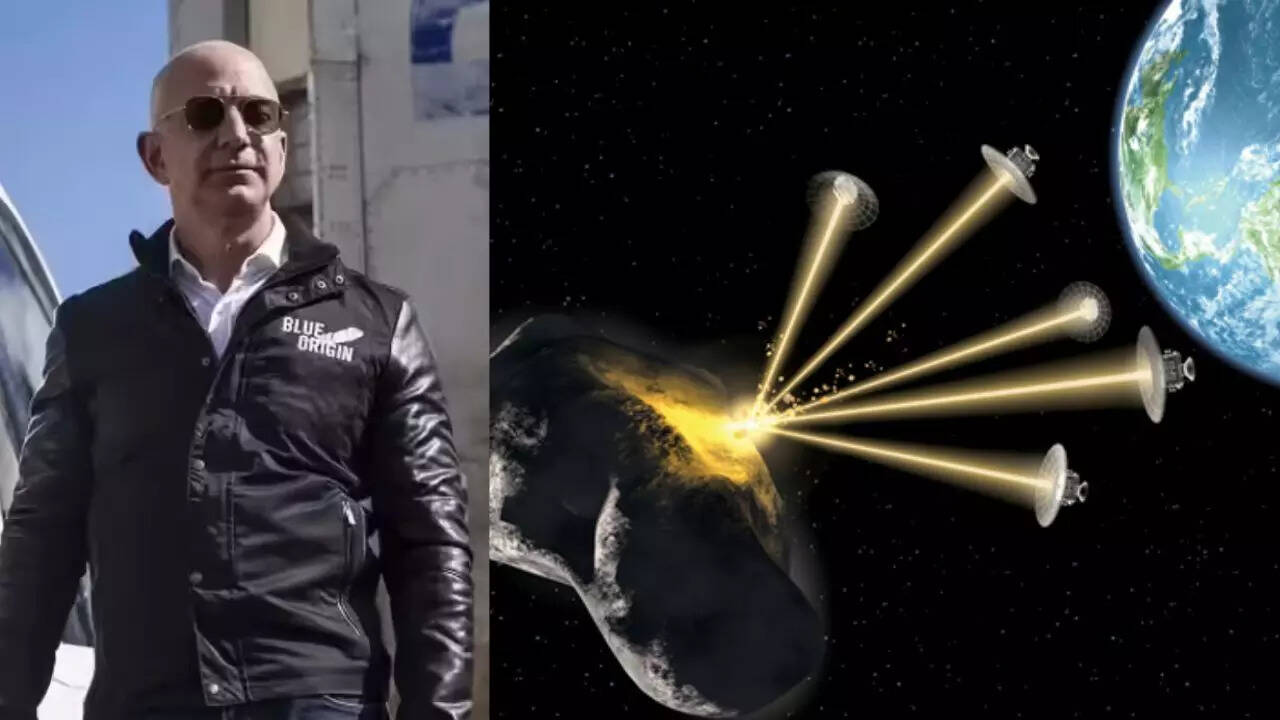
The probability of a civilization-ending asteroid impact remains low on a decadal scale, yet the statistical certainty of such an event over millennia necessitates a shift from passive observation to active planetary defense infrastructure. Current orbital tracking catalogs are significantly incomplete, particularly regarding Near-Earth Objects (NEOs) smaller than 140 meters in diameter—the threshold at which atmospheric entry results in regional devastation rather than localized impact. The collaboration between NASA and private aerospace entities like Jeff Bezos’ Blue Origin to launch the NEO Surveyor mission represents a transition from speculative science to a formal risk-management protocol for the planet.
The Detection Gap and the 140 Meter Threshold
Planetary defense is governed by the George E. Brown, Jr. Near-Earth Object Survey Act, which mandated that NASA identify 90% of NEOs larger than 140 meters. We are currently failing this mandate. Visible light telescopes, the traditional workhorse of astronomy, possess an inherent technical limitation: they rely on albedo. If an asteroid is composed of dark, carbonaceous material, it reflects very little sunlight, making it nearly invisible against the vacuum of space despite its mass.
The NEO Surveyor utilizes mid-infrared sensors to bypass the albedo trap. Instead of looking for reflected light, the mission detects heat signatures. Even the darkest asteroids absorb solar radiation and re-emit it as thermal energy. By positioning the telescope at the Sun-Earth Lagrange Point 1 (L1), the hardware maintains a stable thermal environment and a constant vantage point to scan the neighborhood of Earth's orbit. This positioning creates a "thermal fence" capable of identifying objects that ground-based systems consistently miss.
The Physics of Infrared Detection in Deep Space
Ground-based infrared astronomy is largely impossible due to the Earth's atmosphere, which absorbs most infrared radiation and emits its own thermal noise. The NEO Surveyor mission architecture solves this through two primary technical pillars:
- Cryogenic Stability: The telescope must operate at temperatures below 40 Kelvin to ensure its own heat does not blind the sensors. This is achieved through passive cooling and sunshields rather than consumable coolants, extending the mission’s operational lifespan.
- Dual-Band Imaging: By capturing data in two distinct thermal infrared bands, the system can calculate the diameter of an object with high precision. This is a critical variable. Kinetic energy in an impact scenario is defined by the formula $E_k = \frac{1}{2}mv^2$. Since mass ($m$) scales with the cube of the radius, even a small error in size estimation leads to a massive miscalculation of potential impact energy.
The Economic Logic of Private Launch Integration
Blue Origin’s role in this mission centers on the New Glenn launch vehicle. The choice of a heavy-lift, reusable rocket reflects a shift in the cost-benefit analysis of space exploration. Historically, mission profiles were dictated by the extreme scarcity of mass-to-orbit capacity. Every gram of shielding or fuel was scrutinized because launch costs were a dominant variable in the total mission budget.
The New Glenn’s seven-meter fairing and massive lift capacity decouple mission design from mass constraints. This allows for:
- Redundancy Integration: Engineers can include secondary systems and more robust structural housing for the telescope without risking the launch window due to weight overages.
- Propulsion Margin: Extra mass allowance enables the inclusion of more propellant for station-keeping at L1, directly correlating to a longer mission duration and a more comprehensive survey.
- Cost Amortization: Utilizing a reusable first-stage booster shifts the financial burden from capital expenditure on hardware to operational expenditure on fuel and refurbishment.
This creates a structural advantage for planetary defense. When launch costs drop, the frequency of "sentinel" missions can increase, moving Earth from a state of reactive panic to one of persistent surveillance.
The Kinetic Impactor vs. Gravity Tractor Framework
Detection is only the first phase of the planetary defense value chain. Once an object is identified as a threat, the response strategy is dictated by the lead time—the duration between detection and projected impact. The NEO Surveyor is designed to maximize this lead time, providing the decade-plus windows required for non-nuclear deflection methods.
The Kinetic Impactor (Short-Term Response)
If a threat is detected with a lead time of less than ten years, the primary strategy is a kinetic impactor, a method recently validated by NASA’s DART mission. The goal is a momentum transfer. By hitting the asteroid with a high-velocity spacecraft, the orbital period of the asteroid is slightly altered. Over millions of miles, this tiny change in velocity ($\Delta v$) translates into a miss distance of thousands of kilometers at Earth.
The Gravity Tractor (Long-Term Response)
For threats detected 20 to 50 years in advance, the gravity tractor offers a more surgical approach. A massive spacecraft flies alongside the asteroid, using nothing but its own gravitational pull to gently nudge the object into a safe trajectory. This method is preferred for "rubble pile" asteroids—loose collections of rock held together by weak gravity—which might shatter if hit by a kinetic impactor, creating a "shotgun blast" of multiple smaller impacts.
Structural Bottlenecks in Data Processing
The sheer volume of data generated by a persistent infrared survey creates a secondary challenge: the identification of moving targets against a static stellar background. The NEO Surveyor will produce terabytes of raw imagery that must be processed in near real-time.
The bottleneck is no longer the telescope optics, but the algorithmic filtering of "false positives." Space junk, sensor noise, and distant galaxies can all mimic the signature of a NEO. Success depends on a "Subtraction Pipeline," where known stellar maps are digitally subtracted from new frames to highlight objects that have changed position. Blue Origin’s involvement signals a broader trend where aerospace companies are expected to provide not just the "bus" (the rocket), but the integrated data infrastructure to support mission-critical decisions.
Risk Mitigation and Sovereign Responsibility
Planetary defense occupies a unique space in geopolitical strategy. Unlike climate change or pandemics, which involve complex biological and social variables, an asteroid impact is a purely mechanical problem of orbital mechanics. The variables are known: mass, velocity, trajectory, and composition.
However, the "Deflection Dilemma" introduces a geopolitical risk. If a deflection mission is partially successful, it could shift the impact point from one country to another. This necessitates a global legal framework for planetary defense that does not yet exist. The NEO Surveyor mission provides the technical baseline—the data—that will force these diplomatic conversations. Without precise tracking, no international consensus on deflection can be reached.
The Transition to Active Defense Infrastructure
The NEO Surveyor is not a standalone scientific experiment; it is the foundational layer of a permanent planetary security apparatus. The integration of Blue Origin’s heavy-lift capabilities with NASA’s deep-space sensing creates a blueprint for how private-public partnerships will manage low-probability, high-consequence cosmic risks.
The strategic play now shifts from identifying "what" is out there to establishing a standardized "intercept" capability. This requires the development of "rapid-response" spacecraft that can be mothballed on the ground or in orbit, ready to be deployed the moment a survey identifies a high-probability impactor. The data gathered by the NEO Surveyor over the next decade will define the mass, velocity, and composition profiles that these interceptors must be designed to handle. We are moving from an era of blind luck into an era of managed orbital traffic.
The immediate priority for the aerospace sector is the hardening of the infrared sensor supply chain and the standardization of the Lagrange-point delivery cycle. Once the NEO Surveyor establishes the baseline catalog of the inner solar system, the focus must move to "Characterization Missions"—small, cheap probes sent to the most "Earth-crossing" objects to determine if they are solid iron, porous rock, or ice. This granular data is the only way to move from theoretical defense to an operational, hardened planetary shield.