The sky over Dubai usually behaves like a polished mirror, reflecting a relentless, golden ambition. But when the pressure drops and the clouds bruise into a deep, unnatural purple, the city changes. The wind stops being a breeze and starts being a wall. Sand finds its way into the sealed seams of skyscrapers. Rain, when it finally breaks, doesn't just fall; it colonizes the pavement.
Imagine a driver named Omar. He is thirty miles from home, sitting in a white Model 3, watching the wipers struggle against a deluge that has turned the Sheikh Zayed Road into a river. The digital glow of his dashboard tells him he has 12% battery remaining. Under normal circumstances, 12% is a comfortable buffer. In a flood, with the AC blasting to keep the windows from fogging and the crawl of traffic draining energy minute by agonizing minute, 12% feels like a countdown. Also making headlines in this space: The Polymer Entropy Crisis Systems Analysis of the Global Plastic Lifecycle.
Omar represents the hidden anxiety of the electric transition. When the world works, the car is a miracle of efficiency. When the world breaks, the car becomes a glass box in a rising tide.
During these stretches of atmospheric chaos, the logistics of survival shift. People don't just need sandbags and candles. They need mobility. They need the assurance that if they have to move their families to higher ground or reach a hospital, the "fuel" of the future won't be a luxury they have to weigh against their grocery budget. More details regarding the matter are explored by CNET.
The Mathematics of Mercy
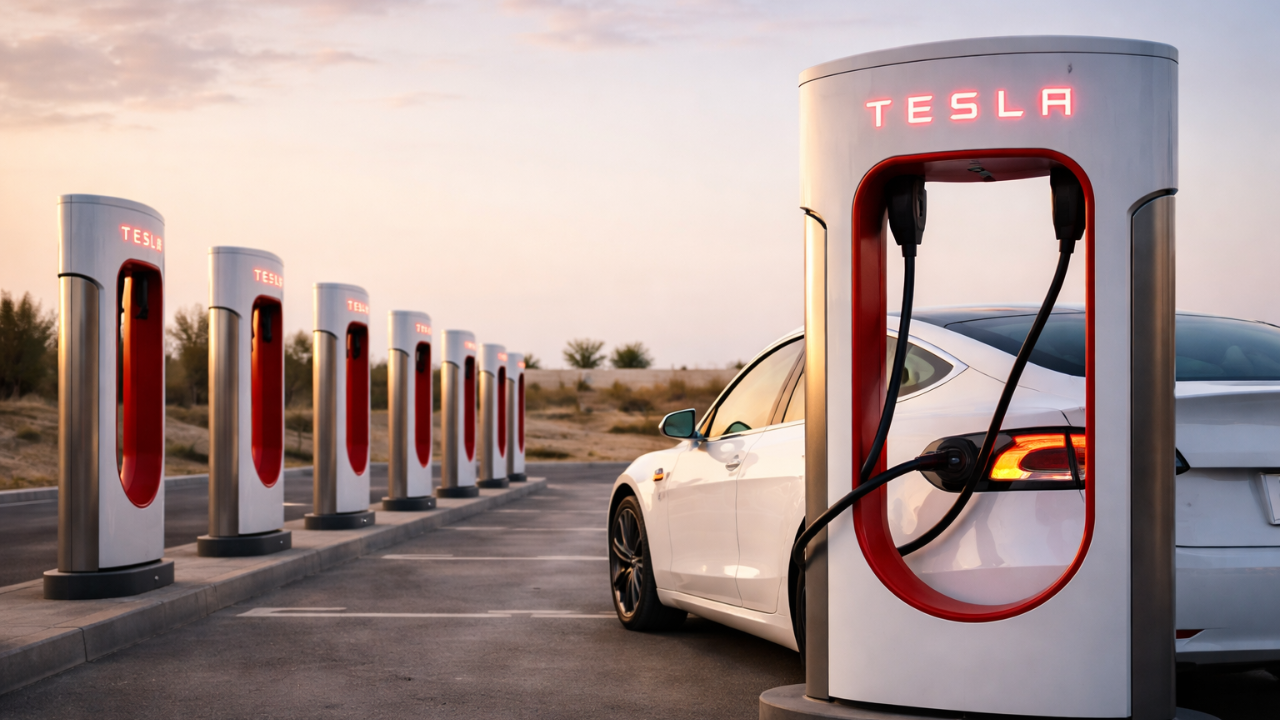
Tesla recently made a decision that bypassed the typical corporate committee's obsession with quarterly margins. They turned the Supercharger network across the United Arab Emirates and broader Gulf stations into a public utility. They made it free.
This isn't a small gesture. In a region where the heat can degrade battery chemistry and the distances between urban hubs are bridged by blistering stretches of empty sand, the Supercharger is the heartbeat of the ecosystem. By clicking a metaphorical switch in a software suite thousands of miles away, Tesla removed the "transaction" from the emergency.
Consider the mechanics of a gas station during a crisis. Prices often spike. Lines wrap around the block. The physical scarcity of a liquid commodity creates a panicked, every-man-for-himself atmosphere. But electricity moves differently. It flows through the grid like a ghost. By removing the payment barrier, Tesla didn't just save drivers a few dirhams. They removed the friction of panic.
The stations remained open, the stalls glowed red in the rain, and the electrons kept moving.
Why the Gulf Matters Now
We often think of the Gulf as the world’s gas station, a place where the internal combustion engine was perfected and fueled. To see the epicenter of the oil world transition so aggressively toward a high-voltage future is a tectonic shift in the human story. It is a recognition that the old ways of moving through the world are reaching a ceiling.
The UAE has one of the highest densities of Tesla owners per capita in the region. These aren't just tech enthusiasts; they are commuters, parents, and couriers. When the "tough times" hit—a phrase used by the company to describe the recent period of severe weather and infrastructure strain—the vulnerability of the EV owner becomes a talking point for skeptics.
"What do you do when the power goes out?" they ask.
"How do you charge in a flood?"
The answer came not in a press release, but in the lack of a bill. By subsidizing the movement of an entire population during a disaster, the company proved that software-defined infrastructure has a level of empathy that a traditional gas pump can never replicate. You cannot "airdrop" free gasoline to every car in a city. You can, however, update the permissions of a charging stall in seconds.
The Invisible Stakes of Range Anxiety
For a driver like Omar, the "free" aspect of the charging was secondary to the "available" aspect. Range anxiety is a psychological weight. It lives in the back of the mind like a low-frequency hum. It tells you that you are tethered to the grid, and if that grid falters, you are stranded.
During the recent storms, the stakes were higher than just getting to work. Roads were washed out. Traditional fuel deliveries were delayed because tankers couldn't navigate the standing water. Yet, the underground electrical lines held. The Superchargers, often elevated and built with redundant cooling and power systems, became islands of reliability.
Tesla’s move was a masterclass in behavioral economics. By making the service free, they encouraged people to keep their batteries topped off, ensuring that if an evacuation order came or a road was blocked, the fleet was ready. It was a preemptive strike against a logistics nightmare.
The Human Core of the Machine
We talk about "The Grid" as if it is a cold, mechanical thing. We talk about "Kilowatts" as if they are abstract numbers. But when you are sitting in a dark parking lot, surrounded by the sound of thunder, watching the green light on your charging port pulse, that electricity feels like a lifeline.
It is the power to keep the heater running for a sleeping toddler in the back seat. It is the power to keep a phone charged to call emergency services. It is the power to know that when the water recedes, you can go home.
There is a specific kind of silence in an electric car during a storm. There is no vibrating engine, no smell of exhaust. Just the sound of the rain hitting the panoramic glass roof. In that silence, the realization sinks in: the transition to sustainable energy isn't just about carbon credits or environmental targets. It is about building a system that is more resilient, more flexible, and more human than the one we are leaving behind.
The Gulf stations are more than just hardware. They are the outposts of a new kind of civilization. In the past, a corporation's responsibility ended at the point of sale. You bought the car; you bought the fuel; you were on your own. Now, the relationship is ongoing. The car is a node in a network, and the network is managed by people who can see the storm clouds on the horizon just as clearly as the driver can.
The Weight of the Gesture
Skeptics will call it a marketing stunt. They will point to the relatively low cost of electricity compared to the massive brand equity gained. They aren't wrong, but they are missing the point. Even if the move was calculated, the result was a tangible reduction in human stress during a period of genuine fear.
When a brand acts like a neighbor, it changes the way we perceive the technology it sells. The Tesla in the driveway stops being a status symbol or a gadget. It becomes a partner.
The water in the streets eventually drains. The sun returns to the UAE, and the sand is swept away. But the memory of that red glow at the Supercharger station remains. It stands as a reminder that in the future we are building, the machine is secondary to the person behind the wheel.
The real power wasn't in the volts. It was in the permission to keep moving when the world told everyone else to stop.
The desert is quiet again, but the hum of the stations continues, a steady, rhythmic pulse beneath the heat. It is the sound of a promise kept. It is the sound of the next mile, paid for by a company that realized, for a moment, that some things are too important to have a price tag.
Omar drove home that night through the subsiding puddles, the battery at 80%, the cabin warm, and the road ahead finally clear. He didn't think about the grid. He didn't think about the software. He just felt the steering wheel in his hands and the quiet confidence that the machine would get him where he needed to be.