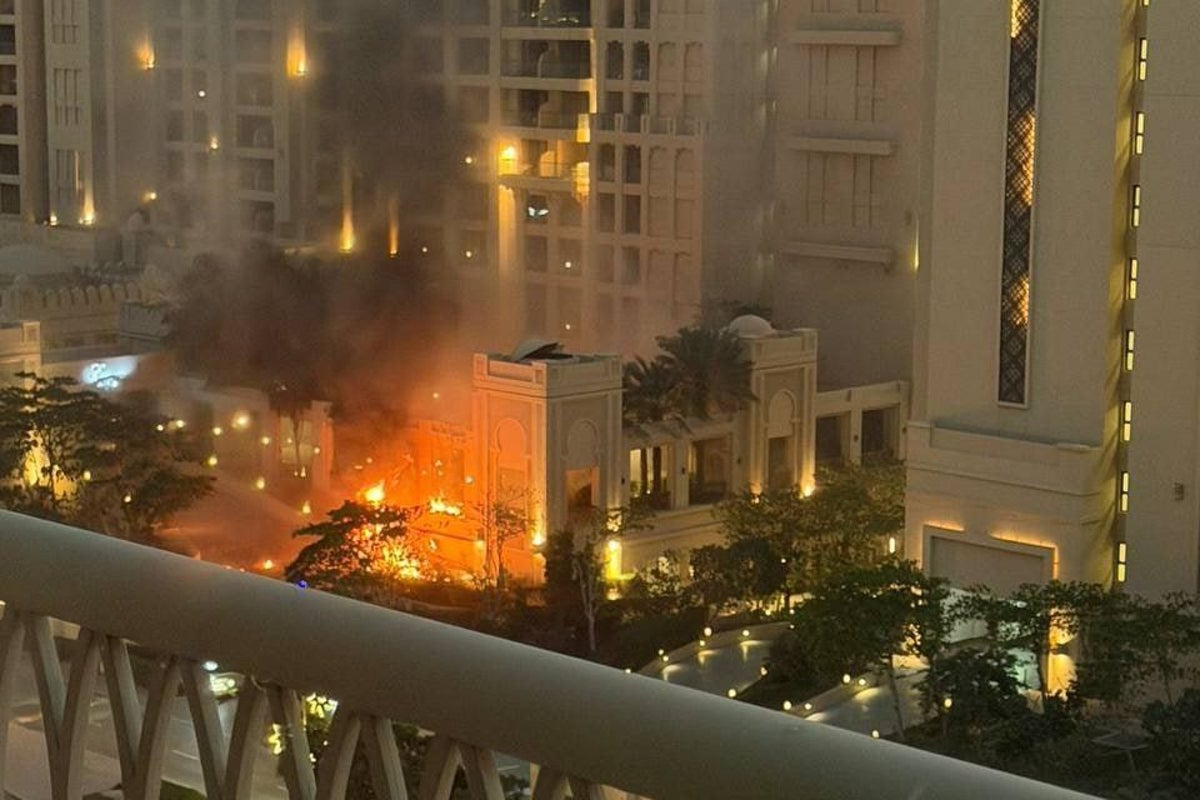
The convergence of kinetic military action and high-density luxury hospitality assets creates a specific risk profile that modern building codes are struggling to address. When a fire occurs at a landmark property like the Fairmont Hotel on Palm Jumeirah during an aerial engagement, the event cannot be viewed as a localized emergency. Instead, it represents a failure point in the intersection of urban defense systems, structural fire engineering, and regional security stability. Understanding this incident requires a breakdown of the causal chain: the identification of the ignition source, the mechanical response of the building’s envelope, and the tactical constraints placed on emergency services during active air defense operations.
The Mechanics of Kinetic Interference in High-Rise Safety
Standard fire safety protocols assume a static environment where the primary variables are internal ignition and suppression system reliability. External kinetic events, such as air attacks or the interception of projectiles, introduce exogenous variables that bypass traditional safety layers. The physical damage to a structure in these scenarios typically follows a tri-part sequence:
- Thermal Pulse or Impact Stress: The initial contact—whether from primary ordnance or secondary debris—introduces energy levels that far exceed the design specifications of standard tempered glass and aluminum cladding.
- Breach of the Building Envelope: High-rise structures rely on a pressurized environment to manage smoke. A physical breach caused by an external strike creates a "chimney effect," where pressure differentials draw oxygen into the fire floor and accelerate flame spread.
- Active Defense Interference: During an air attack, the deployment of electronic warfare (EW) and GPS jamming to neutralize incoming threats can inadvertently disable automated building management systems (BMS) that rely on wireless sensor networks.
The Fairmont incident highlights a critical vulnerability in the "Stay Put" policy commonly used in luxury high-rises. This policy assumes the fire is contained within a fire-rated compartment. When the ignition source is external and concurrent with a broader security threat, the compartmentation is often compromised before the fire alarm even triggers.
Structural Vulnerability and the Aluminum Composite Problem
The rapid vertical spread of fire in modern skyscrapers is often tied to the "Rain Screen" principle. While efficient for moisture management and insulation, the gap between the building’s structural wall and its decorative exterior cladding acts as a vertical wind tunnel.
The Flammability Gradient
The severity of a high-rise fire is determined by the Core Material Composition of its cladding panels. These are generally categorized by their mineral content:
- Category A (Non-combustible): High mineral content (90%+), typically fiber cement or stone. These panels do not contribute to fire spread.
- Category B (Limited combustibility): Mineral core (70%+) with fire-retardant additives. These slow the spread but can still fail under sustained thermal load.
- Category C (High risk): Polyethylene-cored panels. These act as a solid fuel source, melting and dripping "burning rain" onto lower levels, effectively igniting the building from the outside-in.
The Palm Jumeirah skyline, characterized by rapid development cycles, features a mix of these materials. In a kinetic strike scenario, the heat generated by an explosion or a falling projectile can exceed the auto-ignition temperature of even Category B materials. This turns the facade into a fuel source that bypasses internal sprinklers, which are designed to suppress fires originating inside the rooms.
Tactical Constraints of Emergency Response in Conflict Zones
Emergency response in Dubai follows a highly centralized command structure. However, the presence of an active air threat introduces a "Red Zone" constraint that complicates standard Operating Procedures (SOPs).
The Response Bottleneck
Firefighting in a 5-star resort during an air attack is limited by three operational friction points:
- Airspace Closure: Aerial firefighting assets, such as helicopters equipped with "Bambi Buckets" or high-pressure nozzles, are grounded during air defense activations to avoid fratricide or interference with interceptors.
- Resource Allocation: Civil defense must prioritize life-safety at the impact site while maintaining readiness for secondary strikes. This prevents the "saturation response" typically seen in peacetime high-rise fires.
- Evacuation Logistics: The Palm Jumeirah’s geography—a man-made archipelago with limited ingress and egress points—creates a funnel effect. A fire on the trunk or the fronds during a period of high-alert triggers mass panic, clogging the arterial roads required for emergency vehicles.
The Signal-to-Noise Ratio in Crisis Reporting
In the immediate aftermath of the Fairmont blaze, the delta between "verified impact" and "secondary fire" becomes blurred. Proximity to defense batteries can cause "shockwave ignition," where the vibration from an interception shatters windows and causes electrical short-circuits within the hotel, leading to a fire that was not directly hit by a projectile. Distinguishing between these causes is vital for insurance underwriting and state-level liability.
Economic and Geopolitical Ripple Effects
The Palm Jumeirah is not just a residential area; it is a global symbol of the UAE’s "Safe Haven" status. A visible blaze at a flagship property like the Fairmont during a security event serves as a high-visibility stress test for the nation’s brand.
- Insurance Premium Re-Rating: Reinsurance markets (Lloyd’s, Swiss Re) price risk based on the perceived efficacy of a state’s "Iron Shield." Visible failures or significant collateral damage lead to a reclassification of the "War Risk" premium for commercial real estate in the Gulf.
- Investor Flight vs. Resilience: Capital is cowardly. If high-rise fires resulting from regional instability become a recurring theme, the valuation of "trophy assets" on the Palm will face a downward adjustment to account for the physical risk.
- The Luxury Perception Gap: The Fairmont brand relies on the promise of seamless, high-end security. When the reality of regional conflict pierces that bubble, the value proposition shifts from "exclusive luxury" to "high-risk target."
Technical Integration of Defense and Safety Systems
To mitigate the risks exposed by the Fairmont fire, a new architectural paradigm is required. This is the "Hardened Hospitality" model. This involves the integration of building safety systems with national defense feeds.
- Automated Hardening: Future BMS should be linked to early warning systems. Upon detection of an incoming threat, the building should automatically enter "Safe State"—shutting down gas lines, recalling elevators to the lobby, and activating external drenchers to pre-wet the cladding.
- Material Science Mandates: Retrofitting existing towers with fire-intumescent coatings on the exterior can provide the critical 30-minute window needed for evacuation during an air attack when traditional response is delayed.
- Redundant Communications: Shifting from cloud-based BMS to localized, hardened fiber-optic loops ensures that the building remains "intelligent" even if regional GPS or cellular networks are jammed.
The fire at the Fairmont is a data point in a shifting global security environment where the boundaries between the front line and the lobby are dissolving. Asset owners must stop viewing fire safety and national security as separate silos. The strategic play is the immediate audit of cladding composition and the implementation of decentralized, analog-backup fire suppression triggers. The ability to isolate a building’s exterior from kinetic heat transfer will determine the survivability of luxury real estate in the coming decade. Owners should prioritize the installation of high-velocity misting systems on the building crown to create a thermal curtain, effectively shielding the facade from secondary debris ignition during aerial interceptions.