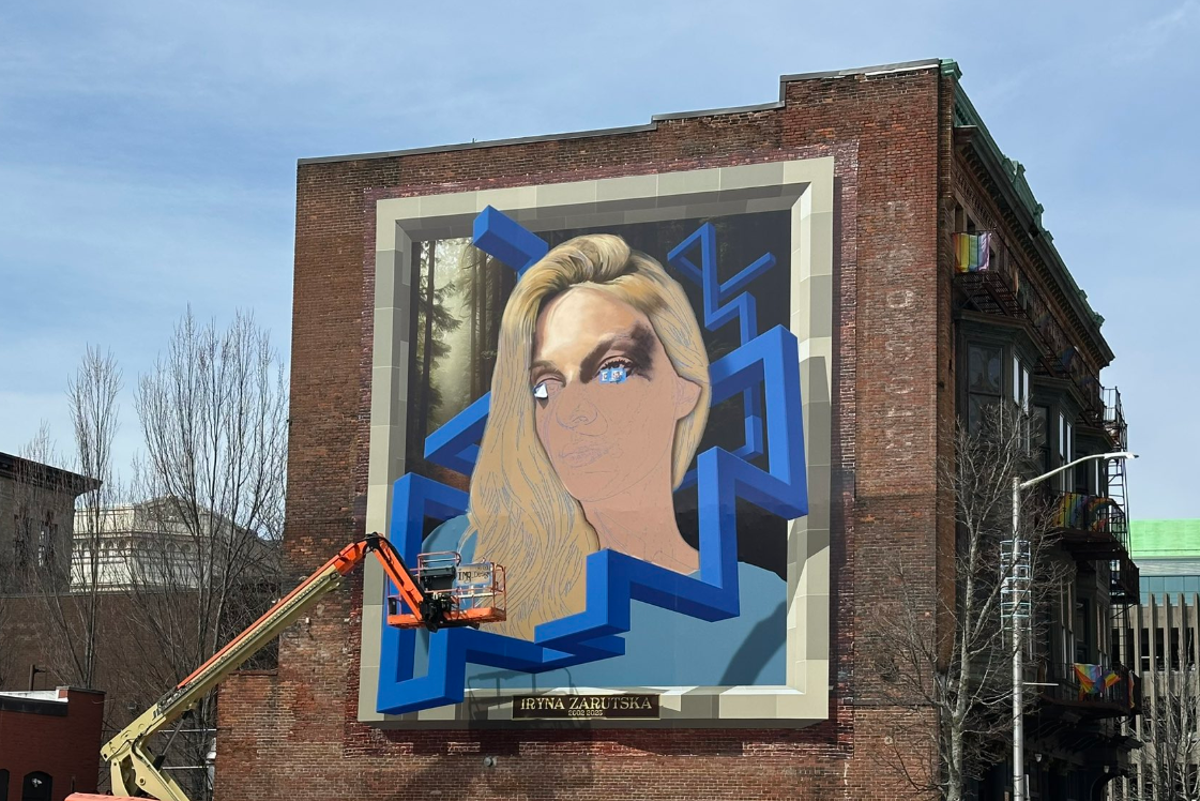
The intersection of digital populism and local governance creates a specific form of friction when physical monuments are used as proxies for online ideological warfare. The controversy surrounding the mural of a slain Ukrainian refugee—funded and amplified by high-profile digital figures like Elon Musk and Andrew Tate—is not a localized aesthetic dispute. It is a case study in the breakdown of municipal sovereignty under the pressure of "The Attention Economy." When a city official calls for the removal of such a mural, they are not just debating art; they are attempting to mitigate a multi-vector risk profile involving social cohesion, public safety, and administrative precedent.
The Triad of Digital Influence and Physical Proxy
The involvement of Musk and Tate transforms a local memorial into a global signal. This phenomenon operates via three distinct mechanisms of influence: For a deeper dive into this area, we recommend: this related article.
- Capital Asymmetry: Small-scale local initiatives are overwhelmed by the sudden injection of hyper-capital. When a figure with Musk’s net worth supports a local project, it ceases to be a community effort and becomes an outpost of a broader geopolitical brand.
- Algorithmic Feedback Loops: The mural exists to be photographed and shared. Its physical location is secondary to its digital footprint. Every interaction—supportive or vitriolic—increases the visibility of the "provocation," forcing the local municipality into a defensive posture.
- Ideological Capture: The subject of the mural—a Ukrainian refugee—is stripped of individual agency and converted into a symbol. For the backers, the mural serves as a proof-of-concept for bypassing traditional media and government gatekeepers.
The mayor's classification of the mural as "divisive" is a bureaucratic shorthand for "uncontrollable." In municipal risk management, a divisive asset is one where the cost of maintenance and security exceeds the social utility it provides.
The Mechanics of Municipal Conflict
Municipalities operate under a rigid framework of zoning, public sentiment, and liability. The mural in question violates the traditional "Permit-to-Presence" pipeline. Under normal circumstances, public art undergoes a rigorous vetting process designed to ensure community buy-in. By bypassing this, the backers have created an "Unsanctioned Institutional Asset." To get more details on the matter, comprehensive coverage can also be found on The Guardian.
The conflict arises from the divergence of two competing value systems:
- System A (The Backers): Values disruption, speed, and the unmediated expression of "truth" or "tribute." Success is measured in impressions, retweets, and the degree of reaction elicited from "the establishment."
- System B (The Municipality): Values stability, consensus, and procedural integrity. Success is measured in the absence of public disorder and the adherence to long-term urban planning goals.
When these systems collide, the result is a "Resource Sink." The city must now allocate police resources to protect the mural from vandals, legal resources to draft removal orders, and political capital to manage the PR fallout. From a cold analytical perspective, the mural is no longer an asset; it is a liability with a high burn rate.
Quantifying the Divisiveness Metric
Divisiveness in a civic context is measurable through three primary variables:
- The Polarization Coefficient: The ratio of public complaints to public endorsements. If the delta between these two groups grows, the social cost of the installation increases.
- The Security Burden: The projected cost of physical security (surveillance, patrols, cleaning) required to prevent the mural from becoming a site of physical escalation.
- The Precedent Penalty: The risk that allowing this mural establishes a loophole for other well-funded actors to occupy public space without oversight. If Musk can fund a mural today, a different billionaire with an opposing agenda can demand equal space tomorrow.
The mayor’s call for removal is a strategic attempt to "Close the Loophole." By framing the issue as one of social cohesion, the city attempts to regain control over its physical geography.
The Geopolitical Layer: Ukraine as a Symbolic Front
The choice of a Ukrainian refugee as the subject is not accidental. It taps into a high-volatility global narrative. For the backers, supporting a refugee mural provides a shield of "moral unassailability." To oppose the mural is to appear heartless or pro-aggression. However, the municipal concern is not with the refugee’s story, but with the politicization of that story.
The "Signal-to-Noise" ratio in this instance is heavily skewed. The "Signal" (the tragedy of the refugee) is drowned out by the "Noise" (the personalities of Musk and Tate). This creates a "Symbolic Overload," where the mural becomes a lightning rod for unrelated grievances—ranging from free speech debates to criticisms of the backers' personal lives.
Structural Failures in Modern Urban Planning
This incident highlights a critical vulnerability in modern urban planning: the "Physical-Digital Gap." Current laws are designed for a world where art is static and local. They are not equipped for a world where a mural can be "weaponized" by a global audience of millions within minutes of its completion.
To mitigate this, cities must evolve their "Art Defense Architecture." This involves:
- Dynamic Zoning: Implementing regulations that specifically address the funding sources and digital promotion of public works.
- Rapid-Response Removal Clauses: Contracts that allow for the immediate decommissioning of art if it exceeds a predefined "Tension Threshold."
- Decentralized Curation: Moving away from centralized boards toward neighborhood-level micro-votes, which are harder for external digital actors to manipulate.
The current strategy of the mayor—public condemnation followed by legal action—is a reactive "Lagging Indicator" approach. It acknowledges the problem only after the damage to the social fabric has begun.
The Cost-Benefit Analysis of Removal
If the city removes the mural, it incurs a "Backlash Cost." The backers will frame the removal as censorship, triggering a fresh wave of digital hostility. If the city keeps the mural, it incurs an "Ongoing Operational Cost" and loses its claim to procedural authority.
The optimal strategy for the city is "The Third Way": Relocation to private property. By facilitating the move of the mural to a private lot, the city removes the "Public Endorsement" component while simultaneously stripping the backers of their "Censorship" narrative. This shifts the liability—both physical and financial—from the taxpayer to the private owner.
Future Vectors of Conflict
The "Mural Strategy" is likely to become a repeatable template for digital influencers seeking to exert physical influence. We should expect to see:
- The Rise of "Pop-Up" Monuments: High-impact, temporary installations designed to provoke a response before legal injunctions can be filed.
- Crowdfunded Provocations: Using DAO (Decentralized Autonomous Organization) structures to fund public works that challenge local ordinances.
- AR Layering: Where the physical mural is simple, but an Augmented Reality layer—visible only through a phone—contains the "divisive" or "politicized" content, creating a legal grey area for municipal regulators.
Local governments that fail to update their frameworks to account for "The Digitally-Enabled Physical Asset" will find themselves perpetually stuck in a cycle of reaction. The solution is not more censorship, but more robust "Resource Allocation Logic." Cities must define what constitutes a "Public Asset" with enough precision to exclude "Digital Trophies" funded by external agitators.
The removal of the mural is the first step in a necessary decoupling of local civic space from global digital theater. The mayor's objective must be to re-establish the city as a neutral platform for its actual residents, rather than a backdrop for the curated narratives of the ultra-wealthy. This requires a shift from "Sentiment Management" to "Systemic Integrity."
The path forward for municipal leaders involves drafting a "Civic Neutrality Protocol." This protocol must define clear triggers for the intervention of local authorities when a physical installation becomes a node for external geopolitical signaling. Key triggers include the percentage of non-local social media engagement relative to local foot traffic and the presence of third-party commercial or personal branding within the artistic composition. By codifying these triggers, cities can bypass the "divisiveness" debate and move directly into "Standard Operational Enforcement." This removes the emotional weight from the decision and positions the city as a neutral arbiter of its own space.