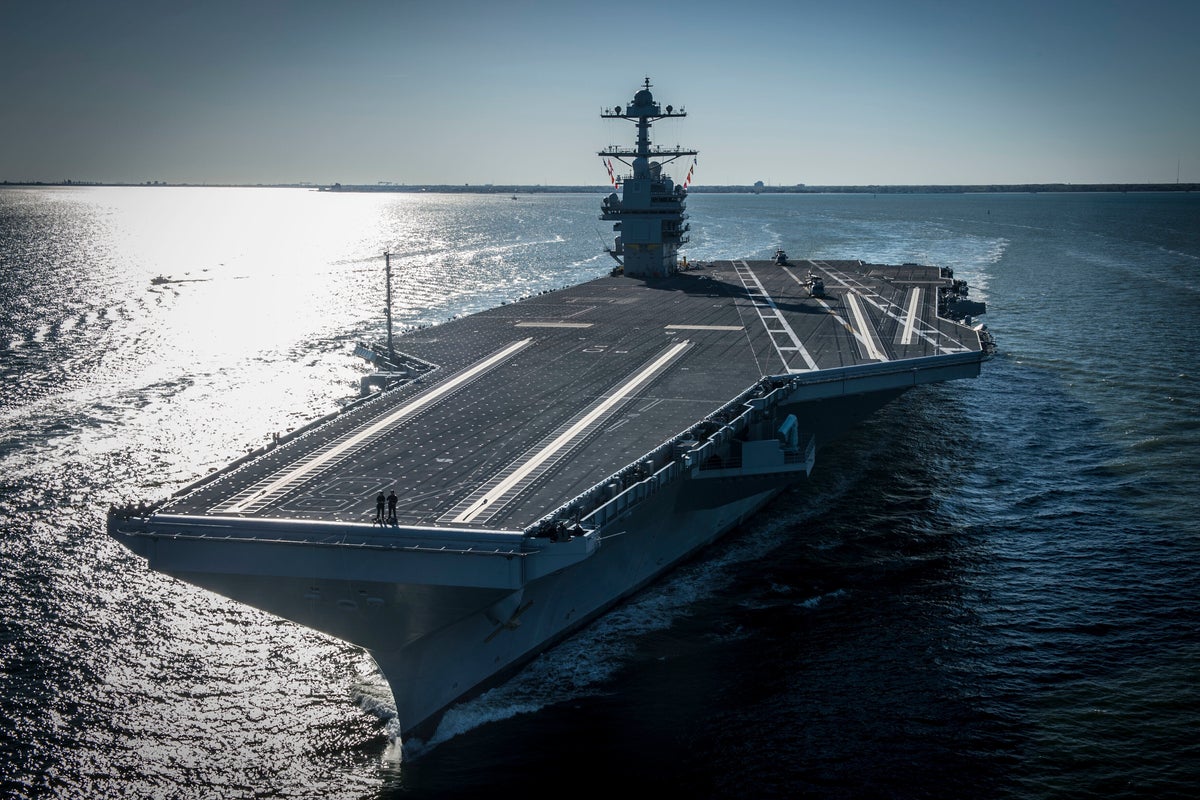
The headlines are screaming about a "mega arsenal." They point to the Gerald R. Ford-class carriers and the F-35 Lightning II as symbols of absolute dominance. They want you to believe that a dozen ships and a few hundred jets represent an untouchable wall of steel against Iranian aggression.
They are wrong.
In reality, the United States is currently doubling down on a 20th-century strategy to fight a 21st-century ghost. We are watching a slow-motion collision between high-cost legacy hardware and low-cost asymmetric reality. While the media salivates over the "world’s largest warship," naval architects and frontline strategists are quietly sweating over the math.
The math is not on our side.
The Aircraft Carrier Is a Floating Liability
Let’s talk about the $13 billion target. The USS Gerald R. Ford is a marvel of engineering. It features electromagnetic catapults and a deck that can launch more sorties than anything in history. It is also a massive, centralized point of failure.
For the price of one Ford-class carrier, an adversary like Iran can mass-produce thousands of anti-ship cruise missiles (ASCMs) and swarm-capable drones. This is the "Salvo Competition." If it costs the U.S. $2 million to fire a single RIM-162 Evolved SeaSparrow Missile (ESSM) to intercept a drone that costs $20,000, the U.S. loses the war of attrition before the first shot even hits its mark.
The competitor’s narrative suggests that these ships project power. I’ve seen the Pentagon’s wargames where "Blue Force" carriers are forced to operate so far offshore—to stay out of the range of Iranian shore-based ballistic missiles—that their aircraft don't have the unrefueled range to reach their targets. We are building the world’s most expensive airport and then parking it so far away the planes can’t reach the runway.
The F-35 Myth of Invisibility
The F-35 is a stunning piece of software wrapped in a stealth airframe. It is also a maintenance nightmare that requires a pristine supply chain to function. In a high-intensity conflict with a regional power that understands "Anti-Access/Area Denial" (A2/AD), stealth is not a magic cloak. It is a diminishing advantage.
Iran isn't trying to out-fly an F-35 in a dogfight. They are trying to crater the runways the F-35s land on. They are using passive coherent location radar—which uses existing radio and TV signals to detect the "hole" a stealth fighter makes in the air—to track what we think is invisible.
The "mega arsenal" relies on the assumption that we will have air superiority on day one. But if the tankers—the slow, fat, non-stealthy KC-46s mentioned in the "mega arsenal" reports—get picked off by long-range missiles, those F-35s become the world’s most expensive gliders. Without gas, the "stealth" doesn't matter.
The Tanker Bottleneck
Everyone looks at the pointy end of the spear. Nobody looks at the shaft.
The U.S. Air Force’s refueling fleet is the aging, brittle backbone of every strike operation. We are currently flying 60-year-old KC-135s into the ground. The "mega arsenal" depends entirely on these flying gas stations. If an adversary uses long-range "carrier killer" missiles or high-speed interceptors to target the tankers, the entire strike package collapses.
Imagine a scenario where 24 F-35s are 500 miles from the nearest carrier, running low on fuel, and their designated tanker has just been splashed by a long-range air-to-air missile. That isn't a "strike"; it's a catastrophe. Our obsession with big platforms—big ships, big wings—makes us predictable.
The Asymmetric Trap
The traditional view of military power is additive: more tons of steel equals more victory. The contrarian truth is that in modern warfare, power is becoming subtractive.
Iran has spent decades perfecting the art of the "mosquito bite." They don't need to sink a carrier to win. They just need to make it too dangerous for a carrier to enter the Persian Gulf. By utilizing thousands of fast-attack boats, sea mines, and mobile missile batteries tucked into the jagged coastline, they create a "contested environment" that turns our $13 billion assets into liabilities.
We are bringing a scalpel to a bar fight. The scalpel is beautiful, expensive, and precise. But if the other guy has twenty rusty screwdrivers and doesn't care if he gets cut, the scalpel-holder is in trouble.
The Logistics of a Lie
We talk about "Inside the Arsenal" as if these weapons are ready to go at the flip of a switch. I have seen the readiness rates. I have seen the "cannibalization" of parts where one jet is stripped to keep another flying because the global supply chain is too thin.
The "mega arsenal" is a paper tiger if the munitions aren't there. During the 2011 intervention in Libya, some European allies ran out of precision-guided bombs within weeks. A sustained strike campaign against a nation with deep, hardened bunkers requires a volume of munitions that our current industrial base is simply not equipped to replace in real-time. We have the "quality," but we have completely forgotten about "quantity."
Stop Asking if We Can Win and Ask if We Can Afford It
The "People Also Ask" section of your brain probably wants to know: "Can the F-35 defeat Iranian air defenses?"
The answer is: "Yes, once."
But the real question should be: "Can the U.S. replace five lost F-35s faster than Iran can replace five surface-to-air missile batteries?"
The answer is a resounding no. An F-35 takes years to build. A missile battery can be bought or manufactured in months. We are trading gold for lead. This is the fundamental flaw of the "mega arsenal" philosophy. It assumes a short, decisive victory. It ignores the reality of a "forever war" fought with hardware that costs $100,000 per flight hour.
The Solution We Refuse to Accept
If we actually wanted to project power effectively, we would stop building $13 billion targets. We would pivot to "Distributed Lethality."
Instead of one carrier, we should have 50 small, unmanned, missile-laden ships. Instead of 100 manned stealth fighters, we should have 10,000 "attritable" drones. We need to make the enemy's targeting problem impossible. Right now, we make it easy for them. We put all our eggs in one very large, very shiny, very trackable basket.
The "mega arsenal" isn't a sign of strength. It's a sign of institutional inertia. It’s the military-industrial complex building what it knows how to build, rather than what the modern battlefield actually demands.
The next conflict won't be won by the side with the largest warship. It will be won by the side that can lose the most hardware and keep fighting. Currently, that isn't us.
Stop admiring the size of the ship and start looking at the cost of the swarm.