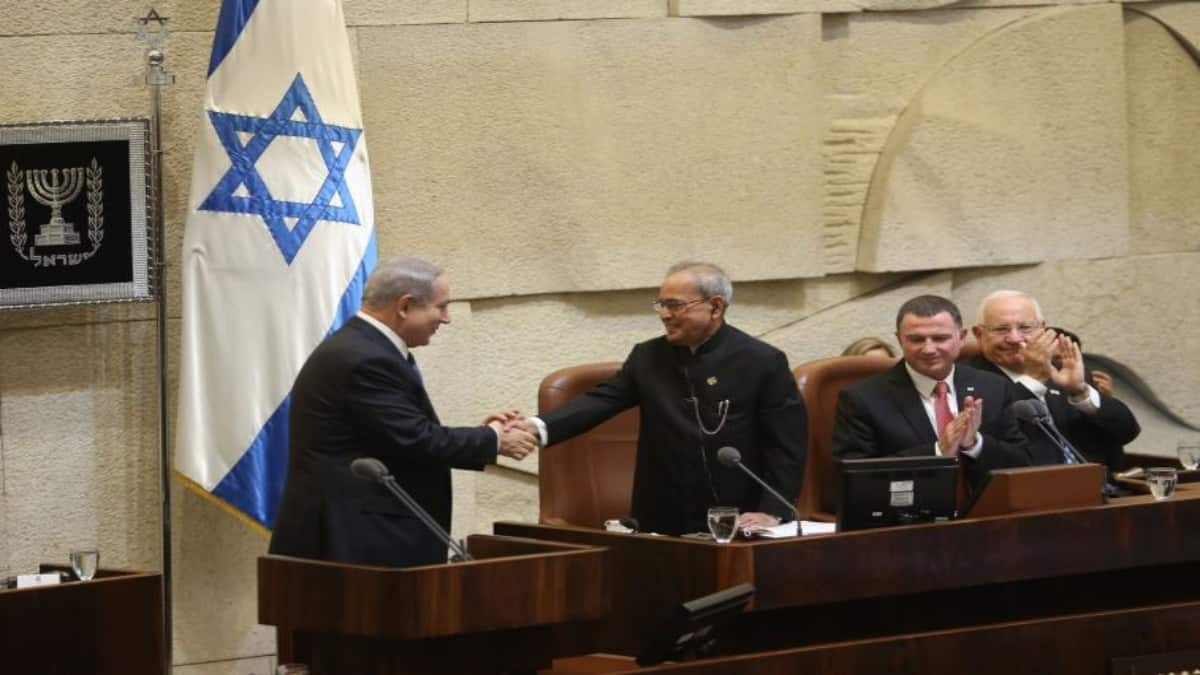
History isn't just about dates and signed treaties. Sometimes, it's about the smell of rain in Ramallah and the awkward silence when a guest mentions a name his hosts would rather forget. When Pranab Mukherjee landed in Tel Aviv in October 2015, he wasn't just the first Indian President to cross that threshold. He was a tightrope walker performing without a net.
India had spent decades keeping Israel at arm's length while hugging Palestine tight. Suddenly, the "Rashtrapati" was there, standing on Israeli soil, trying to prove that India could love two enemies at the same time. It was a messy, fascinating, and deeply symbolic moment that changed how India looks at the Middle East. If you think the current proximity between Delhi and Jerusalem happened overnight, you're missing the groundwork laid by a man who knew exactly how to play the long game.
The ghost in the room at the Knesset
Pranab Mukherjee didn't do "simple." He was a scholar of history who happened to run a country. When he stood before the Knesset—the Israeli Parliament—he did something that made the local politicians shift in their seats. He brought up the "H" word. No, not that one. He brought up Hamas.
While praising the resilience of the Israeli people, Mukherjee didn't stick to the script of blind flattery. He spoke about the need for a peaceful resolution and mentioned the Palestinian struggle. For the Israelis, Hamas is a terrorist organization, full stop. For Mukherjee, representing a nation that had historically championed the Palestinian cause, it was a necessary mention. He wasn't endorsing them, but he was acknowledging the reality of the Gazan landscape.
It was a bold move. Most leaders visiting a country for the first time play it safe. They talk about tech, water, and shared values. Mukherjee talked about the elephant in the room. He reminded the Israelis that India’s friendship isn't a zero-sum game. You don't get India by making them drop Palestine. That’s a lesson many diplomats are still trying to master today.
Hummus and the art of the meal
Diplomacy is often won or lost at the dinner table. Mukherjee’s visit wasn't all heavy political lifting. There were moments of genuine cultural collision. Imagine a high-ranking Indian delegation, steeped in the traditions of Lutyens' Delhi, sitting down to a spread of Mediterranean mezze.
Hummus became the great equalizer. There's a famous anecdote from that trip about the President enjoying the local flavors, finding a strange resonance between the chickpea mash of the Levant and the legumes of his home in Bengal. It sounds trivial, doesn't it? It isn't. When a head of state eats the local food with genuine interest, it signals respect.
In a region where identity is tied to the land—and the food that grows from it—sharing a plate of hummus is a political act. It was a soft-power masterclass. While the bureaucrats argued over defense contracts and agricultural technology, the President was busy humanizing the Indian state. He wasn't just a cold official; he was a guest.
The landmark that defined the trip
You can't talk about this visit without talking about the Hebrew University of Jerusalem. Mukherjee was awarded an honorary doctorate there. It wasn't just a vanity prize. The university is a symbol of Israeli intellectual life, and for an Indian President who was a lifelong teacher and student, this was the real highlight.
During his speech there, he didn't just talk about India’s growing economy. He talked about the "knowledge society." He saw a mirror of India’s own aspirations in Israel’s obsession with education and innovation. This was the moment the relationship shifted from "buyer and seller" to "partners in thought."
He also visited the Yad Vashem Holocaust Memorial. Seeing an Indian leader lay a wreath for the victims of the Shoah was a powerful image. It acknowledged the specific trauma that defines the Israeli psyche. By doing so, Mukherjee gained the moral authority to speak about the Palestinian trauma later in the trip. You have to show you understand one side's pain before they’ll let you talk about the other's.
Why the Ramallah detour was essential
Mukherjee didn't just visit Israel. He visited the State of Palestine. He spent a night in Ramallah. That’s a big deal. Usually, leaders fly in and out of the West Bank in a few hours. Staying the night is a statement of solidarity. It says, "I see you. You are a real state with a real capital."
In Ramallah, he inaugurated the India-Palestine Center for Excellence in ICT. He also named a street "India Boulevard." These weren't just photo ops. They were concrete evidence that India wasn't "de-hyphenating" the relationship yet—or if they were, they were doing it with incredible balance.
The President met with Mahmoud Abbas and reiterated India’s support for a two-state solution. This was the "old India" speaking, the India of Nehru and Indira Gandhi. But by doing it 24 hours after being cheered in the Knesset, he was showing the "new India." An India that is confident enough to be friends with everyone, even if those friends want to kill each other.
The legacy of the balancer
Looking back from 2026, the Mukherjee visit looks like a turning point. Before 2015, Indian Prime Ministers and Presidents stayed away. They were afraid of the domestic political fallout or the reaction from the Arab world. Mukherjee broke the seal. He proved that the sky wouldn't fall if an Indian leader shook hands with a Zionist.
He also set the stage for Narendra Modi’s historic visit in 2017. If Mukherjee hadn't gone first and handled the delicate topics of Hamas and Palestinian rights with such grace, the subsequent deepening of the defense ties might have been much more controversial. He was the scout who went ahead to make sure the bridge was strong enough to hold the weight of a full-scale alliance.
What we get wrong about Indian neutrality
People often mistake Indian "non-alignment" for being indecisive. It’s actually the opposite. It’s an aggressive form of independence. Mukherjee embodied this. He didn't go to Israel to join their side. He went there to bring them into our orbit.
He understood that India needs Israeli tech—especially in irrigation and cyber defense—but he also knew that India’s moral standing in the Global South depends on its support for decolonization and Palestinian rights. Managing that contradiction is the hardest job in the Ministry of External Affairs. Mukherjee made it look like a walk in the park.
How to view this history today
If you want to understand why India reacts the way it does to Middle Eastern conflicts today, look at the 2015 archives. You'll see a blueprint for "strategic autonomy." It’s about being present, being vocal, and being unafraid to eat the hummus while discussing the missiles.
Don't let the dry diplomatic cables fool you. This was a high-stakes drama. It involved navigating the ego of Benjamin Netanyahu, the frustrations of the Palestinian Authority, and the watchful eyes of a billion people back home. It was a landmark because it was the first time India stopped apologizing for its interests.
The next time you see news about India-Israel joint ventures or Indian aid sent to Gaza, remember the man in the bandhgala suit who went there first. He didn't solve the Middle East crisis—nobody can—but he made sure India had a seat at the table where the solutions are discussed.
Check the official archives of the Rashtrapati Bhavan for the full transcripts of his Knesset speech. It's a masterclass in saying exactly what needs to be said without burning the house down.