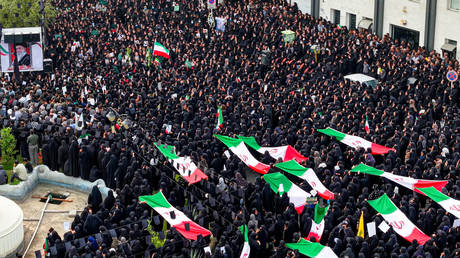
The streets of Tehran don't just feel heavy today. They feel electric with a specific kind of grief that only comes when the victims are children. When you see thousands of people pouring into public squares, clutching framed photos of smiling young girls in school uniforms, you aren't just looking at a funeral. You're looking at a geopolitical breaking point.
The recent strikes, attributed by Iranian officials to US and Israeli forces, didn't hit a military base or a command center. They hit a school. Now, the images of small coffins draped in the national flag are circulating globally, and the fallout is far more than just symbolic. This isn't just another headline in a long-standing conflict. It's a moment where the human cost has become so visible that the usual political talking points feel hollow.
The Reality on the Ground in Tehran
Walking through the crowds, the silence is what hits you first. It's punctuated only by rhythmic chanting and the sound of sobbing. This isn't a state-mandated gathering where people show up because they have to. This is raw. Parents are holding up the notebooks and backpacks of their daughters—items that were supposed to be filled with homework, not shrapnel.
The Iranian government has been quick to point the finger. They've labeled these strikes as a direct provocation and a war crime. While Western media often focuses on the "strategic" nature of regional skirmishes, the perspective here is vastly different. To the people in these streets, this is an unforgivable breach of the most basic rules of engagement. You don't target schools. You don't kill kids.
It's easy to get lost in the "who-said-what" of international diplomacy. But when you look at the sheer scale of this mourning, the politics take a backseat to the tragedy. These girls had names, dreams, and families who are now broken. The emotional weight of this event is fueling a domestic unity in Iran that we haven't seen in years.
Why the US-Israeli Narrative is Being Challenged
For decades, the narrative surrounding strikes in this region has been about "precision" and "targeting assets." This time, that narrative has collapsed. Even for those who are typically skeptical of the Iranian government's claims, the evidence of civilian casualties is impossible to brush aside.
The strikes have sparked a massive wave of condemnation across the Middle East. It’s not just about Iran anymore. Protests have cropped up in Baghdad, Beirut, and even parts of the Gulf. People are asking a very simple, very pointed question: If these strikes are so precise, how did a classroom become a target?
Military analysts often talk about "collateral damage" as if it's a math problem. It’s not. It’s a girl’s empty desk. It’s a mother who won’t ever see her child graduate. By labeling these as US-Israeli strikes, the Iranian leadership is pinning the moral responsibility directly on Washington and Tel Aviv. Whether or not there is a formal admission of responsibility, the court of public opinion in the region has already delivered its verdict.
The Shift in Regional Alliances
This tragedy is doing something that years of diplomacy couldn't. It's hardening the resolve of the "Axis of Resistance." We're seeing a tightened coordination between various groups in the region who now feel they have a moral mandate to retaliate.
- Increased military readiness among regional proxies.
- A surge in volunteer recruitment for local militias.
- Hardline shifts in the Iranian parliament regarding nuclear talks and security.
The domestic pressure on the Iranian leadership to respond is massive. When thousands of your citizens are in the streets crying for justice, "strategic patience" becomes a very hard sell. You can feel the shift in the air. The rhetoric coming out of the Foreign Ministry is no longer just about sanctions or borders; it's about blood.
The Global Silence is Deafening
One of the most striking parts of this story is the contrast between the outrage in the East and the relative quiet in the West. If a school in any Western capital were hit by a missile, the world would stop spinning. But here, there’s a sense that these lives are somehow less worthy of a global outcry.
This double standard isn't lost on the people of Iran. They see it. They talk about it. It breeds a deep-seated resentment that lasts for generations. When international human rights organizations are slow to issue statements, it reinforces the idea that the "rules-based order" only applies to a select few.
The mourning period in Iran usually lasts 40 days. But the impact of this will last much longer. We are looking at a generation of Iranians who will grow up with this event as their primary memory of Western intervention. That's a high price to pay for a "strategic" strike.
The Impact on Future Negotiations
Any hope for a de-escalation in the near term has basically evaporated. You can't talk about peace deals while the funerals are still happening. The political capital required for any Iranian official to sit down at a negotiating table with the US right now is non-existent.
In fact, the opposite is happening. There's a push to accelerate military programs and strengthen ties with Eastern powers like Russia and China. These countries have been vocal in their support for Iran during this period, which only serves to pull Iran further away from the Western orbit.
The geopolitical map is being redrawn in real-time. It’s being redrawn with the ink of these girls' lives. If you think this is just another cycle of violence, you're missing the point. This is a fundamental change in the temperature of the region.
What Happens When the Mourning Ends
When the crowds eventually disperse and the photos are put away, the anger won't go away. It will just go underground, where it becomes more dangerous.
The Iranian government is already signaling that their response will be "calculated but definitive." This usually means we can expect a series of asymmetric moves—cyberattacks, maritime disruptions, or proxy engagements—that keep the US and Israel on edge without triggering a full-scale world war.
But don't be fooled. The goal isn't just to strike back. The goal is to ensure that the cost of these actions becomes too high for the West to maintain its current posture.
If you want to understand where the Middle East is headed in 2026, don't look at the whiteboards in the Pentagon. Look at the faces of the people in Tehran today. Look at the thousands who stood in the rain to say goodbye to schoolgirls who should have been at their desks.
The next steps for the international community are clear, though unlikely to be taken. There needs to be an independent investigation into the school strike. Without an objective accounting of what happened, the cycle of blame and retaliation will only spin faster. Governments and NGOs should be pushing for immediate humanitarian access and a ceasefire to prevent further civilian loss.
Pay attention to the rhetoric coming out of the next regional summit. If the language remains this sharp, expect a long, hot summer of tension. Keep an eye on the internal movements within the Iranian Revolutionary Guard; their next moves will tell you everything you need to know about how far this escalation will go. The time for vague "concerns" has passed. The world needs to look at Tehran and realize that some wounds don't heal with time—they just scar over and become armor.


