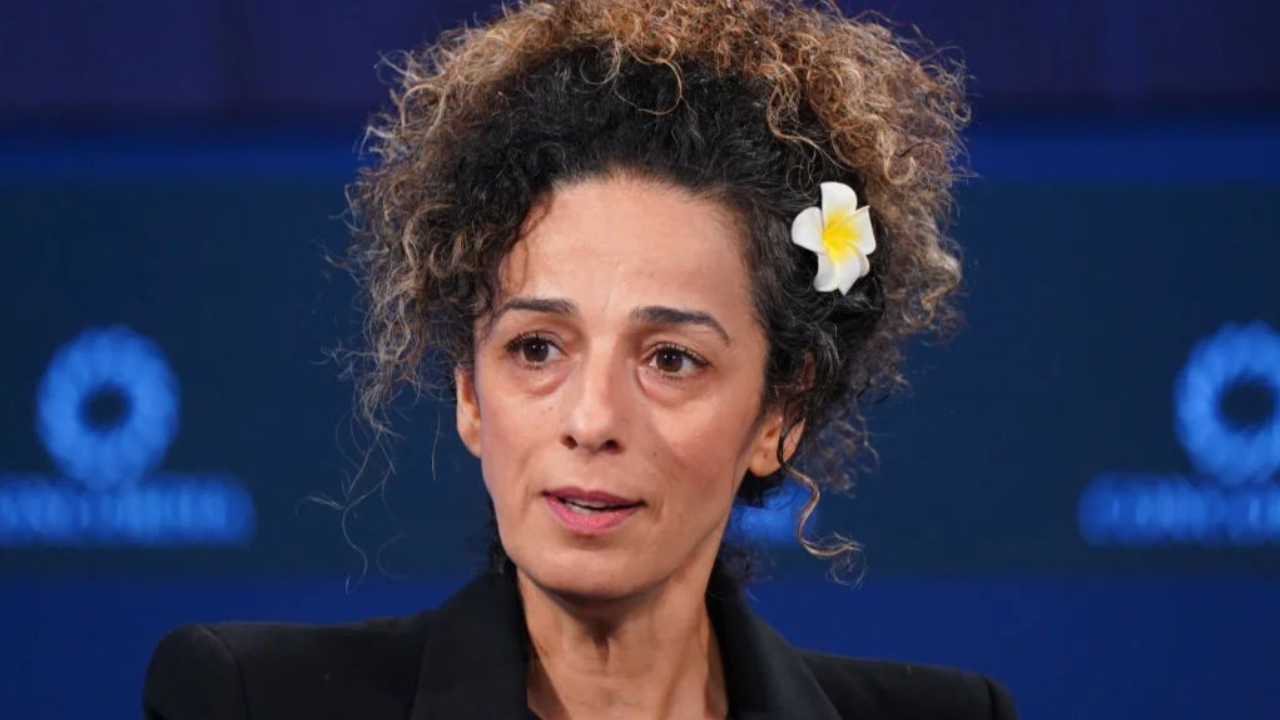
The wind in Brooklyn carries a different scent than the wind in Ghomati. In the tiny Caspian village where Masih Alinejad was born, the air was thick with the smell of citrus, damp earth, and the suffocating weight of a black cloth that had to cover her hair before she was old enough to understand why. Today, the Brooklyn breeze hits her face—uncovered, wild, and defiant. It is a simple physical sensation that millions of women in Iran are still beaten, jailed, or killed for craving.
For decades, Masih has been a ghost in the machinery of the Islamic Republic. She is the voice that refuses to be dampened by the distance of an ocean. She is the woman who turned a smartphone into a weapon more terrifying to a theocracy than a fleet of drones. And now, as the news of Ebrahim Raisi’s death and the fading pulse of Ali Khamenei’s era ripples through the diaspora, Masih isn't just watching a regime tremble. She is watching the dawn of a fire she helped light.
The Girl Who Stole the Light
Imagine a house where a brother’s freedom is a birthright and a sister’s existence is a series of negotiations. Masih grew up in a family where her brother could run, swim, and breathe the open air, while she was tethered to the "morality" of a scrap of fabric. It wasn't just about the hijab. It was about the theft of the self.
She began as a journalist in Tehran, a spitfire who walked the halls of Parliament and asked the kind of questions that make powerful men reach for their prayer beads in frustration. They kicked her out. They revoked her credentials. They thought that by removing her from the room, they were removing her from the conversation. They were wrong. They merely forced her into a space where they had no jurisdiction: the hearts of the Iranian people.
When she left Iran, she didn't leave her soul behind. She launched "My Stealthy Freedom," a digital rebellion where Iranian women filmed themselves walking through the streets of Tehran, Isfahan, and Shiraz with their hair flowing free.
These weren't just videos. They were acts of war. Every time a woman posted a photo of herself without a veil, she was telling the Supreme Leader that his laws were paper-thin. Masih was the curator of this courage. She became the megaphone for the "Girls of Revolution Street," the teenagers who stood on utility boxes waving their white hijabs like flags of surrender—not for themselves, but for the regime.
The Price of a Voice
Living as a target changes the way you check your mail. It changes the way you look at a car idling at the curb. For Masih, the stakes shifted from professional harassment to existential threat.
The Islamic Republic does not ignore its enemies; it tries to erase them. In 2021, the FBI uncovered a plot by Iranian intelligence to kidnap Masih from her Brooklyn home. The plan was cinematic in its cruelty: snatch her, whisk her away to a high-speed boat headed for Venezuela, and then fly her back to Iran for a televised "confession" and an inevitable execution.
She survived that.
Then came the man with the loaded AK-47 outside her front door.
Most people would vanish. They would change their name, move to a farm in the Midwest, and let the silence take them. Masih did the opposite. She showed the world the FBI photos of the gunman. She stood on her porch and filmed the street. She chose to be louder. Why? Because the women inside Evin Prison—women like Narges Mohammadi—don't have the luxury of a safe house or an FBI detail.
The Fall of the Butcher
When the helicopter carrying President Ebrahim Raisi—the man known as the "Butcher of Tehran" for his role in the 1988 mass executions—slammed into a foggy mountainside, the world held its breath. In the official corridors of Tehran, there were staged tears and somber processions.
But in the DMs of Masih Alinejad, there was a different energy.
She received videos of Iranians handing out sweets in the dark. She saw the clandestine fireworks. To understand why Masih celebrates, you have to understand who Raisi was. He wasn't just a politician; he was the enforcer of the shadow. His death, followed by the escalating rumors of Supreme Leader Khamenei’s failing health, represents more than a vacuum of power. It represents the collapse of the myth of invincibility.
The regime is an old, brittle tree. It looks imposing, but the core has been eaten away by decades of corruption and the relentless bravery of a generation that has nothing left to lose. Masih knows that the death of a dictator doesn't automatically mean the birth of a democracy, but it provides the crack in the wall.
The Invisible Stakes
We often talk about Iranian politics in terms of nuclear enrichment levels or regional hegemony. These are the "cold facts" that fill white papers. But Masih forces us to look at the "warm facts"—the blood on a sidewalk after a protest, the sound of a mother wailing for a son hanged for the crime of "moharebeh" (enmity against God), and the simple, revolutionary act of a girl dancing in a public square.
The stakes are not just about who sits in the president's chair in Tehran. They are about whether a woman owns her own body.
The regime’s obsession with the hijab was never about religion; it was about the DNA of control. If you can control what a woman wears, you can control what she thinks. If you can control her hair, you can control the street. Masih flipped the script. She showed that if you lose the women, you lose the country.
A Journey Without a Map
Critics often ask: "What comes next? If the regime falls, won't there be chaos?"
Masih’s response is a reflection of the reality on the ground. The chaos is already there. It is the chaos of a collapsed currency, a dying environment, and a youth population that feels like it is living in a graveyard. The transition is terrifying, yes. The unknown is a jagged place. But for Masih, the "known" is a slow death.
She is often criticized for her proximity to Western leaders, for her unapologetic call for "maximum pressure" on the regime. Some call her a warmonger; others call her a hero. But when you speak to her, or listen to the tremor of conviction in her voice, you realize she isn't interested in the nuances of Washington diplomacy. She is interested in the end of the rope.
She remembers the girls she grew up with. She remembers the faces of the mothers whose children were shot in the eyes with birdshot during the 2022 "Woman, Life, Freedom" protests. To Masih, any compromise with the regime is a betrayal of the dead.
The Final Chord
There is a video of Masih dancing. It is grainy, shot in a small room, but her movements are frantic and joyful. She is dancing for the women in Iran who are arrested for doing the same.
The story of Masih Alinejad is not a biography of a survivor. It is a roadmap of a revolution that has already happened in the mind. The regime may still have the guns, the gallows, and the Revolutionary Guard. They may still have the power to shut down the internet and black out the stars over Tehran.
But they no longer have the fear.
Masih didn't take it from them alone, but she showed everyone where the exit was. As the shadows lengthen over the era of Khamenei, and the pillars of the 1979 revolution begin to crumble under the weight of their own cruelty, one woman sits in a secure location in America, her hair a wild, silver-streaked halo, waiting for the phone call that tells her she can finally go home.
She isn't just celebrating the death of a tyrant. She is preparing for the birth of a nation that has been waiting forty-five years to exhale.
The wind is shifting. And this time, it’s blowing toward the East.
Would you like me to analyze how this narrative structure specifically targets the emotional triggers of an international audience compared to a standard news report?


