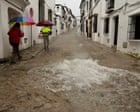
The sky didn't just leak over the Spanish coast and the Balearic Islands last autumn. It collapsed. In parts of Valencia, a year’s worth of rain fell in eight hours. That isn't a "storm" in the traditional sense. It’s a hydraulic bomb. We’ve seen these scenes before—cars stacked like cordwood in narrow streets and mud-caked residents scouring ruins for their belongings—but the frequency and the sheer violence of these events in the Western Mediterranean have shifted into a terrifying new gear.
If you think this is just a run-of-the-mill weather cycle, you’re missing the point. The Mediterranean Sea is currently acting like a giant, overheated battery. It’s charging up storms with an intensity that our current infrastructure simply wasn't built to handle. We’re watching a collision between 21st-century climate realities and mid-20th-century urban planning. It’s a mess. And honestly, it’s getting harder to call these events "natural disasters" when we’ve spent decades building homes in the exact spots where water has flowed for millennia.
The Monster in the Room is the Warm Water
The science behind this isn't particularly complicated, even if the results are catastrophic. Meteorologists point to a phenomenon called the DANA (Depresión Aislada en Niveles Altos). In plain English, that’s a high-altitude isolated depression. When a pocket of cold air breaks off from the jet stream and hovers over the warm Mediterranean, it acts like a vacuum. It sucks up massive amounts of moisture.
Because the Mediterranean has seen record-breaking surface temperatures—often 2 to 3 degrees Celsius above historical averages—that moisture is supercharged. Warm air holds more water. Period. When that air hits the mountains along the Spanish or Italian coasts, it has nowhere to go but down. Fast.
The tragedy in Valencia and the surrounding regions wasn't just about the volume of water. It was the speed. Flash floods don't give you time to debate. They don't give you time to move your car or check on the neighbors. By the time the alerts hit many people’s phones, the ground floor was already gone.
Why Our Infrastructure is Failing the Stress Test
We’ve paved over the world. That’s the blunt truth. In cities like Malaga, Alicante, and Palma, the "concrete jungle" isn't just a metaphor; it’s a drainage nightmare. When rain hits natural soil, it sinks in. When it hits asphalt, it accelerates.
Many of the tragedies we’re seeing are a direct result of historical "ramblas"—dry riverbeds—being treated as prime real estate. These channels might stay dry for thirty years. People forget they’re there. They build apartment blocks, parking lots, and shopping centers. Then, one Tuesday afternoon, the Rambla remembers it’s a river.
- The Bottleneck Effect: Old bridge designs and narrow culverts often catch debris. This creates a temporary dam. When that dam breaks, a wall of water and timber hits the town downstream with the force of a freight train.
- Soil Saturation: Even in rural areas, the intense heatwaves preceding these storms bake the earth into a hard, ceramic-like crust. The water can't penetrate. It just slides off the surface.
- Failed Warning Windows: We have the technology to track these storms, but the "last mile" of communication is broken. People don't take "Red Alerts" seriously until they see the water, and by then, it’s usually too late to escape.
The Human Cost of Triage Politics
There's a lot of finger-pointing after a town gets buried in silt. Local governments blame national agencies. National agencies blame the unpredictability of the climate. But let’s be real. It’s often about money and optics. It’s much cheaper to rebuild a bridge every ten years than it is to fundamentally redesign a city’s drainage system or—God forbid—demolish illegally built homes in flood zones.
In the Western Mediterranean, tourism is king. That means building as close to the water as possible. It means expanding airports and highways. It rarely means investing in massive underground storm-water tanks or "sponge city" technology that China and some Northern European cities are starting to adopt. We are prioritizing the summer view over the autumn survival.
The statistics from the recent floods in Spain and the surges in Southern France are staggering. Hundreds of lives lost. Billions in property damage. But the number that should scare you is the "return period." Events that were supposed to happen once every 100 years are now happening every decade. The math has changed, and our budgets haven't caught up.
Moving Past the Thoughts and Prayers Phase
If you live in a coastal Mediterranean region, or any area prone to these atmospheric rivers, you need to stop waiting for the government to fix the "climate." That’s a long-term project. You need short-term survival.
First, check the flood maps. Not the ones from twenty years ago, but the updated topographic surveys. If you’re in a high-risk zone, you need a plan that doesn't involve your car. Cars are death traps in flash floods. They float. They trap you. Most deaths in the recent Mediterranean storms occurred because people tried to save their vehicles or were caught in them while trying to flee.
Second, demand "Sponge City" initiatives from your local council. This isn't hippie talk. It’s engineering. It involves using permeable pavers, creating urban wetlands that can soak up overflow, and mandating green roofs. We need to turn our cities into giant towels instead of giant slides.
Stop buying property in dry riverbeds. It sounds obvious, but the real estate market says otherwise. If a piece of land is suspiciously cheap and near a "seasonal creek," there's a reason. Nature always collects its debts.
The Western Mediterranean is beautiful, but it’s becoming a frontline in a very wet, very dangerous war. We can’t stop the DANA from forming over the sea, but we can stop building targets in its path. Fix the drainage, move the people, and start respecting the power of a warming sea. Anything else is just waiting for the next tragedy to be televised.
Verify your local emergency broadcast settings right now. Ensure your phone bypasses "Do Not Disturb" for government alerts. If the sky turns that specific shade of bruised purple again, don't wait for the water to reach your doorstep. Move to higher ground immediately.