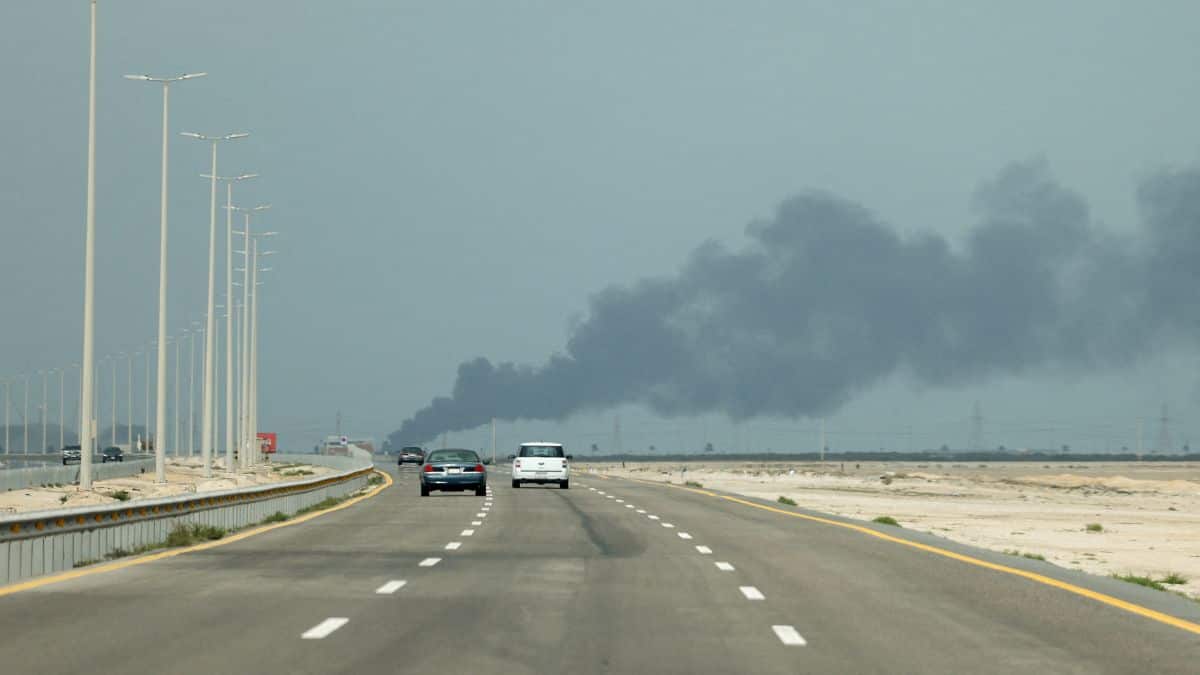
The headlines are screaming about a "Day 4" as if we are watching a sequel to 20th-century desert warfare. They want you focused on the smoke over the US embassy in Riyadh and the logistics of stranded Indian workers in the UAE. It is classic media theater—hyper-focused on the visual debris of a conflict while completely ignoring the structural shift in how power is actually being liquidated in the Middle East.
If you are tracking troop movements on a map, you have already lost the plot. The "Iran war" isn't a territorial dispute; it is the first true stress test of the post-kinetic world. Learn more on a connected topic: this related article.
The Riyadh Embassy Myth
The consensus says an attack on a diplomatic mission is a precursor to total regional collapse. Wrong. In the modern theater, an embassy breach is often a high-fidelity PR stunt designed to trigger a specific, predictable response from Western algorithms.
I’ve spent fifteen years watching intelligence feeds during regional escalations. When a compound is breached in the digital age, the goal isn't to hold the territory. It is to generate the "optics of vulnerability." The attackers don't want the building; they want the 4K footage of the building. Why? Because that footage does more damage to global oil futures and shipping insurance premiums than a thousand traditional sorties ever could. Further reporting by USA Today delves into comparable views on the subject.
The Riyadh incident is a "signal flare" intended to decouple the Saudi-US security pact by proving that traditional air defense systems—the billions spent on Patriot batteries—are effectively useless against swarm-based, low-cost asymmetric threats. If you think this is about "hatred of diplomacy," you are missing the math. It is about proving the ROI of a $500 drone against a $2 million interceptor.
The UAE Transit Trap
Mainstream outlets are weeping over stranded Indian nationals in Dubai and Abu Dhabi. They frame it as a humanitarian hiccup. It’s actually a systemic failure of the "Global Hub" model.
For a decade, the UAE marketed itself as the world’s invincible transit lounge. The moment a hot conflict touches the Persian Gulf, that model evaporates. The "stranded" aren't just victims of canceled flights; they are the human evidence that the geography of the Middle East is a liability, not an asset.
We are seeing the death of the "Neutral Zone." In a Day 4 scenario involving Iran, there is no such thing as a safe bystander state. The UAE's attempt to balance Iranian trade with Western defense ties is hitting a wall of reality. The "Indians returning home" story is the canary in the coal mine for the entire expatriate-driven economy of the Gulf. If the labor leaves, the cities stop functioning within 72 hours. This isn't a travel delay. It’s an evacuation of the engine room.
The Misconception of "Surgical" Strikes
"Surgical" is a word used by generals who want to keep their funding. In the current friction with Tehran, there is no such thing as a clean hit.
- Cyber-Physical Cascades: An attack on an Iranian command center likely triggers a retaliatory shutdown of a desalination plant in a neighboring country.
- The Strait of Hormuz Fallacy: Everyone talks about "closing" the Strait. You don't need to close it. You just need to make the insurance unpayable.
- Asymmetric Scaling: Iran doesn't play by the West's escalatory ladder. They play by a horizontal spread.
Imagine a scenario where no missiles are fired for 24 hours, yet the regional economy loses $50 billion because a specific subsea cable is "mysteriously" severed. That is the war we are in. The "Day 4" the news talks about is the one involving tanks. The real war is on Day 1,400 of a shadow campaign that just went loud.
Why the "Oil Crisis" is a 1970s Fever Dream
The "lazy consensus" screams that a war with Iran means $200-a-barrel oil and global starvation. This ignores the massive shift in energy density and Western domestic production.
Yes, a spike happens. But the real "black swan" isn't the price of crude; it's the total loss of trust in the USD-denominated energy trade. If Riyadh can't protect an embassy, how can it guarantee the safety of the world's primary energy clearinghouse?
We are moving toward a fractured energy market where "security" is a localized commodity. If you are waiting for the "peace talks" to bring prices back down, you are holding a bag that has no bottom. The "status quo" of the global energy flow was a subsidized illusion provided by the US Navy. That subsidy just got canceled.
The Logistics of the "Return"
Watch the way the Indian government is handling the evacuation. This isn't the 1990 airlift from Kuwait. This is a data-driven extraction. It reveals a brutal truth: the era of the "unskilled expat" in the Gulf is ending.
Governments are prioritizing the return of high-value assets and essential personnel while the "labor" is left to navigate the chaos of canceled commercial lines. This is the "nuance" the competitor missed: the war is acting as a massive, violent filter for who belongs in the "New Middle East" and who was just there for the cheap credit.
Stop Asking if War is "Coming"
The question "Will this turn into a full-scale war?" is fundamentally flawed. It implies a binary state—Peace or War.
We are in a state of Persistent Friction.
There will be no surrender ceremony. There will be no "Mission Accomplished" banner. There will only be varying degrees of kinetic intensity. The attack in Riyadh was a volume knob being turned up, not a new song starting.
If you want to survive this shift—financially or intellectually—stop looking at the casualty counts. Start looking at the Bitrate.
- How fast is information being weaponized?
- How quickly are supply chains rerouting around the "Red Zones"?
- Who is actually controlling the undersea infrastructure?
The media wants you to feel fear because fear is easy to sell. I want you to feel the cold reality of a structural realignment. The Middle East isn't "breaking." It is being reformatted.
The Riyadh embassy is just a burning building. The real fire is in the systems that allowed us to believe it was ever safe in the first place.
Move your capital. Secure your data. Stop believing the map.