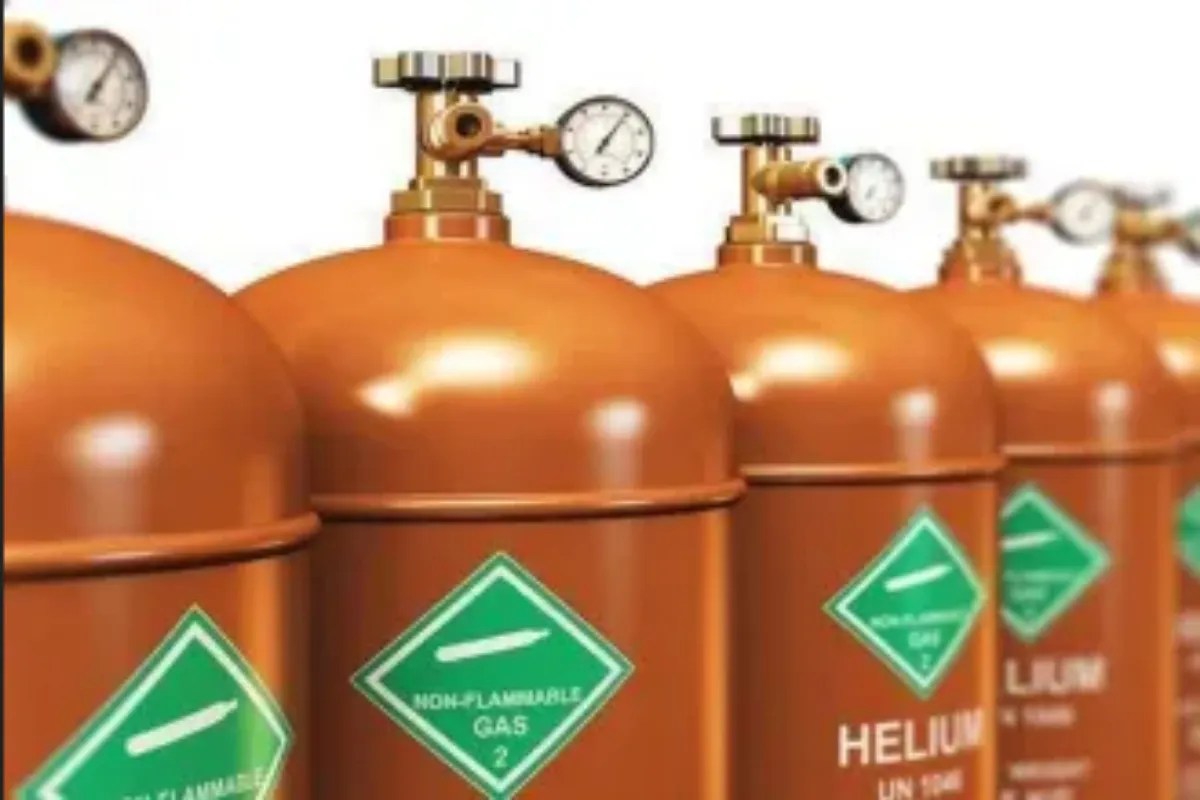
The balloon drifts upward, a speck of silver against a birthday sky, escaping a child’s sticky grip. We watch it go with a smile, a fleeting moment of minor heartbreak. We don't realize we are watching a piece of the Big Bang leak into the vacuum of space, never to return. Helium is the only element on Earth that is completely unrecoverable once it hits the air. It is light enough to defy gravity, slipping through the atmosphere and bleeding into the cosmic dark.
We are running out of the very thing that allows us to see inside the human body, power our digital lives, and touch the edges of quantum reality.
The crisis isn't a sudden explosion. It is a slow, cold hiss.
The Cold Heart of the Machine
Deep in the basement of a metropolitan hospital, Sarah sits in a plastic chair, her hands trembling. The air is sterile, smelling of ozone and floor wax. Ten feet away, a massive white donut—an MRI scanner—looms like a silent god. To Sarah, it is the machine that will tell her if the shadows on her lung are a glitch or a death sentence. To the engineers who maintain it, the machine is a high-pressure thermos filled with a liquid that shouldn't exist on a room-temperature planet.
Liquid helium.
It sits at $4$ Kelvin. That is $-269$°C, or nearly absolute zero. At this impossible temperature, niobium-titanium wires lose all electrical resistance. They become superconductors. A massive electrical current flows through them forever, creating a magnetic field so powerful it can pull the protons in Sarah’s body into alignment.
But there is a catch. The moment the helium boils away, the superconductivity vanishes. The magnet "quenches." The field collapses in a violent burst of heat, and the million-dollar machine becomes a very expensive, very heavy paperweight.
The shortage isn't about party balloons. It is about the fact that every MRI on the planet requires roughly $2,000$ liters of this disappearing liquid to stay alive. When the supply chain stutters—as it is doing now—hospitals face a terrifying choice. Do they pay five times the price to keep the magnets cold, or do they shut down the diagnostic eyes of modern medicine?
A Gift from the Deep Earth
Helium is a paradox. It is the second most abundant element in the universe, yet it is incredibly rare on our rocky home. We don't "make" it. We can't synthesize it in a lab. Every atom of helium on Earth is the result of billions of years of slow radioactive decay from uranium and thorium deep within the crust. It gets trapped in natural gas deposits, huddled in tiny pockets like a secret hoard of ancient gold.
For decades, we treated it as a nuisance. In the early $20$th century, gas drillers would simply vent it into the atmosphere to get to the "real" prize of combustible fuel. Then we realized its power. The United States government began stockpiling it in a massive underground salt dome in Amarillo, Texas—the Federal Helium Reserve.
For a while, the world felt flush. Helium was cheap. It was used for arc welding, for leak detection in spaceships, and for the colorful distractions at grocery store checkouts. But in $1996$, a policy shift decided the government shouldn't be in the gas business. They started selling off the reserve at fire-sale prices to pay off the debt of building the facility.
We flooded the market with a finite, non-renewable miracle. We behaved as if the well would never run dry.
The Invisible Engine of Your Pocket
Consider the smartphone in your hand. It feels solid, but it is a miracle of precision. The microchips inside are etched with patterns so small they are measured in nanometers.
To create these chips, you need a perfectly stable environment. Helium is chemically inert; it refuses to react with anything. It is the ultimate cooling agent and the ultimate shield. In the massive semiconductor "fabs" of Taiwan and South Korea, helium is used to cool the silicon wafers with surgical precision. If the temperature fluctuates by even a fraction of a degree, the chip is ruined.
The global chip shortage that has haunted the car industry and the tech sector for the last few years has a hidden culprit. It isn't just a lack of factory space. It is the rising cost and falling availability of the gas that keeps the assembly lines from melting.
When you see the price of a laptop climb or wait six months for a new hybrid vehicle, you are feeling the ripples of a gas well in Qatar or a pipeline in Russia failing to deliver. We have built a high-tech civilization on the back of a ghost.
The Human Cost of a Gas Leak
The supply chain is a fragile web. Currently, just a handful of places on Earth produce the vast majority of our helium: the United States, Qatar, Algeria, and Russia.
When a major plant in Amur, Russia, suffered an explosion, the shockwaves hit oncology wards in Mumbai and research labs in London. When diplomatic tensions flare in the Middle East, the price of a liter of liquid helium triples overnight.
For a university researcher, this is catastrophic. Imagine a physicist who has spent ten years studying the "God Particle" or the behavior of subatomic matter. Their entire life's work depends on a cryostat—a cooling chamber—remaining at $1.8$ Kelvin. If the university can no longer afford the helium, the experiment warms up. The data is lost. The career stalls.
We are effectively putting a tax on human discovery.
The Myth of the Alternative
People often ask why we don't just use something else. Nitrogen is cheap and makes up $78$% of our air. Why not use that?
The answer is physics. Liquid nitrogen boils at $77$ Kelvin. That is "warm" compared to the temperatures needed for superconductivity. Using nitrogen to cool an MRI is like trying to keep an ice cube frozen by putting it in a refrigerator set to $10$°C. It doesn't work.
Hydrogen is another candidate, but hydrogen has a nasty habit of exploding. Helium is the "Goldilocks" element. It is safe, it is cold, and it is disappearing.
The Silent Evolution
Change is coming, but it is racing against the clock. Engineers are now designing "helium-free" or "low-helium" MRI machines. These new models use sealed cooling systems that cycle a tiny amount of helium—about seven liters—indefinitely, rather than letting it boil off.
But these machines are expensive. They are new. They aren't in the rural clinics or the struggling public hospitals that need them most.
In the world of industry, recycling centers are being built to capture the gas used in welding and chip manufacturing. We are finally learning to be frugal, but it is the frugality of a spendthrift who realizes their bank account has hit double digits.
The era of cheap, disposable helium is over. The balloon at the party is no longer a simple toy; it is a symbol of a resource we are quite literally throwing away.
The Last Breath
Think back to Sarah in the hospital basement. She doesn't care about geopolitics in Siberia or natural gas reserves in Texas. She cares about the hum of the machine. She cares about the images that will appear on the doctor's screen—images made possible by a gas that traveled from the center of the Earth to the edge of space just to help us see.
We are a species that has learned to harness the coldest temperatures in the universe to save our own lives. It is a staggering achievement. But our brilliance is currently matched by our wastefulness. Every time we vent helium into the air, we are thinning the veil between us and a pre-diagnostic age.
The next time you see a silver balloon drifting toward the clouds, don't just see a lost toy. See a piece of our future vanishing into the stars. We are breathing out the very thing that keeps our modern world alive, and once it's gone, the silence will be absolute.