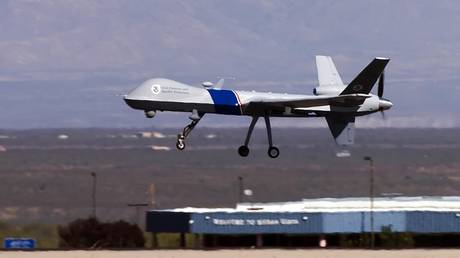
The U.S. military just used a high-energy laser to blast a Customs and Border Protection (CBP) drone out of the sky over Texas. This isn't a scene from a low-budget sci-fi flick. It's a massive, multi-agency screw-up that happened near Fort Hancock, about 50 miles southeast of El Paso. If you think the government has a handle on the thousands of drones buzzing around our borders, this "friendly fire" incident proves otherwise.
Lawmakers are rightfully fuming. Rep. Rick Larsen and other top Democrats on the House Transportation and Infrastructure Committee didn't hold back, saying their "heads are exploding" over the news. This wasn't just a technical glitch. It's a symptom of a much larger breakdown in how our federal agencies talk—or don't talk—to each other while deploying lethal technology in American skies. Recently making headlines recently: The Kinetic Deficit Dynamics of Pakistan Afghanistan Cross Border Conflict.
The Fort Hancock Laser Strike
On Thursday, February 26, 2026, the Pentagon (or the "Department of War," as the current administration prefers) detected what they thought was a "threatening" unmanned aerial system. They didn't wait to check the registration. They fired a laser and neutralized the target.
The problem? The target was one of our own. CBP was flying the drone in what the military claimed was "military airspace," but nobody bothered to tell the other guys. The result was a pile of charred government property and a fresh round of questions about who's actually in charge of the border's "Safer Skies." More insights into this topic are detailed by TIME.
Why this is a pattern and not a fluke
This isn't even the first time this month that lasers and drones have caused chaos in Texas. Two weeks ago, the FAA had to abruptly shut down El Paso International Airport after another laser incident. In that case, CBP used a laser near Fort Bliss without coordinating with the FAA.
At first, officials blamed "Mexican cartel drones." Later, reports surfaced that the high-tech weapon might have actually been targeting a stray Mylar party balloon. When the military and the Department of Homeland Security (DHS) start playing with direct-energy weapons without a shared playbook, the civilian aviation system pays the price in grounded flights and wasted taxpayer dollars.
High Tech Weapons and Low Tech Communication
The technology being used here is impressive and terrifying. We're talking about systems like the LOCUST, a 20-kilowatt direct-energy weapon capable of melting drone frames in seconds. It’s built to handle the 27,000+ drones detected along the southern border in the last half of 2024 alone.
But a laser is only as smart as the person (or agency) pulling the trigger.
- The Pentagon says it acted because the drone was in military airspace.
- CBP says it was conducting routine surveillance.
- The FAA is left scrambling to close airspace after the fact to "ensure safety."
The "Safer Skies Act" passed recently was supposed to fix this by giving more agencies the power to down rogue drones. Instead, it seems to have created a "Wild West" atmosphere where everyone has a gun but nobody has a radio.
The Incompetence Argument
Lawmakers are pointing the finger directly at the White House. They claim the administration sidestepped a bipartisan bill that would have mandated specific training and coordination between the Pentagon, DHS, and the FAA. By "sidestepping" these rules, the government has created a scenario where our own defense systems can't distinguish between a cartel threat and a federal patrol.
Honestly, it’s a miracle a commercial airliner hasn't been caught in the crossfire yet. These lasers aren't just dangerous to drones; they can blind pilots or damage the sensors of passing planes if not used with surgical precision and total situational awareness.
What Happens When the Smoke Clears
Senator Tammy Duckworth is already calling for a joint investigation by the Inspectors General of the Departments of Defense, Transportation, and Homeland Security. She’s calling it "chaos in our skies," and she isn't wrong.
If you live in the El Paso area or fly through it, you should expect more "Temporary Flight Restrictions" (TFRs). The FAA has already extended the restricted radius around Fort Hancock until June 2026. This isn't a temporary fix; it's a quarantine of the airspace because the agencies can't be trusted to play nice.
Immediate Next Steps for Border Aviation
- Establish a Unified Command: There needs to be a single, real-time dashboard where every authorized drone flight (CBP, FBI, local police) is visible to military counter-drone units.
- Mandatory IFF Transponders: Every government drone must carry "Identification Friend or Foe" tech that the military's laser systems can recognize automatically before firing.
- Public Transparency: The FAA needs to stop using vague "special security reasons" as a catch-all for when the military messes up.
Stop thinking of this as a "drone problem." It’s a management problem. Until the Pentagon and DHS can agree on who owns the air, we’re going to keep seeing millions of dollars in hardware turned into expensive scrap metal by our own hands. If you're a drone hobbyist or a commercial pilot in the Southwest, keep your eyes on the NOTAMs (Notice to Airmen) and maybe stay clear of Fort Hancock for a while.