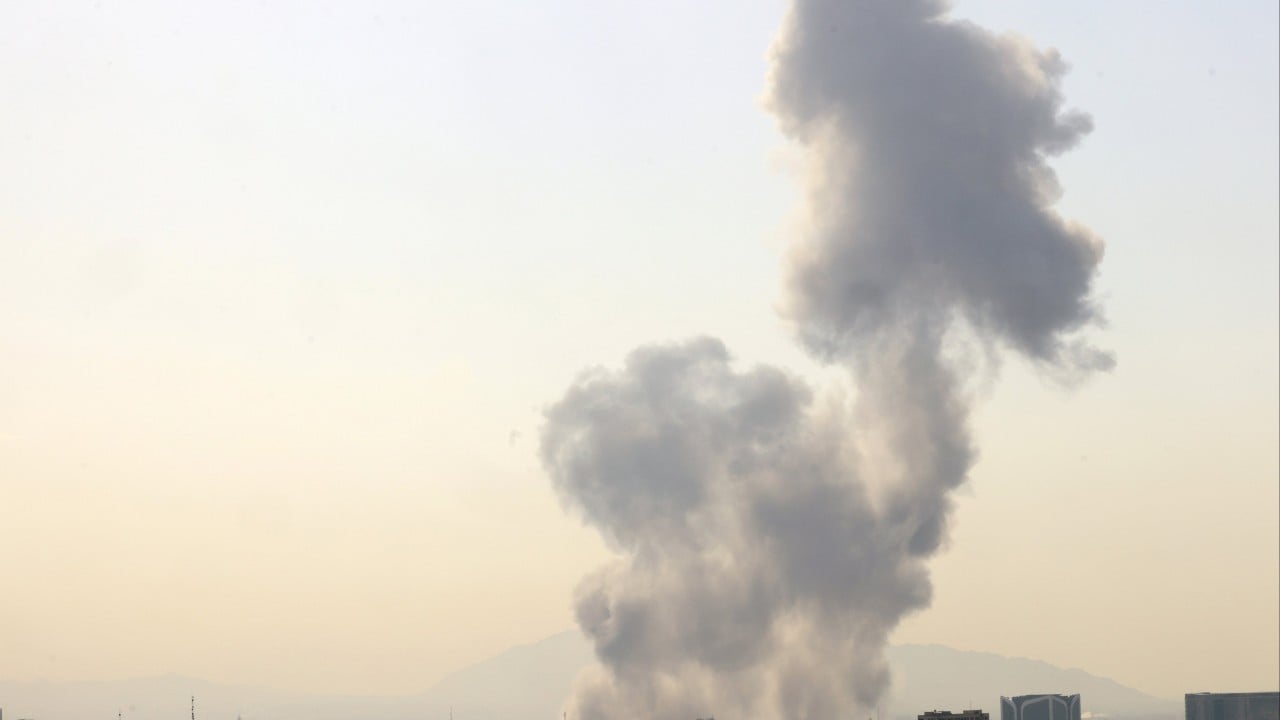
The tension that's been simmering for decades finally boiled over on February 28, 2026. If you woke up to headlines about explosions in Tehran, you’re looking at the start of a massive military campaign. It’s not just another "limited strike" or a "message" to the Ayatollahs. This is a full-scale effort by the United States and Israel to dismantle the Iranian regime’s core power.
You’ve probably seen the names: Operation Epic Fury from the Americans and Operation Roaring Lion from the Israelis. While previous clashes in 2024 and 2025 focused on "mowing the grass"—hitting specific missile factories or air defenses—this one is different. It’s aimed at the top. For a more detailed analysis into similar topics, we suggest: this related article.
The day the strategy changed
Everything kicked off around 9:45 a.m. Tehran time. That’s a Saturday, a normal workday in Iran, which tells you the attackers weren't looking to minimize the psychological impact. This wasn't a middle-of-the-night operation designed to avoid notice.
Reports confirm that the Pasteur district in Tehran, home to the Supreme Leader’s compound and the presidential palace, was one of the first targets. Israel used roughly 30 "bunker buster" bombs to level the site. While Iranian state media initially claimed the leadership was safe, they’ve since admitted that Supreme Leader Ali Khamenei was killed in the strike. To get more details on this topic, in-depth coverage can be read on NPR.
This isn't just about blowing things up. It’s a decapitation strike. By removing the head of the "Axis of Resistance," the US and Israel are betting that the entire system will fracture. President Trump was blunt about it, saying the goal is to "eliminate threats" and ensure Tehran "can never have a nuclear weapon."
How the attack actually went down
The scale of this thing is hard to wrap your head around. The Israeli Air Force (IAF) launched what they're calling the largest combat sortie in their history. We're talking about 200 fighter jets, including F-35 stealth fighters, hitting 500 targets across central and western Iran in the first wave alone.
- Cyber Warfare: Before the first missile hit, Iran’s mobile networks were flooded. Citizens received messages calling on them to rise up against the government. This was a coordinated attempt to spark internal chaos while the bombs were falling.
- Naval Annihilation: The US hasn't just stayed in the air. The Navy targeted the IRGC's naval assets, including the frigate Jamaran. The goal is to "annihilate" Iran’s ability to disrupt shipping in the Strait of Hormuz.
- Nuclear Facilities: Unlike the 12-day war in June 2025, which hit sites like Fordow and Natanz, this campaign is looking to finish the job. B-2 stealth bombers were deployed to hit fortified underground facilities that regular missiles can't touch.
Why now and why together
You might wonder why the US is getting its hands dirty now when it mostly stood back during Israel's "Days of Repentance" strikes in October 2024. Honestly, it comes down to a total collapse of diplomacy.
Throughout 2025, talks to revive the nuclear deal fell apart. Iran pushed its uranium enrichment to 60% and kicked out international inspectors. At the same time, the regime was brutally suppressing protests at home. Washington and Jerusalem reached the same conclusion: Iran was weeks away from a bomb, and the regime was too unstable to be trusted with one.
The 12-day war in June 2025 was a dress rehearsal. It proved that Iran’s air defenses—specifically the Russian-made S-300 systems—couldn't stop a modern Western assault. Once those were degraded, the door was wide open for the February 2026 campaign.
The immediate fallout and risks
Iran didn't just sit there and take it. Within four hours of the initial strikes, they launched ballistic missile salvos at Israel and US bases in the region.
It’s a mess.
Countries like Kuwait, Qatar, the UAE, and Bahrain—all of which host US forces—have been caught in the crossfire. Iran’s message is clear: if the US uses these bases to attack, the host countries will pay the price.
- Israel’s Shield: While the Iron Dome and Arrow systems are world-class, they aren't perfect. In the June 2025 conflict, dozens of missiles got through, hitting the Haifa refinery and killing over 30 people. This time, the volume of fire is even higher.
- Internal Iranian Chaos: With the Supreme Leader dead, there’s a massive power vacuum. You're likely to see a split between the regular military (Artesh) and the ideological IRGC. One wants to protect the country; the other wants to protect the revolution at any cost.
What you should keep an eye on
Don't expect this to be over in a weekend. The US has moved two carrier strike groups—the Abraham Lincoln and the Gerald R. Ford—into the area. This is a sustained campaign.
If you’re watching the markets, keep an eye on oil. Even if the US "annihilates" the Iranian navy, the risk to the Strait of Hormuz is enough to send prices through the roof.
The real question is whether the Iranian people will actually "finish the job" as Trump suggested. They’ve been through waves of protests since 2022, and they’re tired. Whether they have the energy to rise up while their cities are being bombed is the biggest wildcard in this whole scenario.
Stay informed by following official government travel advisories if you're anywhere in the Middle East, and expect significant volatility in global energy markets over the coming weeks.