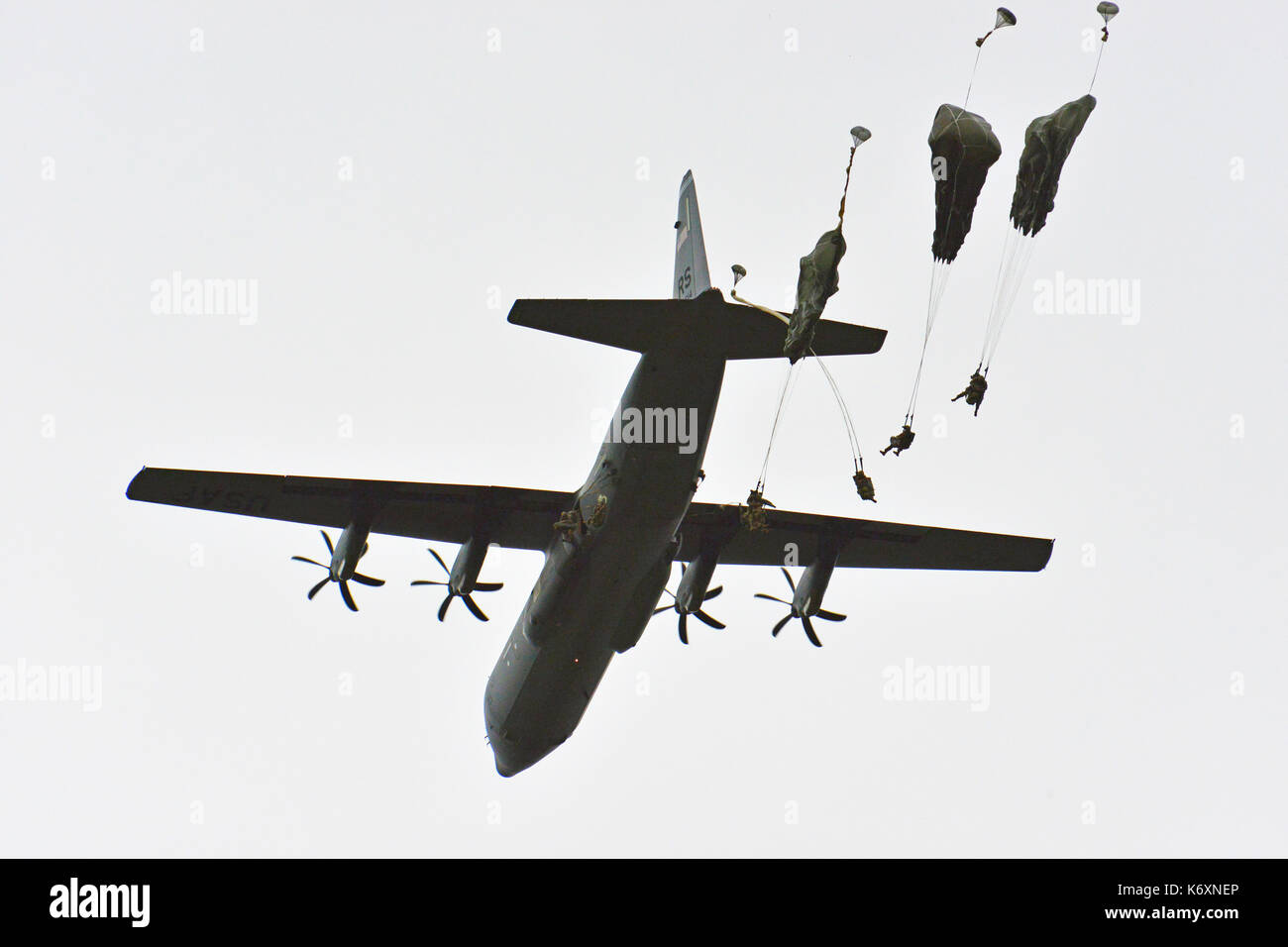
Thousands of soldiers from the 82nd Airborne Division are currently moving into the Middle East. It’s a massive logistical undertaking. This isn't just another routine rotation or a training exercise. When the "All-American" division gets the call to spin up their C-17s, it means the Pentagon sees a situation that could boil over in minutes, not days. If you’re watching the news and wondering why your tax dollars are suddenly flying toward a potential conflict zone, you aren't alone.
The core of this deployment centers on the Immediate Response Force (IRF). These are the paratroopers who live with their rucksacks packed. They're trained to be anywhere in the world within 18 hours. While the headlines focus on the sheer number of boots on the ground, the real story is about deterrence. The US is trying to put a lid on a pressure cooker before the lid blows off.
The mechanics of a rapid deployment
People often think of military moves as slow, bureaucratic grinds. For most of the Army, that’s true. But the 82nd Airborne operates differently. They use a "push" system. Everything from bullets to bottled water is pre-staged. When the order hits, the first wheels leave the tarmac at Fort Liberty, North Carolina, almost immediately.
This specific buildup involves specialized infantry battalions, engineers, and signal units. They aren't just there to stand guard. They bring "forcible entry" capabilities. That’s military-speak for taking an airfield or a port even if the person currently holding it doesn't want to give it up. This presence provides the White House with options. Without these troops, the US has to rely on diplomacy or long-range strikes. With them, there’s a physical wall between stability and chaos.
What the 82nd Airborne actually does on the ground
You might wonder what 2,500 or 3,000 paratroopers actually do once they land in a place like Kuwait or Jordan. They don't just sit in tents. Their primary job is security for "high-value assets." This includes embassies, communication hubs, and airfields. If an evacuation becomes necessary—think Kabul in 2021—these are the people who manage the perimeter.
- Airfield Seizure: Making sure planes can land and take off safely.
- Non-combatant Evacuation Operations (NEO): Getting civilians out of harm's way.
- Deterrence: Showing a potential adversary that a ground force is ready to fight.
It’s a high-stakes game of chicken. By putting elite light infantry in the region, the US tells rivals that any escalation will met with a professional, lethal force. It’s about changing the math for the other side. If an adversary thinks they can move quickly without consequence, they might try it. If they see a brigade of paratroopers in the way, they usually think twice.
Why the timing matters for regional stability
The Middle East is currently a web of overlapping tensions. You have state actors, proxy groups, and various militias all looking for an opening. The arrival of US paratroopers acts as a stabilizer, but it also carries risks. Some argue that more troops just lead to more friction. Others, including many veteran commanders I’ve spoken with, argue that a vacuum is far more dangerous.
Historically, when the US pulls back, smaller players try to fill the gap. That’s when miscalculations happen. A stray rocket or a misunderstood maneuver can trigger a regional war. The 82nd Airborne acts as a "tripwire." It’s a clear signal of intent.
Looking at the logistical nightmare of a buildup
Moving thousands of humans is the easy part. Moving the gear is what keeps colonels awake at night. Each paratrooper carries roughly 100 pounds of gear. Then you have the Humvees, the artillery, the medical supplies, and the millions of rounds of ammunition.
The Air Mobility Command handles the heavy lifting. They fly "iron mountains" of equipment across the Atlantic. It’s an expensive, loud, and incredibly complex dance. If one link in the chain breaks—a fuel tanker delay or a closed airspace—the whole timeline shifts. The fact that the US can do this at all is a flex of its own. Very few nations can project this much power this quickly.
The human cost of the alert cycle
We should talk about the soldiers themselves. These aren't just "assets." They’re people who were likely at a backyard BBQ or a kids' soccer game when their phones buzzed. The 18-hour window applies to their personal lives too. They say goodbye to their families and disappear into a "green ramp" hanger.
The psychological toll of being on the IRF is real. You live in a constant state of "maybe today." When the "maybe" becomes a "definitely," the adrenaline is high, but the long-term fatigue is higher. These paratroopers are often the most highly trained, but they’re also the most frequently deployed.
What happens if the situation escalates
If the buildup doesn't work as a deterrent, these paratroopers are the first line of defense. They aren't heavy armor. They don't have M1 Abrams tanks with them. They're light infantry. They rely on speed, surprise, and close air support. In a real fight, they're designed to hold the line until heavier units can arrive by sea, which takes weeks.
This is the "bridge" phase of a conflict. The 82nd Airborne holds the door open. They're the ones who buy time for the rest of the military and the diplomats to figure out a permanent solution. It’s a dangerous job, and it’s why they’re considered the elite.
Keep an eye on the flight tracking data around Rota, Spain, and Ramstein, Germany. Those are the main pit stops for these flights. If the tempo of planes increases, the buildup isn't over. If things quiet down, it means the Pentagon thinks they have enough "chess pieces" on the board to keep the peace.
If you want to understand the real impact, look past the political posturing. Watch the logistics. Watch the movement of the 18th Airborne Corps. That’s where the real story lives. The next few weeks will determine if this was a successful show of force or the beginning of a much longer, much more difficult chapter in the Middle East. It’s a tense time, and the paratroopers are right in the thick of it. Over and out.