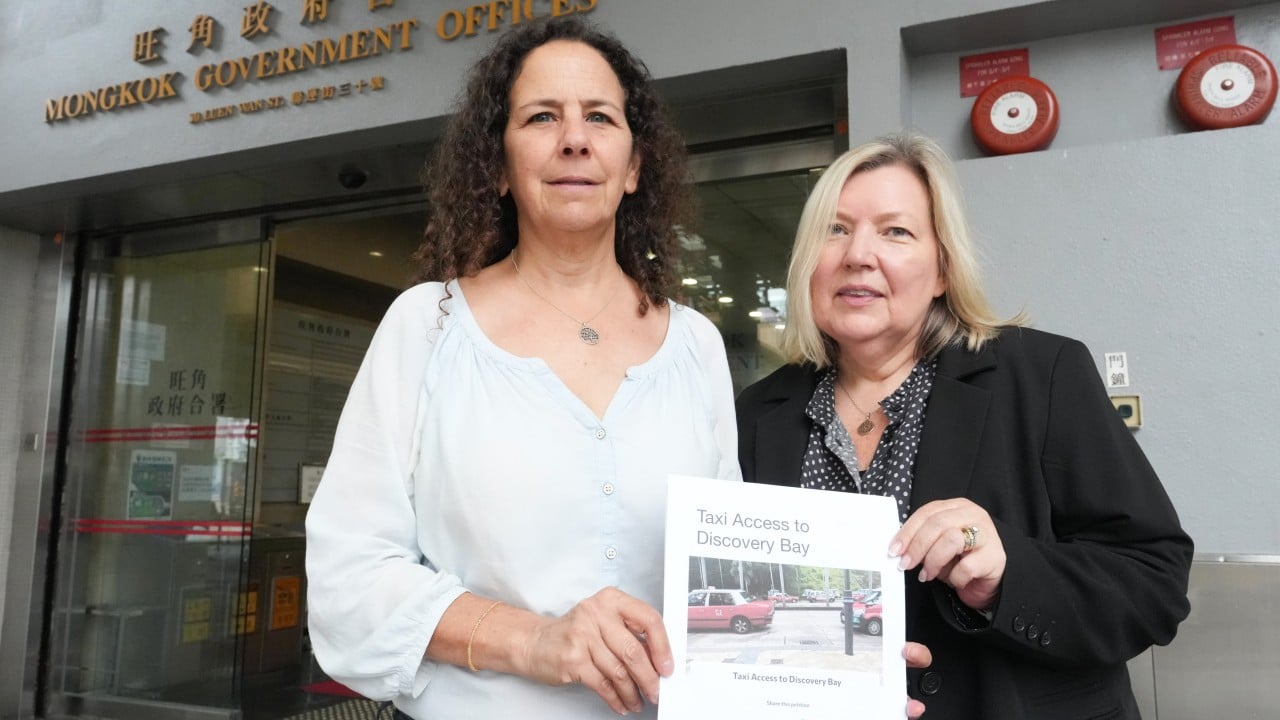
The petition to the Ombudsman regarding taxi access in Discovery Bay (DB) is not a localized grievance about transportation; it is a fundamental conflict between Legacy Statutory Protectionism and Modern Urban Velocity. For decades, Discovery Bay has operated as a closed-loop logistical ecosystem, predicated on the exclusion of external vehicular traffic to maintain a premium on "resort-style" living. The filing of a formal complaint signals that the internal equilibrium of this model has failed, as the opportunity cost of isolation now outweighs the utility of exclusivity.
The Trilemma of Private Township Transit
The tension in Discovery Bay can be mapped through three competing variables that cannot all be maximized simultaneously: Residents must choose between Environmental Quietude, Transit Connectivity, and Operational Autonomy.
- Environmental Quietude: The original value proposition of DB—a "car-free" environment—relies on the total exclusion of the 18,000+ urban and Lantau taxis operating in Hong Kong.
- Transit Connectivity: The efficiency with which a resident can travel from point A (their doorstep) to point B (the airport or Central) without intermediate transfers.
- Operational Autonomy: The ability for the developer, Hong Kong Resort Company Limited (HKRCL), to manage its internal road network without government interference or the entry of third-party commercial actors.
The Ombudsman complaint suggests that the current reliance on internal shuttle buses and a limited fleet of hire cars has reached a breaking point. When the internal supply of transit cannot meet the external demand for mobility, the "private enclave" model transitions from a luxury benefit to a logistical bottleneck.
The Mechanics of the Hire Car Bottleneck
The primary friction point identified by residents involves the "Hire Car" system. Unlike standard taxis, which operate on a regulated, metered, and high-volume basis, Discovery Bay’s internal hire cars function as a restricted utility.
The Supply-Demand Mismatch
The internal hire car fleet is capped. This creates an inelastic supply curve. During peak hours—early morning airport runs or inclement weather—demand shifts rightward, but because the number of vehicles is fixed by permit and developer policy, the "price" is paid in time rather than currency. Wait times frequently exceed 45 minutes, a duration that is unacceptable for a high-net-worth demographic whose hourly value exceeds the marginal cost of a premium transport option.
The Regulatory Arbitrage
By restricting full taxi access to the North Plaza and preventing "door-to-door" service throughout the entire estate, the system forces a reliance on the developer’s own transport subsidiaries. This is a form of vertical integration that internalizes profit but externalizes the inconvenience to the resident. The Ombudsman’s role here is to determine if this restriction constitutes a "maladministration" of public interest, given that the roads, while privately maintained, serve a significant population of taxpayers.
The Cost Function of the Two-Tier Transfer System
The current logistical requirement for residents involves a "Two-Tier Transfer." A resident must take an internal shuttle to the North Plaza or the Pier to interface with external transport (ferries or buses).
The total cost of a journey ($C_{total}$) under the current regime is defined by:
$$C_{total} = (T_{wait1} + T_{transit1}) + T_{transfer} + (T_{wait2} + T_{transit2}) + P_{fares}$$
Where:
- $T_{wait1}$ is the time spent waiting for an internal shuttle.
- $T_{transfer}$ is the physical time spent moving between vehicles (often with luggage or children).
- $P_{fares}$ is the cumulative cost of multiple tickets.
In a full-access taxi model, the variables $(T_{wait1} + T_{transit1}) + T_{transfer}$ are eliminated. For a professional commuting to the International Finance Centre or a frequent flyer, the time-savings represent a significant reclaim of "lost" GDP at the household level. The complaint to the Ombudsman is essentially an attempt to force a re-optimization of this cost function.
Structural Hazards of Opening the Enclave
The resistance to full taxi access is not merely bureaucratic; it is rooted in the preservation of property valuations. A shift in the transportation model introduces several risks that the current infrastructure is ill-equipped to handle.
- Pavement Degradation and Maintenance Cycles: Discovery Bay’s roads were designed for light internal traffic and specific axle loads. Opening the gates to 18,000 taxis would accelerate the degradation of the road surface. Under the current deed of mutual covenant (DMC), residents—not the government—are responsible for these maintenance costs. A 20% increase in heavy vehicle throughput could lead to a 50% increase in annual road repair levies.
- The "Queueing" Externality: Taxis do not just drive; they "rank." Without a purpose-built holding area for hundreds of taxis, vehicles would likely cruise or double-park within narrow residential loops like Headland Drive or Seabee Lane. This creates a noise and safety externality that direct door-to-door access proponents often underestimate.
- Security Perimeter Erosion: The "gatehouse" model provides a psychological sense of security. Full taxi access necessitates a permeable border. For many legacy owners, the removal of the vehicle filter is perceived as the first step toward the "normalization" of the district, potentially eroding the price premium DB holds over Tung Chung.
The Ombudsman’s Path: Precedent and Jurisdiction
The Ombudsman of Hong Kong has limited power to dictate private business strategy but significant power over the Transport Department (TD). The strategic angle of the resident complaint likely targets the TD’s "inaction" or "failure to facilitate" better access.
In previous urban planning disputes, the Ombudsman has focused on whether the government has exercised due diligence in oversight. If the Transport Department has granted the developer a de facto monopoly on transport within the area without ensuring that the service meets a "Reasonable Utility Standard," the Ombudsman can recommend policy shifts.
The most likely outcome is not an immediate opening of the floodgates, but a mandated "Phased Integration."
Strategic Recommendation for Discovery Bay Stakeholders
The resolution of this conflict requires moving beyond the binary "Taxis vs. No Taxis" argument and toward a Managed Access Framework.
Implementation of a Digital Permitting System
The developer should replace the manual gate check with an Automated Number Plate Recognition (ANPR) system linked to a resident-driven "Invite" app. Taxis would only be permitted entry if they have a confirmed booking ID from a resident. This prevents "roaming" and "ranking" while providing the door-to-door utility requested.
Variable Access Levies
To offset the increased road maintenance costs, a "Road User Charge" should be applied to every external commercial vehicle entering the enclave. This fee, collected at the gate via Octopus or sensor, would flow directly into the estate’s maintenance fund. This internalizes the cost of the taxi to the person using it, rather than socializing the cost across all residents through general management fees.
Fleet Diversification
If the goal is to maintain the "green" image of Discovery Bay, the Transport Department should mandate that only Electric Taxis (e-Taxis) are permitted beyond the North Plaza. This leverages the city’s broader push for electrification while addressing the noise and pollution concerns of the "quiet enclave" faction.
The friction in Discovery Bay is a microcosm of the global shift in urban planning: the transition from "Static Exclusivity" to "Fluid Connectivity." The residents filing the complaint have recognized that in the 2026 economy, time is the scarcest resource. The developer’s failure to adapt the internal logistics to this reality has made government intervention inevitable. The final strategic move is no longer about stopping the taxis; it is about building the digital and physical infrastructure to tax and track them the moment they cross the tunnel.