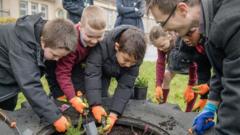
The restoration of lepidoptera populations in Glasgow is not a matter of aesthetic gardening but a complex exercise in fragmented habitat re-linking. Urban environments function as biological deserts due to thermal stress, high-velocity wind tunnels, and chemical runoff. To reverse the decline of species like the Small Blue or the Grayling, Glasgow’s initiative must address the structural disconnect between isolated green pockets. The efficacy of these new "wild spaces" depends entirely on their ability to function as a high-frequency network rather than a series of disconnected botanical exhibits.
The Tri-Factor Architecture of Urban Refugia
To transform a post-industrial city into a viable corridor for pollinators, the strategy must satisfy three distinct ecological constraints: Nutritional Continuity, Microclimatic Stability, and Structural Connectivity.
1. Nutritional Continuity and Phenological Matching
Butterflies require specific caloric intake (nectar) and larval development sites (host plants). A common failure in urban rewilding is the "Goldilocks Trap," where floral resources are abundant in July but absent during the critical emergence periods of early spring or late autumn.
The Glasgow model focuses on:
- Host-Specific Seeding: Generalist flowers support honeybees, but butterflies often require specific botanical families. For example, the Common Blue requires Lotus corniculatus (Bird’s-foot trefoil). Without these specific proxies, the wild space is merely a transit point, not a breeding ground.
- Sequential Bloom Cycles: Engineering a landscape that provides a steady caloric supply across the 180-day active window.
2. Microclimatic Stability: The Thermal Buffer
The urban heat island effect can accelerate larval development at rates that outpace food availability. Conversely, glass-heavy architecture creates wind shear that prevents small-bodied insects from navigating.
- Vegetative Roughness: By introducing varying heights of grasses and shrubs, these spaces create "dead air" zones where butterflies can thermoregulate.
- Solar Traps: The strategic placement of dark stones or south-facing embankments allows butterflies to reach the requisite thoracic temperatures for flight—roughly $30^\circ\text{C}$ to $35^\circ\text{C}$—even in the cooler Scottish climate.
3. Structural Connectivity: The Step-Stone Logic
Island Biogeography Theory dictates that the distance between habitats determines the rate of extinction and colonization. In Glasgow, the challenge is reducing the "matrix resistance"—the difficulty an insect faces moving through concrete.
- Functional Grain: If the distance between wild spaces exceeds the average flight capacity of the target species (often less than 500 meters for smaller lycaenids), the population remains isolated. Isolation leads to genetic bottlenecks and local extinction events.
- Permeability vs. Area: Increasing the total square footage of wild space is secondary to the spatial distribution of that area. Ten small, well-placed "stepping stones" are mathematically superior to one large park for species dispersal.
Economic and Maintenance Bottlenecks in Rewilding
The transition from manicured "mown-and-blown" lawns to wild spaces involves a shift in Operating Expenditure (OPEX). While many perceive "wilding" as a cost-reduction strategy (due to less frequent mowing), the reality is a reallocation of labor towards specialized management.
The Problem of Nutrient Loading
Urban soils are often hyper-nutritious due to decades of fertilizer runoff and atmospheric nitrogen deposition. High-nutrient soil favors aggressive grasses and thistles, which outcompete the delicate wildflowers butterflies depend on.
- Nutrient Stripping: To establish a successful wild space, the top layer of enriched soil often needs to be inverted or removed to expose lower-nutrient substrates.
- The Scythe Constraint: Maintenance cannot be automated via standard heavy machinery. Wild spaces require specific "cut and collect" regimes to prevent decomposing matter from re-enriching the soil. This creates a labor-intensive feedback loop that cities often fail to budget for in long-term planning.
Public Perception and the "Messy" Threshold
The primary barrier to scaling urban biodiversity is social, not biological. Residents often interpret ecological complexity as "neglect." This creates political pressure to revert to high-maintenance, low-biodiversity lawns.
- Cues to Care: Structural elements like mown borders, signage, and defined pathways act as visual signals that the "mess" is intentional.
- Educational Lag: There is a significant gap between the public desire for "nature" and the tolerance for the actual components of that nature, such as insects and decaying plant matter.
Quantifying Success: Metrics Beyond Species Counts
Traditional biodiversity metrics often focus on "species richness" (how many types of butterflies are present). However, in an urban recovery context, this metric is a lagging indicator. A more precise analytical framework uses Functional Diversity and Occupancy Dynamics.
Occupancy vs. Abundance
Seeing a butterfly in a park does not prove the park is successful. It might be a "sink" habitat—a place where individuals go but cannot successfully reproduce.
- Recruitment Rates: Measuring the presence of eggs and larvae is the only way to confirm a space is a "source" habitat.
- Metapopulation Analysis: Tracking the movement between Glasgow’s new spaces using mark-release-recapture techniques or genetic sampling provides data on whether the city is actually functioning as a network.
The Role of Citizen Science Data
The Glasgow initiative relies heavily on local monitoring. While this provides a massive data set, it introduces observation bias. People tend to look for butterflies in sunny, pleasant areas, neglecting industrial or shaded zones. Correcting this requires a Bayesian approach to data analysis, adjusting for the probability of detection based on weather conditions and observer effort.
The Logic of Ecological Gentrification
A secondary risk of localized rewilding is "ecological gentrification." Improving the environmental quality of specific neighborhoods can drive up property values, potentially displacing the very communities the green spaces were intended to serve.
- Distributed Green Infrastructure: The strategic play is to integrate wild spaces into public transit corridors, social housing verges, and industrial brownfields rather than just high-traffic parks.
- The "Grey-to-Green" Ratio: Success should be measured by the increase in per-capita exposure to high-biodiversity zones across all socioeconomic deciles.
Execution Requirements for Municipal Success
For Glasgow to move from a pilot program to a resilient ecological system, the following operational shifts are mandatory:
- Mandatory Biodiversity Net Gain (BNG): Any new development in the city must contribute to the corridor network, ensuring that private capital funds the expansion of these wild spaces.
- Seed Provenance Rigor: Utilizing seeds from local Scottish ecotypes rather than generic "UK Wildflower Mixes" ensures the plants are synchronized with local insect emergence times.
- Hydro-Ecological Integration: Aligning wild spaces with Sustainable Drainage Systems (SuDS). Butterflies thrive in the moisture-rich margins of swales and rain gardens, which also serve the city’s flood-mitigation needs.
The strategy must prioritize the connectivity of the network over the beauty of the individual plot. If a wild space does not connect to a broader matrix, it is not an ecosystem; it is a museum. The long-term viability of the Glasgow butterfly initiative will be determined not by the flowers planted this year, but by the city’s ability to maintain a low-nutrient, high-complexity landscape against the pressures of urban sprawl and climatic volatility.
The immediate tactical move for urban planners is the identification of "corridor gaps" using GIS mapping. By overlaying current heat maps with existing green space data, the city can pinpoint the exact locations where a 10-square-meter wild patch would have the highest marginal utility for insect transit. This data-driven placement is the difference between a performative environmental gesture and a functional biological engine.