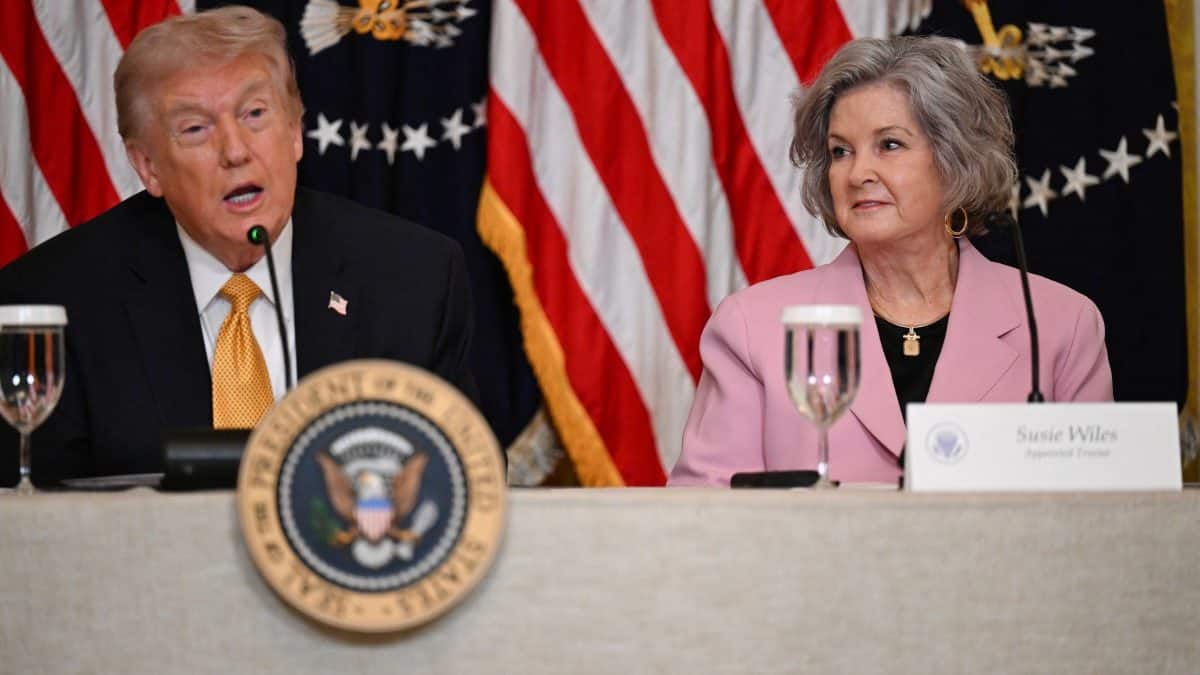
The air in the West Wing does not move like the air anywhere else. It is heavy, charged with the static of a thousand conflicting ambitions and the relentless ticking of a clock that never stops for a holiday or a sunset. In this environment, Susie Wiles has long been the ghost in the machine—the quiet, disciplined architect of a political revival that many deemed impossible. She is the "Ice Maiden," a nickname earned through a career of keeping her head while everyone else was losing theirs.
But recently, the veteran strategist found herself facing a variable that no amount of polling data or ground-game logistics could account for.
It started with a diagnosis. Breast cancer.
The words themselves carry a weight that can collapse a room. For most, such news is a signal to retreat, to pull the curtains and focus entirely on the internal war of cells and chemotherapy. But Susie Wiles is not most people. Her decision to remain at the helm of the White House staff while undergoing treatment isn't just a choice about a job. It is a profound statement on the nature of duty, the limits of the human body, and the terrifying, beautiful stubbornness of the will.
The Anatomy of the Grind
A Chief of Staff is the ultimate shock absorber. Every crisis, from a diplomatic spat in the South China Sea to a legislative bottleneck on Capitol Hill, filters through their desk before it ever reaches the Resolute Desk. The hours are not merely long; they are atmospheric. You arrive before the sun, and you leave long after the news cycle has reset itself for the next day.
Now, imagine that schedule overlaid with the clinical reality of oncology.
Cancer treatment is a thief. It steals your energy, your appetite, and often, your sense of self. It turns the body into a battlefield where the medicine sometimes feels as aggressive as the malady. To manage the most complex bureaucracy on the planet while navigating the fog of treatment requires a level of compartmentalization that borders on the superhuman.
Consider a hypothetical Tuesday. A Chief of Staff is juggling a dozen high-stakes meetings, a briefing with the President, and a constant stream of "urgent" interruptions. Now, add the physical toll of radiation or the lingering exhaustion of a biological therapy. The stakes aren't just political anymore. They are visceral. Every memo written is a victory over fatigue. Every crisis averted is a testament to a mind that refuses to be clouded by the pain of the physical form.
The Invisible Stakes of Public Service
There is a specific kind of loneliness in high-level leadership. When you are the one everyone relies on, you rarely have the luxury of being the one who needs help. Wiles has spent her life being the fixer, the one who smooths the path for others. Stepping into the role of a patient—someone who must, by definition, be cared for—is a jarring shift in identity.
Yet, there is a hidden power in this vulnerability.
History is littered with leaders who governed through private agony. We remember the public triumphs, but we often forget the private costs. When a figure like Wiles chooses to stay in the arena, she isn't just doing her job; she is redefining what it looks like to be "fit for service." She is challenging the notion that a diagnosis is a disqualification.
This isn't a metaphor for resilience. It is resilience in its rawest, most inconvenient form. It is the refusal to let a biological malfunction dictate the trajectory of a life’s work.
The Calculus of Continuity
Stability is the most valuable currency in Washington. When a key figure in an administration faces a health crisis, the immediate reaction in the press and among political rivals is to look for cracks in the foundation. Who will step up? Who will fill the vacuum? By choosing to remain, Wiles effectively silences the vultures. She ensures that the institutional knowledge and the strategic vision she spent years cultivating remain at the center of the administration.
But there is a human cost to continuity.
The body requires rest to heal. The immune system, already taxed by the stressors of the most high-pressure job in the world, must now contend with a cellular insurgency. This is where the narrative of the "Ice Maiden" meets the reality of the human woman. Behind the closed doors of the West Wing, there are moments where the mask must slip—not out of weakness, but out of necessity.
The strategy here is not just about political survival. It is about the human spirit’s refusal to be sidelined. It is about the belief that the work—the mission—is a form of medicine in itself. For some, the distraction of a monumental task is the only thing that keeps the fear of a diagnosis at bay.
Beyond the Diagnosis
We often talk about "fighting" cancer as if it is a conventional war with clear front lines and predictable maneuvers. It isn't. It is a slow, grinding war of attrition. To fight that war while also managing the volatile ego of a superpower is a feat of endurance that few can comprehend.
Wiles’ situation forces us to look at the people behind the titles. We see the suits, the motorcades, and the televised briefings, and we forget that these are individuals who wake up with the same anxieties, the same aches, and the same terrifying medical reports as the rest of us. They are not caricatures of power; they are people trying to hold a world together while their own bodies are trying to pull themselves apart.
There is a quiet dignity in the way Wiles has handled this. No grandstanding. No long-form interviews about her "journey." Just a commitment to show up. To do the work. To remain the steady hand on the tiller even as the storm rages within.
The statistics tell us that one in eight women will be diagnosed with breast cancer in their lifetime. It is a universal struggle that crosses every partisan line and every social strata. In this sense, Wiles has become an accidental avatar for millions of workers who don't have the luxury of stepping away—the mothers, the teachers, the executives who receive the worst news of their lives on a Friday and show up for work on a Monday because people are counting on them.
The Weight of the Chair
The desk of a Chief of Staff is rarely clean. It is covered in the debris of a government in motion. There are classified folders, half-drunk cups of coffee, and the constant hum of secure communications. Now, there might also be a bottle of water and a schedule of medical appointments tucked under a briefing book.
This is the new reality of the West Wing.
It is a reminder that power provides no immunity from the frailties of the flesh. It is a testament to the fact that the most important work is often done by those who are hurting the most. We measure leaders by their policy wins and their polling numbers, but perhaps we should also measure them by their capacity to endure.
The hallways of the White House are long, and the walk to the Oval Office can feel like a mile when your bones are tired. But as long as Susie Wiles is making that walk, she is sending a message that resonates far beyond the Beltway. She is proving that while a diagnosis can change your life, it does not have to define your limit.
The lights in her office stay on late into the evening. The work continues. The strategy evolves. Outside, the world moves on, oblivious to the cellular drama unfolding behind the heavy curtains of the West Wing. But inside, there is a woman who knows exactly what is at stake—and she has no intention of looking away.
She sits at her desk, adjusts her glasses, and picks up the next folder.