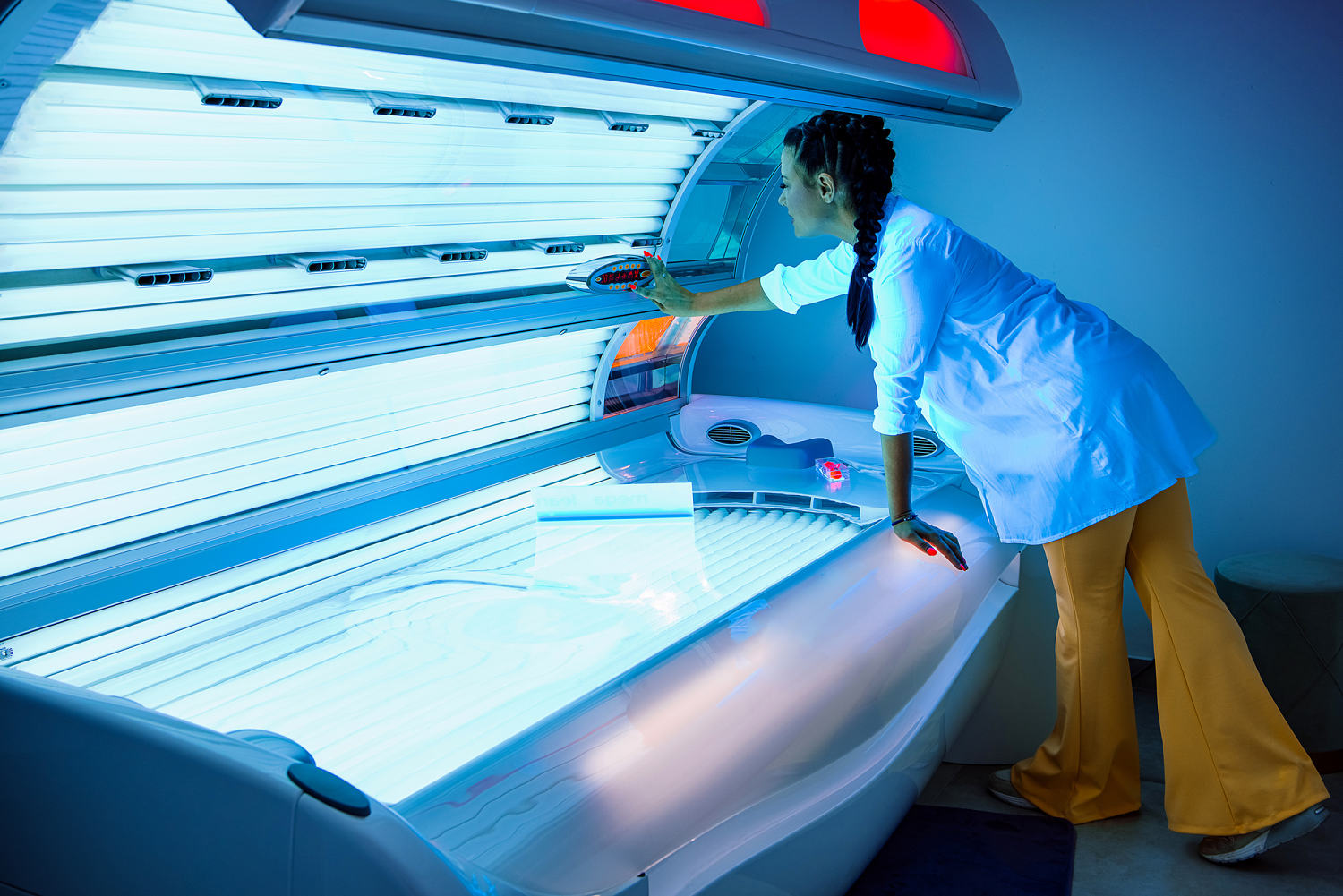
The light is a hum you can feel in your teeth. It is a warm, electric vibration that smells of ozone and coconut-scented accelerators. For a seventeen-year-old girl in a suburban strip mall, that acrylic casket isn't just a bed; it’s a portal. She steps in, clicks the plastic goggles over her eyes, and for twenty minutes, the gray slush of a Midwestern February disappears. She is chasing a glow that suggests health, vitality, and a social currency she can’t yet name.
She doesn't see the DNA in her skin cells snapping like dry twigs under a boot. She doesn't see the silent, microscopic mutations stacking up like a deck of cards being shuffled by a cheat. She only sees the tan line.
For years, the Food and Drug Administration (FDA) held a heavy folder of evidence that this specific ritual was killing people. They had a plan. They were going to ban anyone under the age of eighteen from using these machines. It was a clear-cut move to protect children from a known carcinogen, a risk factor so potent that the World Health Organization puts tanning beds in the same category as plutonium and cigarettes.
Then, the folder was shelved. The proposed rule was pulled. The hum continues.
The Mathematics of a Burn
To understand why a regulatory reversal matters, you have to look past the bureaucratic paperwork and into the biology of a teenager.
Consider a hypothetical high school junior named Sarah. Sarah wants a "base tan" before spring break. She believes the common myth that a light tan will protect her from a sunburn later. This is a biological lie. A tan is not a shield; it is a distress signal. It is the skin’s desperate attempt to prevent further damage after the blueprints of its cells have already been compromised.
When Sarah lies under those lamps, she is exposed to UVA radiation that can be three times more intense than the midday sun at the equator. Because her skin cells are dividing more rapidly than an adult’s, the damage is amplified. The math is brutal. Research shows that using a tanning bed just once before the age of thirty-five increases the risk of developing melanoma—the deadliest form of skin cancer—by 59%.
The FDA knew this. In 2015, they moved to tighten the reins, proposing a nationwide ban for minors and requiring adults to sign risk acknowledgement forms. It was a rare moment of preventative clarity. But the gears of regulation are often gummed up by the friction of industry lobbying and shifting political priorities. When the rule was recently withdrawn, the responsibility for Sarah’s safety shifted from the federal government back to a patchwork of state laws and the whims of a multi-billion-dollar industry.
The Invisible Stakes
Why did the rule vanish? The official reasons often involve "regulatory burden" or the idea that the government shouldn't be a "nanny" to the American family. There is a seductive logic to the argument of personal freedom. We want to believe that parents should be the ones to decide.
But freedom requires informed consent, and the tanning industry has spent decades perfecting the art of the half-truth. They sell Vitamin D. They sell "mood enhancement." They sell the idea that "moderation" is the key.
But you cannot moderately consume a carcinogen during the most vulnerable years of your physical development and expect the bill not to come due.
I remember talking to a woman who started tanning at sixteen. By twenty-four, she was sitting in a sterile room listening to a dermatologist explain that the small, pearly bump on her shoulder wasn't a clogged pore. It was basal cell carcinoma. By twenty-seven, she had a jagged, three-inch scar on her thigh where a melanoma had been carved out. She described the "sun-kissed" look of her youth as a high-interest loan she’d been tricked into signing. She got the glow at seventeen, but the interest rates were paid in biopsies and terror throughout her twenties.
When the FDA pulls a rule like this, they aren't just removing a restriction. They are signaling that the risk is negotiable. They are allowing a lethal vanity to remain accessible at the local mall, sandwiched between a pizza place and a dry cleaner.
A Patchwork Protection
The withdrawal of the federal ban creates a dangerous vacuum. While some states have their own laws prohibiting minors from tanning, others are far more relaxed. This creates a "zip code lottery" for health. A teenager in one state is protected by law, while a teenager twenty miles away, across a state line, can walk into a salon with nothing but a twenty-dollar bill and a dream of looking like a celebrity.
The industry argues that a ban would crush small businesses. They point to the thousands of salons that provide jobs and tax revenue. It is the classic tension of the American machine: how many future cancer cases is a current small business worth?
We have seen this script before. We saw it with tobacco. We saw it with lead paint. There is always a period of "scientific debate" that is actually just a delay tactic funded by those with the most to lose. In the case of tanning beds, the science isn't debating. The data is screaming. The American Academy of Dermatology and the Skin Cancer Foundation have been relentless in their warnings. They see the victims. They see the twenty-somethings with holes in their faces where a "healthy" tan used to be.
The Psychology of the Glow
There is a deeper, more human reason why we struggle to regulate this. We are hardwired to associate a tan with wealth and leisure. A century ago, pale skin was the status symbol; it meant you were rich enough to stay indoors while the poor toiled in the fields. Today, the reverse is true. A tan says you have the time and money to fly to the islands—or at least the twenty dollars to pretend you did.
We are fighting an evolutionary instinct to find warmth and light attractive. The tanning bed exploits this. It provides a dopamine hit, a warmth that feels like safety, and a physical transformation that offers instant gratification.
The FDA’s decision to back off is a surrender to that psychology. It’s an admission that the immediate desires of the market and the optics of deregulation have outweighed the long-term biological cost.
Consider what happens next: the marketing will get sleeker. The "prom season" specials will return with a vengeance. The "graduation glow" packages will be pushed to girls who are still months away from their eighteenth birthdays. And somewhere, a regulator will look at a spreadsheet and see a reduction in "administrative costs," while a surgeon will look at a pathology report and see a cell that has forgotten how to stop growing.
The Final Account
The sun is a star. It is a nuclear furnace. When we try to bottle its power in a box made of glass and gas, we are playing with a fire we don't fully respect.
The government’s retreat from the tanning bed ban isn't just a change in policy; it is a failure of imagination. It is a failure to imagine the thousands of people who will, in ten or fifteen years, find a spot on their skin that doesn't belong. It is a failure to see the human cost of a "regulatory burden" that was designed to save lives.
We live in a world where the hum of the machine is louder than the quiet growth of a tumor. We choose the warmth of the lamp over the cold reality of the data.
The girl in the tanning bed clicks her goggles off. She steps out into the cool air of the salon, feeling transformed. She checks her reflection in the mirror, smiling at the faint pink hue on her cheeks. She feels beautiful. She feels alive. She has no idea that she is carrying a ghost inside her, a tiny, fractured piece of code that was broken under the lights and is now waiting for its moment to speak.
The door to the salon clicks shut. The "Open" sign flickers in the window. The hum continues, undisturbed by the laws that almost were.
Would you like me to look up the specific tanning bed laws in your state so you can see what protections currently exist for your family?