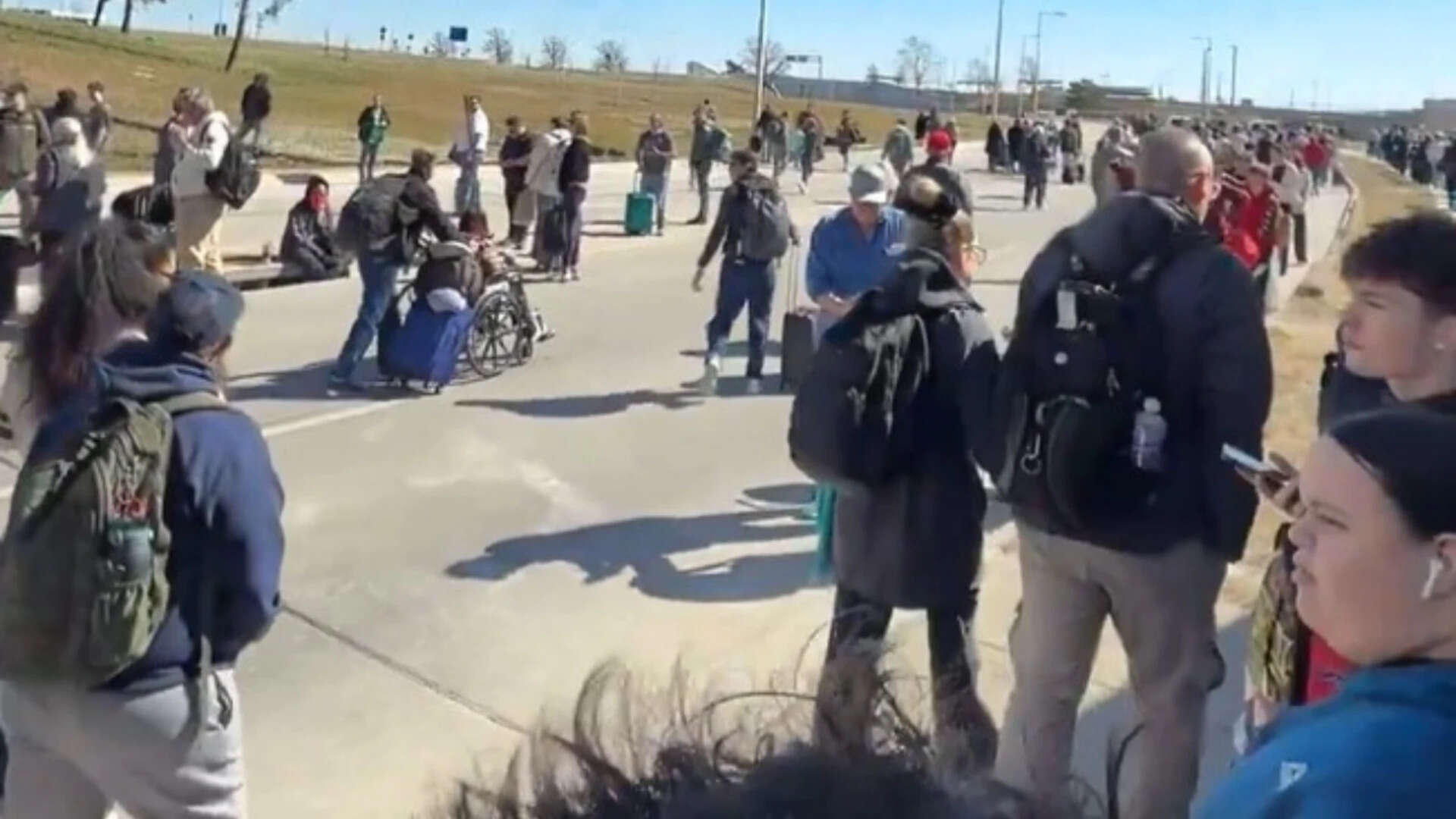
The current surge in airport wait times is not merely a byproduct of increased traveler volume; it is a systemic failure to align labor supply with the volatile demand curves inherent to global aviation. While media narratives focus on the immediate frustration of "long lines," an objective analysis reveals a breakdown in the Workforce Elasticity Model required to secure high-traffic infrastructure. When the Transportation Security Administration (TSA) fails to maintain a buffer of operational capacity, the result is a non-linear escalation of wait times—a phenomenon where a 5% increase in passenger arrival rates can lead to a 50% increase in queue length once the system hits its saturation point.
The Mechanics of the Security Bottleneck
To understand why security lines spiral out of control, one must deconstruct the checkpoint into a series of interconnected functional units. The checkpoint is a high-stakes "First-In, First-Out" (FIFO) queueing system governed by Little’s Law, which states that the average number of items in a system is equal to the average arrival rate multiplied by the average time an item spends in the system. For an alternative perspective, check out: this related article.
The bottleneck occurs because the "service rate"—the speed at which TSA officers can process a passenger—is fixed by rigid regulatory protocols. Unlike a private-sector retail environment where additional registers can be opened or self-service options expanded, a TSA lane requires a specific, non-negotiable staffing complement to be legal and functional. This complement typically includes:
- The Travel Document Checker (TDC): Validates identity and boarding credentials.
- The Divestiture Officer: Manages the flow of bins and ensures passengers remove prohibited items.
- The X-Ray Operator: Analyzes images for threats, representing the primary cognitive load of the system.
- The Property Search Officer: Conducts manual inspections of flagged bags.
- The Walk-Through Metal Detector/AIT Lead: Manages the physical screening of the individual.
If a single one of these roles is unfilled due to staffing shortages, the entire lane remains shuttered. This binary nature of lane availability—it is either 100% operational or 0%—creates a "step-function" in capacity. When an airport loses 10% of its staff, it doesn't just slow down by 10%; it may lose 25% of its active lanes, causing the arrival rate of passengers to vastly exceed the service rate. Similar insight on this matter has been published by National Geographic Travel.
The Labor Supply Deficit: A Three-Pillar Failure
The shortage of TSA personnel is not a localized grievance but a structural mismatch between the job’s demands and its compensation architecture. This can be categorized into three distinct pressure points.
1. The Geopolitical Wage Gap
TSA officers are often recruited in high-cost-of-living areas (HCOL) like New York, San Francisco, and Chicago. Because federal pay scales often lag behind the rapid inflation of local service-sector wages, the TSA finds itself in direct competition with private entities—such as Amazon fulfillment centers or hospitality groups—that offer higher starting pay with significantly lower barrier-to-entry requirements and less daily stress.
2. The Attrition Feedback Loop
Staffing shortages create a self-perpetuating cycle of turnover. When a checkpoint is understaffed, the remaining officers are subjected to mandatory overtime and reduced break intervals. This increases cognitive fatigue, which is particularly dangerous for the X-ray operator role where vigilance decrement is a documented psychological phenomenon. As fatigue increases, morale drops, leading to higher "call-out" rates and further resignations, which then puts more pressure on the surviving staff.
3. Training and Certification Lag
The "Time-to-Productivity" for a new TSA recruit is measured in months, not weeks. A recruit must pass background checks, attend the Federal Law Enforcement Training Center (FLETC), and complete on-the-job training. Consequently, a hiring surge initiated in response to a summer travel crisis will not yield actual throughput capacity until the following winter. The system lacks the "Agile Labor" capability found in other industries.
Stochastic Arrival Patterns vs. Rigid Staffing
The fundamental mathematical problem facing airport management is the Stochastic Nature of Passenger Arrivals. Travelers do not arrive in a smooth, continuous stream; they arrive in "pulses" dictated by flight schedules.
A hub airport might see 3,000 passengers arrive between 6:00 AM and 7:00 AM, followed by a lull of only 400 passengers at 9:00 AM. Efficient staffing requires a highly flexible workforce that can "peak" alongside these pulses. However, federal labor contracts and the logistics of commuting to an airport (often involving off-site parking and shuttles) make "split-shifting"—where workers come in only for peak hours—difficult to implement.
When the TSA cannot match the peak, the queue "backs up" into the terminal. Once the queue exceeds the physical footprint of the stanchions, it begins to impede other airport operations, such as check-in counters and baggage claim, creating a "Systemic Cascade Failure."
The Technological Limitation: Why Tech Isn't a Quick Fix
There is a common misconception that "better technology" (like CT scanners or automated bin returns) will instantly solve staffing shortages. In reality, new technology often introduces a "Learning Curve Tax" that temporarily reduces throughput.
- CT Scanners: While they allow passengers to keep electronics in bags, the 3D imagery is more complex for the operator to analyze, sometimes increasing the time spent per bag.
- Biometric ID: While the Travel Document Checker role can be automated via facial recognition, the physical screening bottleneck remains.
Technology serves as a force multiplier only when the baseline staffing is stable. Without a human to manage the "out-of-gauge" luggage or the "alarm" on a body scanner, the most advanced machine in the world becomes a high-tech paperweight.
Quantifying the Economic Friction of Wait Times
The cost of TSA delays is not just a matter of "traveler annoyance." It is a measurable economic drag. The Opportunity Cost of Time (OCT) for a business traveler can be estimated by their hourly compensation. If 50,000 travelers at a major hub are delayed by an average of 60 minutes, and the weighted average hourly value of their time is $50, the daily economic loss for that single airport is $2.5 million.
Furthermore, there is the "Missed Connection Cost." When a traveler misses a flight due to security delays, the airline incurs costs for rebooking, and the passenger loses the utility of their trip. This creates a "Risk Premium" for air travel; as wait times become unpredictable, travelers begin to opt for alternative modes of transport for shorter distances (the "Shift to Rail/Road"), or they cancel discretionary trips entirely.
Strategic Recommendation: Shifting to a Resilience-Based Model
To move beyond the cycle of reactive hiring and public apologies, the aviation security apparatus must adopt a Resilience-Based Staffing Strategy. This involves three specific shifts in operational logic:
First: The Implementation of "Retention-Based Pay Differentials."
The TSA must move away from a flat federal pay scale toward a "Market-Responsive" model. In cities where the "Living Wage" exceeds the GS-level starting pay, a localized "Security Premium" should be applied. This is more cost-effective than the constant cycle of recruiting and training new cohorts who leave within six months.
Second: The Modularization of the Checkpoint.
The TSA should redesign the physical checkpoint to allow for "Micro-Lanes" that require fewer personnel to operate during off-peak hours, alongside "Heavy-Duty" lanes for peak times. This allows for more granular control over capacity, ensuring that even with limited staff, the maximum number of "Service Points" remains open.
Third: Data-Transparent Demand Management.
Airports must integrate airline "Load Factor" data directly into TSA staffing algorithms in real-time. Currently, the lag between an airline seeing a "fully booked" flight and the TSA seeing those passengers at the gate is too wide. A unified data layer would allow for "Pre-emptive Surging," where staff are moved to specific terminals 30 minutes before a known pulse of passengers arrives from the check-in counters.
The solution to the "hourslong line" is not found in the line itself, but in the structural elasticity of the labor force that guards the gate. Without addressing the underlying economics of the TSA officer’s career path, the aviation industry will remain trapped in a state of perpetual bottleneck, where the speed of global commerce is dictated by the slowest belt on the X-ray machine.