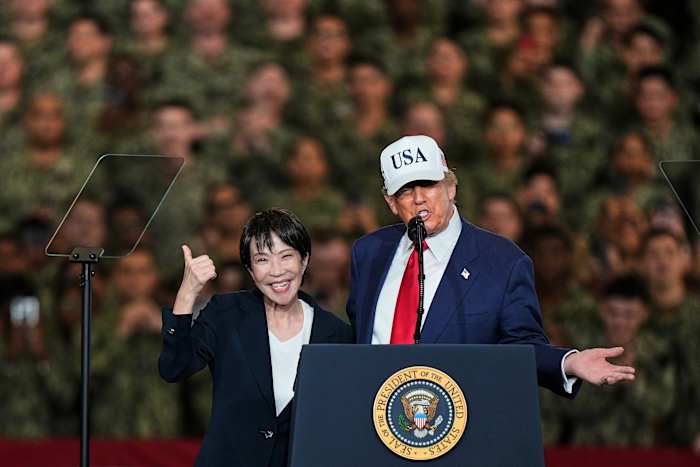
Donald Trump doesn’t do subtle. When he wants something, he asks for it on social media, in person, and through every diplomatic channel available. Right now, he wants Japanese warships in the Strait of Hormuz. Prime Minister Sanae Takaichi is currently in Washington to explain why that’s a lot harder than it sounds.
The timing couldn’t be worse. This trip was supposed to be a victory lap for the U.S.-Japan alliance, focusing on a massive $550 billion investment deal and a shared front against China. Instead, the war between the U.S., Israel, and Iran has hijacked the agenda. Takaichi, Japan's first female prime minister and a staunch conservative, finds herself in the ultimate "hot seat" at the White House.
The Hormuz Headache
Japan gets nearly 90% of its oil from the Middle East. Most of that crude flows through the Strait of Hormuz, a narrow chokepoint that Iran has effectively shut down in response to recent strikes. You’d think Japan would be the first to volunteer for a naval mission to reopen the taps.
But Japan has a "peace constitution" that makes sending the Self-Defense Forces (SDF) into a literal war zone a legal and political nightmare. Trump isn’t interested in legal nuances. He’s already called the lukewarm response from allies "very disappointing" and suggested that countries benefiting from the strait should be "thanking" him by helping out.
The pressure is real. Trump has even delayed a planned trip to China because of the conflict, signaling that the Middle East is his absolute priority. Takaichi has to walk a tightrope: she needs to keep Trump happy to maintain the U.S. security umbrella over Japan, but she can't just ignore the law or the Japanese public, which isn't exactly itching for a fight in the Persian Gulf.
What Japan Is Bringing to the Table
Takaichi isn't arriving empty-handed. She’s a protege of the late Shinzo Abe, and she knows how to speak "Trump." Her strategy is to offer so much in other areas that the warship issue becomes a footnote.
- The $550 Billion Carrot: Japan has pledged over half a trillion dollars in investments and loans to the U.S. We’re talking about natural gas plants in Ohio, crude oil export facilities on the Gulf Coast, and even synthetic diamond manufacturing.
- Next-Gen Nukes: During this visit, they’re expected to announce a second round of projects worth about 10 trillion yen (roughly $67 billion), including the construction of next-generation nuclear reactors.
- The Golden Dome: Japan is signaling it wants in on Trump’s "Golden Dome" missile defense system. This isn't just about protection; it’s a massive industrial and military commitment that aligns perfectly with Trump’s "America First" manufacturing goals.
The China Factor in the Room
While the Middle East is on fire, Tokyo is still looking nervously at Beijing. The U.S. recently pulled Patriot and THAAD missile systems out of South Korea and redirected Marines from Japan to the Arabian Sea. For Japan, this is terrifying.
If the U.S. gets bogged down in a long war with Iran, does it still have the stomach—or the hardware—to defend Taiwan or the Senkaku Islands? Takaichi’s main goal is to ensure that "America First" doesn't mean "Japan Alone" in the Pacific.
She’s already doubled down on Japan’s own military buildup, accelerating the deployment of long-range missiles that can actually hit targets on the mainland of an aggressor. It’s a massive shift from Japan’s postwar pacifism, and it’s exactly the kind of "burden-sharing" Trump has been screaming for.
Why This Meeting Is Different
In the past, Japan could rely on "checkbook diplomacy"—writing a big check to support U.S. efforts without getting its hands dirty. That won't work this time. Trump wants boots on the ground—or, more accurately, hulls in the water.
Takaichi told parliament right before leaving that she would explain what Japan "can and cannot do." That "cannot" is the part Trump hates hearing.
What to watch for in the coming days
- The Intelligence Compromise: Look for Japan to offer "information sharing" or maritime domain awareness instead of direct combat escorts. It’s the classic diplomatic middle ground.
- The "Coalition of the Willing" Lite: Japan might join a multi-national mission that is technically separate from U.S. combat operations to save face at home while still checking Trump's box.
- The Trade Offset: If Takaichi can't give Trump the ships, she’ll have to give him more on trade, likely in the form of even more aggressive investment in "red states" where the manufacturing boost helps Trump politically.
Honestly, Takaichi has a harder job than almost any other world leader right now. She has to manage a mercurial American president, a constitution that ties her hands, and a global energy crisis that could tank the Japanese economy.
Don't expect a simple "yes" or "no" on the warship question. Expect a complicated, expensive, and very Japanese "maybe."
If you’re tracking how this affects global markets, keep an eye on the specific energy projects announced this week. The shift toward U.S.-based LNG and nuclear tech isn't just a trade play; it’s a desperate attempt by Japan to decouple its energy security from the volatile Middle East once and for all. Check the official joint statements for mentions of "maritime security cooperation"—that's the code for how much Takaichi actually gave in on the Hormuz request.