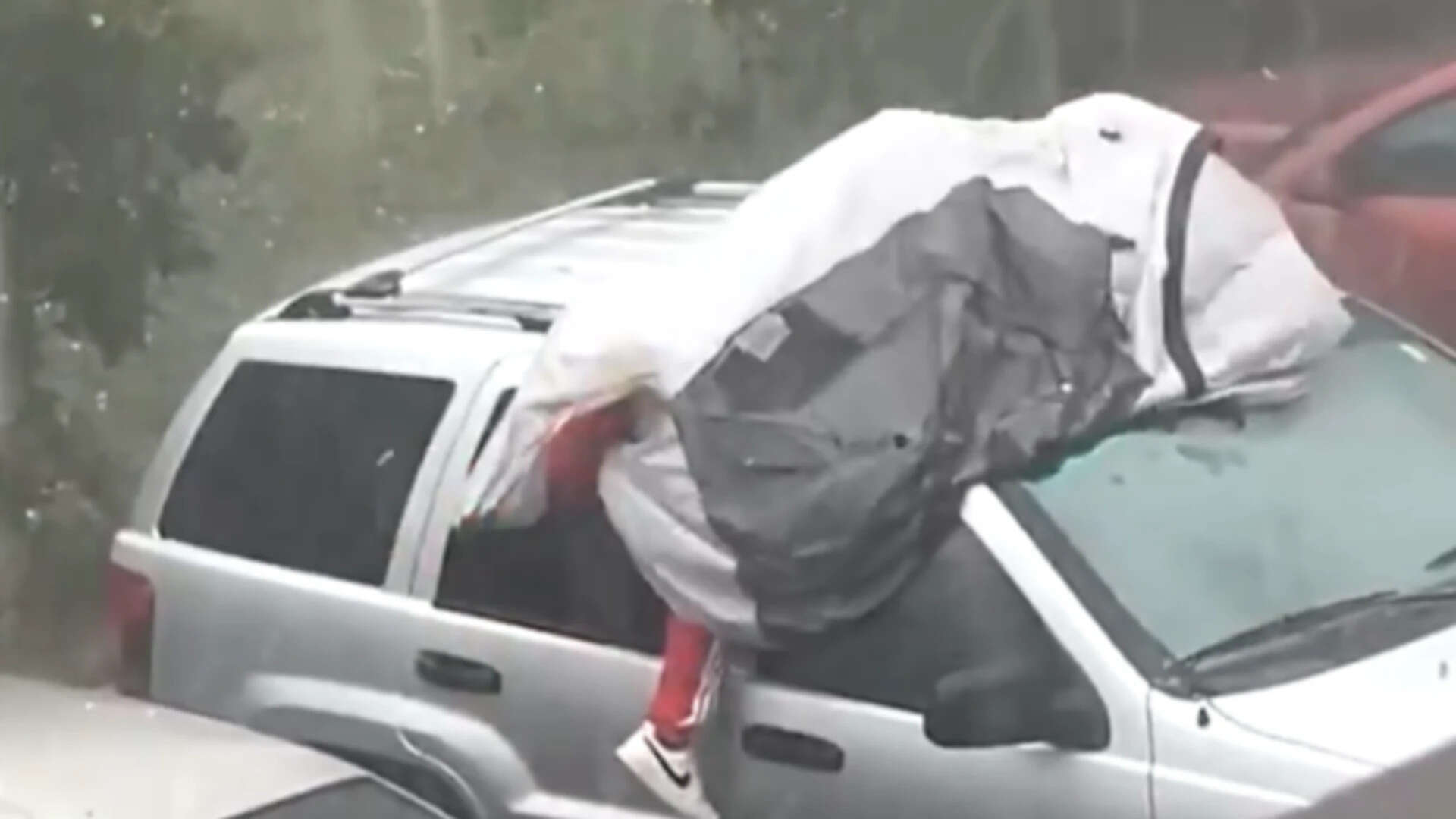
You've seen the video. A man in Florida, desperate to save his car from a sudden hailstorm, decides the best course of action is to use his own body as a human shield. He's sprawled across the hood, arms wide, while ice chunks pelt his back and the metal around him. It looks absurd. It looks painful. But mostly, it looks like a person who knows their insurance policy isn't going to cover the "act of God" currently denting their pride and joy.
When a hailstorm hits, your first instinct is protection. Your car is likely your second most expensive asset. Watching it get pulverized by frozen water is a visceral kind of torture. However, jumping on top of a 3,000-pound machine while ice falls from the sky at terminal velocity is a gamble you'll never win. You might save a few square inches of the roof, but you’re risking a trip to the ER that will cost ten times more than a new windshield. For a different perspective, consider: this related article.
The Florida man's viral moment isn't just a funny internet clip. It's a loud, bruising reminder that most people don't actually understand how their car insurance works until they’re watching a storm destroy their property.
Why Comprehensive Coverage Is Your Real Bodyguard
If you’re tempted to pull a stunt like the guy in the video, you probably have "liability only" coverage. That’s the bare minimum required by law, and it does exactly zero for you when nature gets angry. Related analysis on this matter has been shared by Associated Press.
To actually survive a hailstorm financially, you need comprehensive coverage. This is the part of your policy that handles things that aren't collisions. Fire, theft, falling trees, and yes, those golf-ball-sized ice pellets. Without it, you're on your own.
I’ve talked to many car owners who think "full coverage" is a real legal term. It isn't. It’s a marketing phrase. You either have the specific line item for comprehensive coverage or you don't. If you live in a state like Florida, where weather can turn violent in minutes, skipping this to save twenty bucks a month is a recipe for a viral video you won't want to be the star of.
The Physics of Hail vs the Human Body
Let's get real about the damage. Hail can fall at speeds exceeding 100 mph. When a piece of ice the size of a marble hits a metal surface, it creates a localized point of high pressure that deforms the steel.
Now imagine that hitting your spine.
Soft tissue and bone aren't meant to absorb that kind of impact. You’re looking at severe bruising, broken ribs, or even a concussion if a stray chunk hits your head. Even if you're the toughest person on the block, you're not tougher than atmospheric physics. The Florida man in the video was lucky he didn't end up with a cracked skull. The car can be fixed. Your central nervous system? Not so much.
Smart Ways to Protect Your Car When the Sky Falls
If you see the clouds turning that nasty shade of green and the wind starts picking up, don't run outside to be a human blanket. There are better ways to handle this.
Find a Bridge or Gas Station Canopy
If you're driving, don't stop under a bridge on a highway—that’s a safety hazard for other drivers. But if you can safely pull into a covered gas station or a parking garage, do it immediately. Even ten minutes of cover can save you thousands in repair bills.Floor Mats Are Your Best Friend
If you're at home and don't have a garage, grab your heavy rubber floor mats. Throw them over the windshield and the sunroof. These are the most expensive parts to replace. The hood can be hammered out or replaced, but a shattered sunroof leads to a soaked interior and mold issues.Blankets and Tape
Heavy moving blankets or even thick comforters can dampen the impact of hail. The trick is securing them. If the wind is blowing at 50 mph, your blankets will be three blocks away before the first hailstone hits. Use duct tape on the glass or weighted bags to keep them down.
The Myth of Opening the Windows
There’s an old wives' tale that suggests opening your car windows slightly during a hailstorm will equalise pressure and prevent them from breaking. This is nonsense. Hail breaks glass because of physical impact, not air pressure changes. Keep your windows shut so you don't end up with a car full of ice and water.
Dealing with the Aftermath and Insurance Adjusters
Suppose the worst happened. You didn't lay on your car, but the hail did its work anyway. Your car now looks like a giant golf ball.
The first thing you do is take photos. Lots of them. Don't just take pictures of the dents; take pictures of the hail next to a reference object like a coin or a ruler. This proves the size of the storm to your adjuster.
Insurance companies hate hail claims because they're widespread. When one storm hits a zip code, they get five hundred calls at once. You want to be the first one in line.
Be wary of "storm chasers"—the guys who knock on your door offering "free" dent repair. Many of these are legitimate mobile Paintless Dent Repair (PDR) experts, but some are scammers who will take your insurance check and vanish. Always check for a local business license and actual reviews before letting anyone touch your car.
Understanding Paintless Dent Repair (PDR)
Most hail damage is fixed via PDR. Technicians use specialized tools to "massage" the metal back into its original shape from the underside. It’s an art form. It keeps your original factory paint intact, which is huge for your car’s resale value. If a shop tells you they need to sand and paint your entire hood for minor hail pocking, get a second opinion. They’re probably trying to pad the bill.
Checking Your Policy Before the Next Storm
Go pull up your insurance app right now. Don't wait. Look for the word "Comprehensive." If it's not there, call your agent.
The cost to add it is usually surprisingly low compared to the cost of a new paint job or a windshield. In states with high weather volatility, it’s basically mandatory for peace of mind.
If you find yourself standing in your driveway as the sky begins to roar, remember the Florida man. Laugh at the video, but don't imitate it. Your car is a tool; your body is a temple. Let the tool take the hit.
Check your deductible while you're at it. A $1,000 deductible might save you money on premiums, but it hurts when you have to cough it up for a storm you couldn't control. If you live in a hail-prone area, dropping that deductible to $250 or $500 is often the smartest financial move you can make.
Stay inside. Stay dry. Let the insurance company handle the dents.