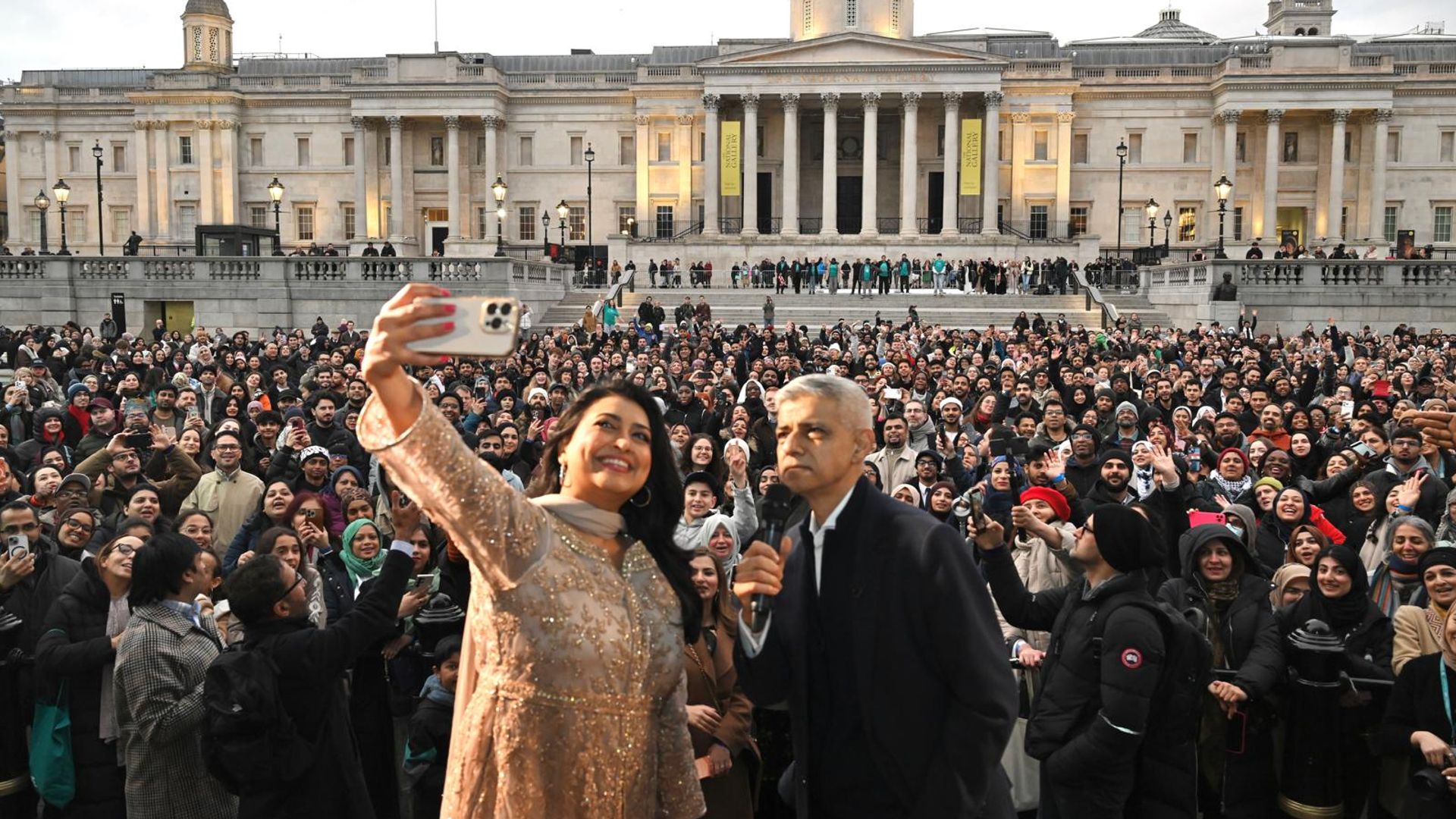
The British political scene just got a lot more heated, and it isn't because of a budget or a trade deal. It’s about a prayer mat in a public square. When a high-ranking Conservative figure characterized a peaceful Muslim prayer gathering in Trafalgar Square as an "act of domination," it didn't just ruffle feathers. It set off a firestorm that reached the very top of the UK government. Prime Minister Keir Starmer's call for the sacking of this Tory official isn't just a bit of political theater. It’s a line in the sand regarding how we talk about religion in the 21st century.
You’ve probably seen the footage. Hundreds of people gathered at the base of Nelson’s Column, bowing in unison. For some, it’s a beautiful display of the UK’s multi-faith fabric. For others, apparently, it’s a territorial claim. But calling a religious service "domination" is a heavy accusation. It suggests that the mere presence of a minority faith in a landmark space is an aggressive takeover. That’s a dangerous road to walk down.
The Comments That Sparked the Crisis
The controversy centers on remarks made by a senior Conservative figure regarding an Inter-Iftar event. These events are common during Ramadan. They bring people together to break their fast, often inviting those of all faiths and none to share a meal. This specific gathering included a public call to prayer and a communal prostration.
The Tory official in question claimed that such displays were designed to "assert control" over iconic British spaces. They didn't just critique the logistics or the noise. They attacked the intent. By using words like "domination," they framed a religious practice as a political conquest. It’s the kind of rhetoric that used to stay in the darker corners of the internet. Now, it’s coming from people who help shape national policy.
Keir Starmer didn't hold back. He labeled the comments "racist and Islamophobic," arguing that they are fundamentally incompatible with modern British values. The Prime Minister’s stance is clear: if you can't distinguish between a prayer and a power grab, you shouldn't be in a position of influence. The Conservative leadership, meanwhile, finds itself in a familiar bind. Do they double down on "free speech" or do they excise a member who is clearly alienating a massive chunk of the electorate?
Breaking Down the Domination Narrative
Why does the word "domination" matter so much here? It’s about the "Great Replacement" theory and other fringe ideas that have slowly leached into mainstream conservative thought. The idea is that Western culture is being "erased" by the visible presence of Islam.
If a group of Christians sang carols in Trafalgar Square, would anyone call it an act of domination? No. They’d call it Christmas. If a group of yoga enthusiasts did a mass session there, would it be a "secular takeover"? Of course not. The standard changes when the group in question is Muslim.
This isn't just my opinion. Organizations like Tell MAMA, which monitors anti-Muslim incidents in the UK, have documented a sharp rise in this specific type of rhetoric. They note that public religious expression is increasingly being used as a "gotcha" by political actors looking to stoke culture wars.
- Selective Outrage: Critics often ignore other large-scale public events.
- Intentional Misreading: Communal prayer is a spiritual obligation, not a political strategy.
- Alienation: This rhetoric tells millions of British citizens that their faith makes them an "occupier" in their own home.
The Legal and Social Reality of Public Prayer
Let's look at the facts of how public spaces work in London. Trafalgar Square is managed by the Greater London Authority (GLA). You don't just show up with a megaphone and a thousand friends. You need permits. You need a health and safety plan. You need to coordinate with the Metropolitan Police.
The Ramadan event was fully sanctioned. It followed every rule in the book.
When a politician calls a permitted, legal event "domination," they aren't just attacking the participants. They’re attacking the rule of law. They’re saying that even if you follow the rules, your presence is still illegitimate because of who you are or how you pray.
The irony is that these same politicians often talk about "British values." One of the most core British values is the freedom of religion and the right to peaceful assembly. You can't claim to be a defender of the UK's heritage while trying to dismantle the very freedoms that make the country a global leader in human rights.
Political Fallout and the Tory Identity Crisis
The Conservative Party is at a crossroads. For years, they've flirted with "populist" rhetoric to keep their base energized. But there’s a cost. By allowing this kind of language to go unpunished, they risk becoming a party of grievance rather than a party of government.
Starmer's demand for a sacking puts the Tories in a corner. If they sack the official, they risk a backlash from their right wing. If they don't, they basically admit that Islamophobia is acceptable within their ranks. It’s a PR nightmare, but more importantly, it's a moral failure.
We saw similar tension during the tenure of former home secretaries who used "invader" imagery regarding migrants. It’s a pattern. The language gets more extreme, the target shifts slightly, but the goal remains the same: divide the public into "us" and "them."
Why This Matters to You
You might think, "I'm not religious, why should I care about some prayers in a square?"
You should care because the language we use to describe our neighbors eventually dictates how we treat them. If we accept that a segment of our population is "dominating" us simply by existing in public, we're paving the way for discriminatory policies.
History shows that when politicians start pathologizing the public presence of a minority group, things don't end well. It starts with a tweet or a comment about a prayer mat. It ends with restricted rights, increased hate crimes, and a fractured society where nobody feels safe.
Moving Past the Rhetoric of Fear
The solution isn't to ban religion from the public square. The solution is to get better at living together. Britishness isn't a static thing that gets "diluted" when a new group enters the chat. It’s a living, breathing identity that has always been shaped by the people who live here.
If you’re concerned about the direction of political discourse in the UK, don't just sit there. The best way to counter the "domination" narrative is to show up and participate in the pluralism these critics hate so much.
- Educate yourself: Read the actual guidelines for public events in London. You'll see how strictly regulated they are.
- Support inclusive organizations: Look into groups like the Faith & Belief Forum that work on social cohesion.
- Hold your reps accountable: If your local MP uses inflammatory language, write to them. Tell them you expect better.
The row over Trafalgar Square isn't about religion. It’s about whether we want to live in a country that embraces its complexity or one that cowers in fear of it. The "act of domination" isn't the prayer; it’s the attempt to silence it through vitriol.
Don't let the noise distract you from the reality. The UK is a diverse, multi-faith democracy. That’s a strength, not a weakness. It’s time our political language caught up to that fact. Stop entertaining the idea that visibility is a threat. It’s just life in a modern city.