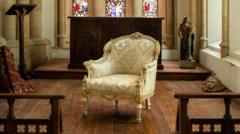
If you want to understand the soul of a nation, do not look at its monuments. Look at where its people sit.
The history of India is often told through the flash of swords, the roar of crowds, or the ink of treaties. But there is a quieter, sturdier history carved into the rosewood, teak, and cane of its chairs. For centuries, the vast majority of Indians didn't use them. They sat on the floor—a practice of humility, of shared space, of a direct connection to the earth. To sit on a chair was to claim a different kind of space. It was an act of power, a gesture of defiance, or a mark of surrender.
Each leg and armrest tells a story of how a subcontinent was reshaped, one seat at a time.
The Weight of the Lion
In the beginning, there were no "chairs" in the sense we recognize them today. There were asanas. There were gadhis. There were low stools that felt more like an extension of the floor than a departure from it.
Consider the hypothetical craftsman in the Vijayanagara Empire. He isn't building for comfort; he is building for presence. His creation is a heavy, ornate platform. It is designed to elevate a ruler above the common eye level. This wasn't about lumbar support. It was about the gravity of the state. When you sat there, you became a focal point of the universe. The "throne" was a symbol of the cosmic order, often guarded by carved lions or elephants.
But even these were rare. For the average person, life happened at ground level. You ate, slept, prayed, and died on the floor. The transition from the mat to the four-legged chair wasn't a natural evolution of furniture; it was a collision of worlds.
The Arrival of the High Back
When the Europeans arrived, they brought more than just spices and muskets. They brought a rigid, vertical way of existing.
To the Portuguese, the Dutch, and eventually the British, sitting on the floor was seen as a lack of civilization. They brought their high-backed, dark-wood chairs—heavy, imposing things that forced the spine into a straight line. These chairs were physical manifestations of the colonial hierarchy.
Imagine a local merchant in 18th-century Goa. To do business with the new arrivals, he has to change how his body occupies space. He has to learn to sit "up." This wasn't just a change in posture; it was a psychological shift. The chair became a barrier. It separated the ruler from the ruled, the "civilized" from the "native."
The "Goanese Chair" is a hauntingly beautiful hybrid of this era. It features the dark, heavy woods favored by the Portuguese, but the intricate carvings often depict Indian motifs—vines, flowers, and local deities. It is a piece of furniture caught between two identities. It is beautiful, but it carries the tension of a forced marriage.
The Planter’s Exhaustion
As the British solidified their grip, the furniture adapted to the sweltering heat of the plains and the humidity of the hills. Enter the "Planter’s Chair."
You have seen it in old photographs, usually occupied by a man in a pith helmet. It has an impossibly long, sloping back and extended armrests. Those arms weren't just for resting your elbows. They were designed so a tired colonial officer could swing his legs up onto them, allowing the blood to drain and the air to circulate around his boots.
It is the chair of the weary overseer. It represents a specific kind of exhaustion—the exhaustion of trying to manage a land that doesn't want to be managed. Yet, over decades, this chair became a staple of Indian verandas. It was adopted, repurposed, and softened. It moved from the site of colonial administration to the site of the afternoon nap.
This is how India conquers its conquerors: it waits for them to leave, then it keeps their best chairs and makes them comfortable.
The People’s Plastic Revolution
But for most of the 20th century, a "proper" chair remained a luxury. Wood was expensive. Craftsmanship took time. Then came the 1980s, and with them, the Monobloc.
You know this chair. It is white, or perhaps a dull forest green. It is made of injection-molded polypropylene. It is light, stackable, and virtually indestructible. It is the most common chair in the world, but in India, it became something more. It became the great equalizer.
Suddenly, the chair was no longer a symbol of the elite. You find it at roadside tea stalls, in village panchayats, and at massive wedding receptions where thousands of people sit together. It doesn't care about your caste or your bank account. It is functional, cheap, and honest.
While the antique rosewood chairs of the Raj sit in museums, the plastic chair is in the mud, in the rain, and under the blazing sun. It is the chair of the democracy. It is the seat of the modern Indian story—unpretentious, resilient, and everywhere.
The Ghost in the Corner
There is a specific kind of silence found in an old Indian house. It’s the silence of a discarded wooden chair sitting in a corner, its cane mesh sagging or broken.
If you look closely at that cane work—the bunaai—you see the fingerprints of a disappearing world. Caning was a skill passed down through generations. A master could tension the weave so perfectly that it would support a person’s weight for thirty years before even thinking of snapping.
Today, we prefer the ergonomic office chair with its levers and wheels, or the cushioned sofa that swallows us whole. We have traded the breathability of cane for the sweat of faux leather. We have traded the permanence of teak for the planned obsolescence of particle board.
When we look at the history of India through its chairs, we aren't just looking at design trends. We are looking at a map of our own movements. We moved from the floor to the throne, from the throne to the veranda, and from the veranda to the plastic stack.
We have gained comfort, but perhaps we have lost a bit of the earth.
The next time you pull out a chair to sit down, feel the weight of it. Notice the material. Ask yourself what it demands of your posture. Every chair is a silent instruction on how to be a person in the world.
Some chairs tell you to rule.
Some tell you to work.
Some tell you to hide.
And somewhere, in a dusty room in an ancestral home, a simple wooden stool is still waiting, reminding you that once, not so long ago, you didn't need any of this to feel at home.
The wood remembers the tree. The cane remembers the forest. And the seat remembers everyone who ever leaned back, took a breath, and watched the world go by.