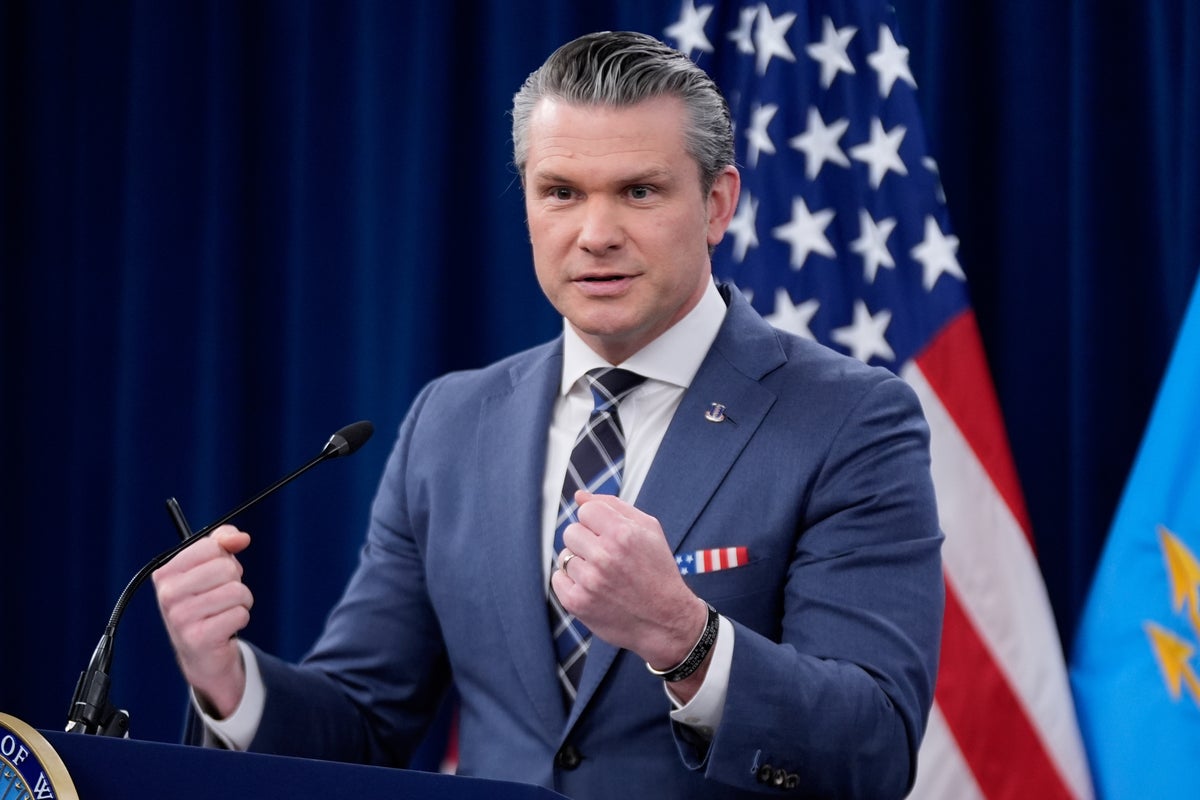
Pete Hegseth’s selection as Secretary of Defense has pushed a specific brand of crusader-style Christian rhetoric into the center of American military strategy. This isn’t just about personal faith or Sunday morning worship. It represents a fundamental shift in how the United States might justify and execute lethal force in the Middle East, particularly regarding Iran. For decades, the Pentagon has operated under a veneer of secular rationalism and international law. Hegseth’s past statements suggest a departure from that norm, replacing bureaucratic caution with a conviction that frames geopolitical conflict as a spiritual necessity.
The concern among career diplomats and military strategists is not that a believer is at the helm. Washington has seen plenty of those. The friction lies in the specific "Deus Vult" iconography and the historical lens Hegseth applies to modern statecraft. When a leader views a potential war with Iran not as a chess match of containment but as a continuation of a thousand-year struggle between civilizations, the rules of engagement change.
The Jerusalem Cross and the Optics of Holy War
Visual symbols often carry more weight than policy papers in the world of high-stakes intelligence. Hegseth’s tattoos, specifically the Jerusalem Cross and the phrase "Deus Vult" (God wills it), have become flashpoints for a reason. To a casual observer, they are historical nods. To an Iranian Revolutionary Guard commander, they are signals of a renewed Crusade.
Military leadership usually tries to de-escalate religious tension to protect troops stationed in Muslim-majority countries. The arrival of a Pentagon chief who wears the symbols of medieval holy wars creates an immediate intelligence hurdle. It validates the propaganda used by adversaries who claim the United States is engaged in a war against Islam rather than a struggle against a specific political regime. This isn't a theoretical problem. It affects how local militias in Iraq or Syria perceive American presence. If they believe the man giving the orders views them as "infidels" in a cosmic struggle, the likelihood of asymmetric attacks on U.S. outposts increases.
Rewriting the Rules of Proportionality
Standard military doctrine relies on the principle of proportionality. You use the amount of force necessary to achieve a military objective while minimizing "collateral damage." Hegseth has historically criticized these constraints. He has argued that the desire to be "polite" or "legalistic" has hampered American effectiveness in the Global War on Terror.
In the context of Iran, this mindset is a departure from the "maximum pressure" campaigns of the past. If the objective is no longer just to stop a nuclear program but to defeat an "evil" ideological foe, the threshold for using tactical nuclear weapons or targeted strikes on cultural sites lowers. Hegseth has previously suggested that the U.S. should not be afraid to strike Iranian infrastructure, including sites that might be considered off-limits under the Geneva Convention, if it serves the ultimate goal of victory.
This is where the "why" becomes more important than the "what." The "why" is rooted in a belief that the United States is a providential nation. Under this framework, the law is secondary to the mission.
The Influence of Constantinian Christianity
To understand the shift, you have to look at the specific strain of theology Hegseth champions. It is a muscular, confrontational version of the faith that views the military as a tool for righteous justice. This isn't the "turn the other cheek" philosophy of the New Testament. It is the Christianity of Constantine—the blending of the cross and the sword.
Critics in the Pentagon worry this will lead to a purge of the "intellectual" officer class. For years, the military has prioritized leaders who understand the nuances of counter-insurgency and soft power. Hegseth has been vocal about his disdain for "woke" generals and the bureaucratic bloat of the Joint Chiefs. His goal appears to be a return to a "warrior culture" that prioritizes lethality over everything else. While that sounds effective on a recruitment poster, it ignores the reality that modern wars are won through logistics, diplomacy, and economic leverage as much as they are won through direct combat.
Iran as the Ultimate Adversary
Iran occupies a unique space in this worldview. It is not just a regional competitor like China or a fading power like Russia. For the movement Hegseth represents, Iran is the modern embodiment of the ancient Persian threat to Western, Christian-Judeo values.
The rhetoric often skips over the complexities of Iranian society—the young, pro-Western population or the internal fractures within the clerical establishment—and treats the nation as a monolith of radicalism. When you simplify an enemy to that degree, you lose the ability to negotiate. Diplomacy requires the belief that the other side is a rational actor with whom you can find a middle ground. If you believe the other side is inherently demonic or driven by an apocalyptic desire to bring about the end of days, then total destruction becomes the only logical policy.
This creates a dangerous feedback loop. Hardliners in Tehran point to Hegseth’s rhetoric to justify their own "Holy Defense" narrative. Each side uses the other’s religious fervor to consolidate power and silence moderates.
The Impact on Global Alliances
The United States does not fight alone. The North Atlantic Treaty Organization (NATO) and various regional partnerships are built on shared strategic interests, not shared religious identities.
European allies, many of whom are staunchly secular, view the infusion of religious rhetoric into U.S. military policy with deep suspicion. If the Pentagon begins to justify its actions in the Middle East through a Christian lens, it will become increasingly difficult to maintain the "rules-based international order" that Washington has spent seventy years building. Nations like France or Germany are unlikely to join a coalition that looks like a modern-day Crusade.
Furthermore, the Abraham Accords—the peace deals between Israel and several Arab nations—rely on a pragmatic, business-first approach to regional stability. Infusing the Pentagon with "crusader" imagery risks alienating the very Arab partners the U.S. needs to contain Iran. You cannot build a regional security architecture with Sunni Muslim nations while your Secretary of Defense wears symbols of the men who sacked their cities eight hundred years ago.
Tactical Reality vs. Ideological Purity
There is a significant difference between talking about war on a cable news set and managing a $800 billion budget and millions of service members. The Pentagon is a massive, slow-moving ship. Hegseth will face immediate pushback from the career civil service and the uniformed leadership who view his arrival as a threat to the military’s non-partisan tradition.
The real test will come during the first major Iranian provocation. Will Hegseth lean on the traditional "options menu" provided by the Joint Chiefs, or will he push for the "decisive" and potentially disproportionate response he has advocated for in the past?
If he chooses the latter, the U.S. could find itself in a full-scale regional war without the support of its traditional allies. In that scenario, religious conviction doesn't provide more bullets or better fuel lines. It only provides a narrative for the carnage.
The Disconnect in the Ranks
Rank-and-file service members are not a monolith. While many share Hegseth’s frustrations with military bureaucracy, others are wary of a leader who seems more interested in culture wars than in the technical proficiency of the force.
The military has spent decades trying to become more inclusive, not out of a sense of "wokeness," but out of a realization that a diverse force is a more capable force in a globalized world. If the leadership at the top is seen as favoring a specific religious identity, it erodes the "unit cohesion" that is the bedrock of military success. A platoon in a foxhole doesn't care about a "civilizational struggle." They care about the person to their left and right.
Hegseth’s challenge will be to prove that he can lead the entire force, not just the segment that agrees with his theological outlook.
A Shift in the American Way of War
We are witnessing a pivot away from the post-Cold War era of "policing the world" and toward an era of "ideological combat." This shift suggests that the primary goal of the American military is no longer just stability, but the triumph of Western values as defined by a specific, traditionalist interpretation of Christianity.
This is a high-stakes gamble. If it succeeds in deterring Iran through pure intimidation, it will be hailed as a masterstroke. If it fails, it risks igniting a religious conflict that the U.S. is not prepared to contain. The world is watching to see if the Pentagon remains a secular instrument of state power or becomes a pulpit for a new kind of American militantism.
The immediate next step for observers is to track the upcoming Senate confirmation hearings, where the specific definitions of "just war" and "proportionality" will be the true battleground for the future of the American military.


.png?width=1200&auto=webp&trim=0%2C0%2C0%2C0)