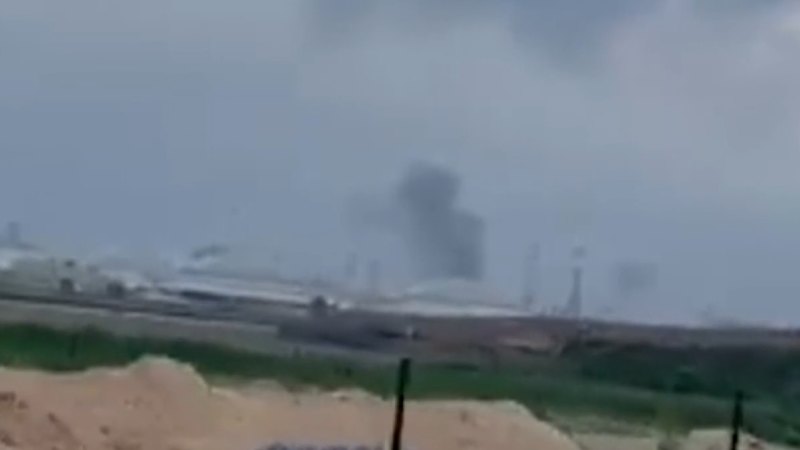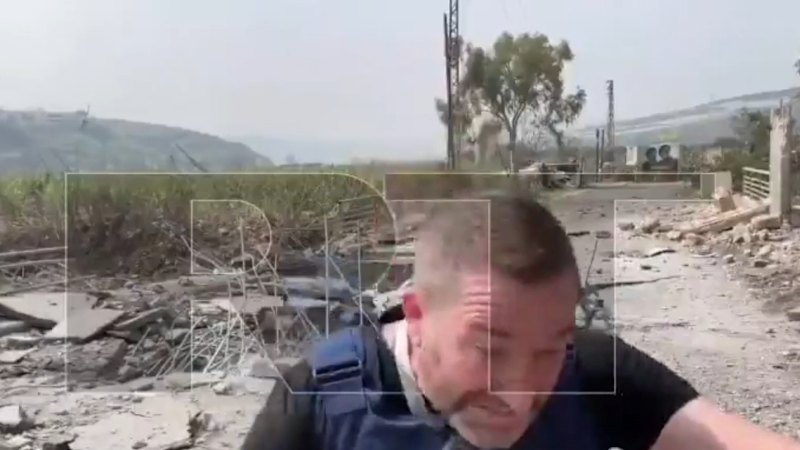
A split second separates a routine live broadcast from a lethal disaster. You've seen the footage by now. A reporter stands in a flak jacket, microphone in hand, trying to explain the complexities of a border conflict. Then, the world explodes. A missile slams into the ground just meters away, turning a news segment into a raw struggle for survival. This isn't just about a viral video or a close call. It's about the rapidly shrinking safety zone for journalists trying to cover the escalating violence in Southern Lebanon.
When a strike lands that close, the physics of it are terrifying. You don't just hear the blast; you feel the overpressure wave hit your chest like a physical blow. Dirt, shrapnel, and concrete dust fill the air instantly. For the crew on the ground, the internal debate between the "job" and "survival" vanishes. Everything becomes instinct.
Why the Buffer Zone for Journalists has Vanished
The recent strike near a reporting crew in Lebanon highlights a shift in how this conflict is being fought. In previous decades, press markings—the bold "PRESS" lettering on vests and vehicles—acted as a soft shield. There was a tacit understanding that media crews were observers, not targets. That shield is gone.
Modern warfare in the Middle East uses high-precision munitions. These aren't stray bullets from a 1970s skirmish. When a missile lands thirty feet from a camera, it's rarely an "accident" in the traditional sense. It’s either a terrifyingly close miss of a nearby target or a deliberate warning shot. Either way, the message is clear. Nowhere is safe.
Journalists in Lebanon are now operating in what military analysts call a "non-permissive environment." This means the old rules of engagement don't apply. If you're standing near a site that a drone operator perceives as a launch point or a lookout, you're in the kill zone. The blue vest doesn't give you a magical aura of invincibility. It just makes you a highly visible person in a high-risk area.
The Mental Toll of the Near Miss
Most people watch these clips on social media and move on after ten seconds. They don't think about what happens when the camera stops rolling. I've talked to people who have been through this. The adrenaline keeps you moving for an hour, maybe two. Then the "what ifs" start.
What if the wind had been different? What if the launcher was angled two degrees to the left?
This is the hidden cost of war reporting. It's not just the physical danger; it's the psychological erosion. Every time a reporter like the one in the recent Lebanon footage goes back out, they're gambling with a hand that gets weaker every day. The sound of a buzzing drone overhead—a constant in Southern Lebanon—becomes a source of chronic stress that never really goes away.
We often praise the bravery of these correspondents. Bravery is part of it, sure. But there's also a grim necessity. Without these crews willing to stand in the dust of a missile strike, we wouldn't see the reality of the civilian impact on the ground. We'd only have the sanitized press releases from government spokespeople.
Equipment and Training Can only Do So Much
News organizations spend a fortune on "Hostile Environment and First Aid Training," known as HEFAT. They buy Level IV body armor and armored SUVs. These things are great for stray fragments or small arms fire. They aren't designed to stop a direct or near-miss hit from a modern guided missile.
The reality of 2026 is that technology has outpaced protection. A reporter can have the best helmet on the market, but if a missile hits the building next to them, the shockwave alone can cause internal injuries that no vest can prevent.
We see crews moving in smaller teams now. They're trying to stay mobile. They spend less time in one spot to avoid being "fixed" by thermal sensors or surveillance drones. It’s a cat-and-mouse game where the mouse is carrying a tripod and the cat has a laser-guided bomb.
The Problem with Proximity
- Target Saturation: In places like Lebanon, military assets are often tucked into civilian infrastructure.
- Signature Tracking: Even a news broadcast emits signals that can be picked up by electronic warfare units.
- The Fog of War: High-speed combat leads to rapid decision-making cycles where mistakes are lethal and final.
Accountability in the Crosshairs
When a reporter is nearly killed, the finger-pointing starts immediately. One side says the press was being used as a human shield. The other side says the military is intentionally targeting truth-tellers. Usually, the truth is buried under the rubble.
International law is supposed to protect journalists as civilians. The Geneva Conventions are pretty clear on this. But international law only works if there's a mechanism to enforce it. In the heat of the Lebanon conflict, those legal protections feel like a polite suggestion rather than a hard rule.
We need to stop treating these "close calls" as mere spectacles. They are evidence of a collapsing international consensus on the safety of the press. If we lose the ability to report from these zones because the risk becomes 100% fatal, we lose our eyes on the world's most dangerous flashpoints.
What Needs to Change for Ground Crews
The industry has to stop pushing for the "money shot." Sometimes, the most important thing a producer can do is tell their team to pack up and leave before the strike happens. There is a toxic culture in some newsrooms that prizes proximity over life. That has to end.
Security advisors on the ground need more authority. If a local security expert says a ridge is too hot, the desk in London or New York shouldn't argue. We also need better transparency from military forces regarding their "no-strike" lists. If a news crew registers their GPS coordinates with a deconfliction cell, that data needs to actually reach the guy with his finger on the trigger.
If you want to support real journalism, stop just "liking" the video of the explosion. Read the deep-dive reports that these journalists risk their lives to write. Demand that your representatives hold military forces accountable for the safety of non-combatants and press.
Check the bypass filters on your news feed. Look for independent reporting that hasn't been scrubbed by a military censor. The best way to honor the risk these reporters take is to actually pay attention to the story they were trying to tell before the sky fell in on them. Don't let the blast be the only thing you remember.