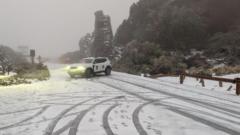
The sight of snow blanketing the peak of Mount Teide while tourists sunbathe on the beaches of Costa Adeje is the quintessential postcard image of Tenerife. It sells a dream of eternal spring coupled with Alpine drama. However, the arrival of Storm Therese has stripped away the aesthetic charm to reveal a more grit-toothed reality. This is not just a picturesque dusting of white. It is a systemic shock to an island infrastructure that remains stubbornly unequipped for the volatile shifts in North Atlantic weather patterns.
Storm Therese did not just bring rain. It brought a breakdown of the standard operating procedures for the Canary Islands. While the headlines focus on the novelty of snow in the subtropics, the investigative truth lies in the paralysis of the transport networks and the fragility of the local power grid. When the thermometer drops on the high ground, the economic gears of the island begin to grind.
The Atmospheric Trigger Behind Therese
To understand why this storm hit with such localized ferocity, we have to look at the breakdown of the Azores High. Usually, this high-pressure system acts as a shield, deflecting cold northern fronts away from the archipelago. When that shield wobbles or migrates, a corridor opens. Storm Therese took full advantage of this atmospheric gap, pulling a mass of polar maritime air down to latitudes that usually expect mild trade winds.
This was a classic "cold drop" scenario, known locally as a DANA. The interaction between the warm sea surface temperatures of the Atlantic and the sudden influx of freezing air at high altitudes creates a vertical instability that defies standard seasonal expectations. In the case of Tenerife, the massive topography of the island—dominated by the 3,715-meter peak of Teide—acted as a physical barrier. The storm didn't just pass over; it collided with the mountain, dumping massive amounts of precipitation that turned to snow above the 2,000-meter mark.
Logistics on Ice
The immediate impact was the closure of all access roads to the Teide National Park. While this sounds like a routine safety measure, it highlights a recurring failure in regional planning. The TF-21 and TF-24 highways are the main arteries for both tourism and scientific research, yet they lack the specialized clearing equipment seen in mainland European mountain ranges.
Tenerife operates on a binary weather philosophy. It is either sunny or it is a "weather event." There is very little middle ground in the institutional mindset. Consequently, when Therese hit, the response was reactive rather than proactive. Emergency services found themselves stretched thin, not because of the volume of snow, but because of the volume of unprepared travelers who attempted to "chase the snow" without thermal gear or appropriate vehicles.
The Hidden Cost of the Snow Chasers
Every time snow falls on Teide, a strange phenomenon occurs in the local population. Thousands of residents from the coastal towns rush toward the peaks to see the snow, often for the only time that year. This creates a logistical nightmare.
- Gridlock on narrow mountain passes: Emergency vehicles cannot move when the roads are clogged with rental cars and family hatchbacks.
- Pressure on local resources: Small mountain villages like Vilaflor are overwhelmed by a sudden influx of thousands of visitors, straining water and sanitation systems.
- Environmental degradation: Off-road parking and littering in the protected National Park surge during these brief windows of winter weather.
Water Security and the Silver Lining
If there is a counter-argument to the chaos, it lies in the reservoirs. The Canary Islands are in a perpetual state of anxiety regarding water security. Desalination plants are expensive to run and energy-intensive. Storm Therese, for all its disruption, provided a massive hydrological injection.
Snow on the peaks acts as a natural slow-release reservoir. Unlike heavy rain, which often runs off the volcanic soil too quickly to be absorbed, snow melts gradually. This allows the water to seep into the underground aquifers (the galerías). For the agricultural sectors in the north of the island, particularly the banana plantations and vineyards, this moisture is more valuable than any government subsidy. The "white gold" of Teide is the only thing keeping certain inland farming communities viable during the increasingly frequent drought cycles.
The Energy Fragility Exposed
While the peaks were freezing, the mid-altitude towns faced the brunt of the wind and rain. Storm Therese exposed the precarious nature of the Canarian electrical grid. Because the islands are not connected to a continental power block, they operate as "energy islands."
When high winds hit, the overhead lines—many of which are decades old and exposed to salt-heavy air—frequently fail. During the height of the storm, thousands of residents in the northern municipalities experienced rolling blackouts. The irony is that while the islands are a prime location for wind and solar energy, the current storage technology and grid stability measures are not yet robust enough to handle the sudden surges and drops caused by a storm of this magnitude.
Rethinking the Eternal Spring Narrative
The marketing of Tenerife as a place where the weather never changes is becoming a liability. As North Atlantic storm tracks become more erratic, the frequency of these "unseasonal" events is increasing. Industry analysts suggest that the travel sector needs to pivot.
Instead of promising 365 days of sun, there needs to be an honest dialogue about the wild diversity of the Canarian climate. You can experience four seasons in a single hour-long drive from Santa Cruz to Las Cañadas. Travelers need to be briefed on the necessity of carrying more than just swimwear.
The economic fallout from Storm Therese isn't just about a few canceled tours or closed roads. It is about the cost of repair for infrastructure that was designed for a climate that no longer exists. The drainage systems in the coastal tourist hubs are frequently overwhelmed by the volume of runoff from the mountains, leading to "brown flag" incidents at the beaches due to sewage overflow. This is the unglamorous side of the storm that the brochures won't mention.
A Question of Preparedness
The Canary Islands government faces a choice. They can continue to treat storms like Therese as "freak occurrences," or they can begin the expensive process of hardening the island’s infrastructure. This means undergrounding power lines, investing in modern snow removal for the high-altitude roads, and completely overhauling the urban drainage systems in the south.
The snow on Teide is a warning. It is a visual reminder that the islands are at the mercy of a changing Atlantic. The next storm might not just bring snow to the peaks; it could bring the kind of sustained wind and rain that the current coastal developments are simply not built to withstand.
If you are planning a trip to the highlands in the wake of a storm, check the official Cabildo de Tenerife social media channels for road closures before you leave your hotel. The mountain does not care about your holiday itinerary. Be ready for the cold, or stay on the coast. For the island itself, the task is much harder: it has to learn how to survive the winter it spent fifty years pretending didn't exist.