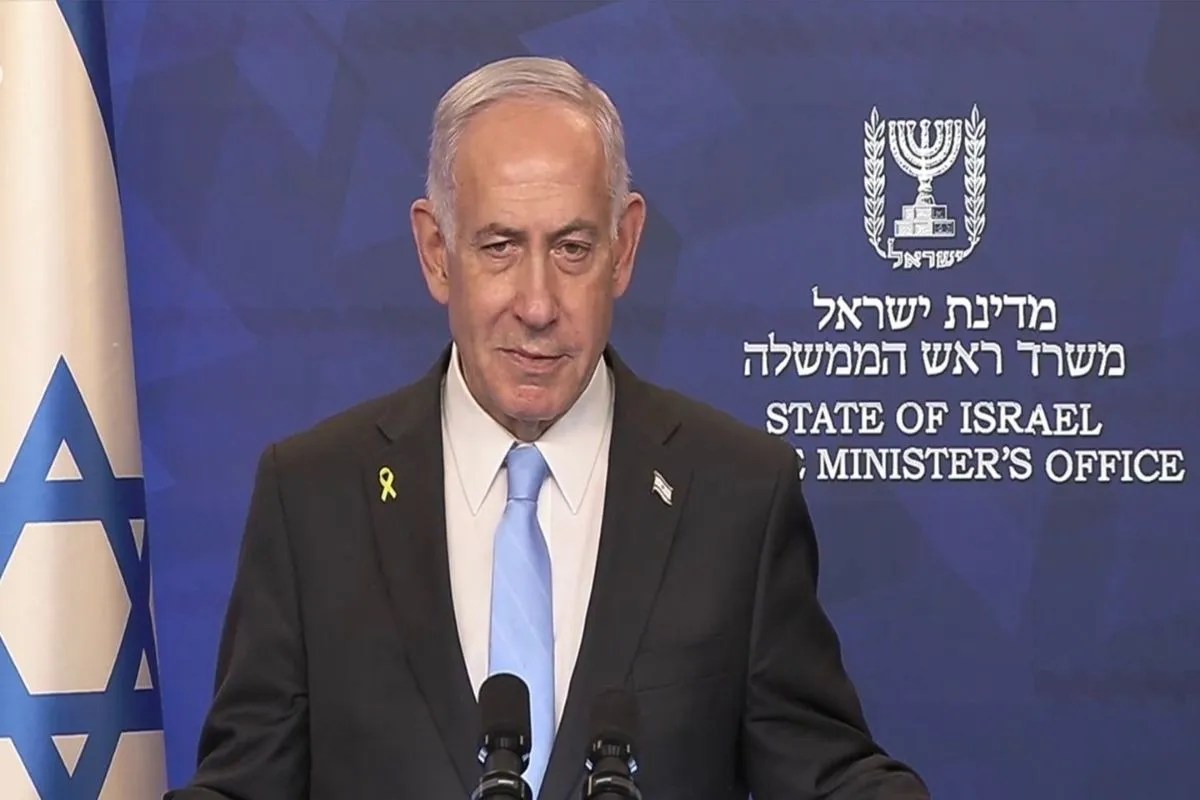
The shadow war between the West and the Islamic Republic of Iran ended at 9:45 a.m. IRST on February 28, 2024. In a coordinated blitz of kinetic force, the United States and Israel launched Operation Epic Fury and Operation Roaring Lion, a combined strike that has effectively decapitated the Iranian leadership. Within hours, Israeli Prime Minister Benjamin Netanyahu confirmed what many intelligence circles suspected: Ayatollah Ali Khamenei, the 86-year-old Supreme Leader, is almost certainly dead. This is not just another exchange of fire in a long-running proxy conflict. This is a deliberate, high-stakes gamble on regime change that has turned the regional status quo into a memory.
Netanyahu’s message, delivered from the Kirya military headquarters, was devoid of the usual diplomatic ambiguity. He described the strikes as a "pre-emptive blow" designed to dismantle an "existential threat" before it could achieve nuclear breakout. By targeting the Pasteur district in Tehran—the nerve center of the regime—the coalition wiped out not just the Supreme Leader, but an estimated 40 to 48 senior officials, including Defense Minister Aziz Nasirzadeh and IRGC Commander-in-Chief Mohammad Pakpour.
The Intelligence Coup Behind the Firestorm
The success of the opening salvos suggests a catastrophic failure of Iranian internal security. For decades, the IRGC prided itself on a "passive defense" strategy, burying its command structures deep beneath the Alborz mountains. Yet, the coalition forces hit their marks with terrifying precision. Reports indicate that the strike on Khamenei’s compound was guided by actionable intelligence, likely human assets within the inner circle or sophisticated signal intercepts that bypassed Iran’s aging electronic warfare suites.
We are seeing the debut of Task Force Scorpion Strike, a US unit utilizing low-cost one-way attack drones in massive swarms. These "suicide" drones acted as the vanguard, overwhelming the S-300 and S-400 air defense batteries that Tehran relied upon for protection. While Iran spent billions on its missile program, its air shield proved to be a paper tiger when faced with the combined electronic suppression of 200 Israeli fighter jets and US Tomahawk cruise missiles.
A New Doctrine of Elimination
The strategy shift is jarring. In previous years, the US and Israel focused on "cutting the grass"—targeting proxies like Hezbollah or slowing down nuclear enrichment through cyberattacks like Stuxnet. This weekend, they pulled the weed out by the roots. By eliminating the clerical and military leadership simultaneously, the coalition has created a power vacuum that the regime’s remaining apparatus is struggling to fill.
Netanyahu’s appeal directly to the Iranian people—"take your destiny into your own hands"—reveals the ultimate objective. This is an invitation to domestic revolt. The Israeli Prime Minister is betting that the grief over the strikes will be eclipsed by the long-simmering resentment of a population that has endured decades of economic ruin and social repression.
The High Cost of the Iranian Counterpunch
Tehran did not go quietly into the night. Even as the central command crumbled, decentralized units of the IRGC and the regular army launched a desperate retaliatory barrage. Missiles and drones have rained down on Israel and US assets across the Middle East.
- Beit Shemesh under fire: An Iranian missile strike on this city near Jerusalem killed at least eight civilians on Sunday morning.
- The Gulf in flames: Iran has targeted US bases in Iraq, Qatar, Kuwait, and the UAE. In Dubai and Doha, the world’s busiest air hubs have ground to a halt as airspace remains closed.
- Maritime chaos: Pro-regime forces have attacked tankers in the Strait of Hormuz and the Gulf of Oman, hitting the oil tanker "Skylight" and sinking several smaller vessels.
This is the "painful days" Netanyahu warned about. The Israeli military is currently mobilizing 100,000 reservists, signaling that this operation is not a one-off event. It is a full-scale regional war. The risk for the coalition is that while the head of the snake has been cut off, the body—the vast network of proxies and sleeper cells—is thrashing with lethal unpredictability.
The Geopolitical Fallout and the Death of International Law
The international community is fractured. While Washington and Jerusalem claim "legitimate self-defense" against a nuclear-aspirant terror state, the legal foundations of the global order are shaking. This operation bypasses the United Nations Security Council entirely, establishing a precedent for pre-emptive regime change that Moscow and Beijing will undoubtedly use to justify their own future aggressions.
China has already issued a "strong condemnation," and Russia is likely to see this as a green light for further escalation in its own spheres of influence. The question is no longer whether Iran will have a nuclear weapon, but whether the global system of sovereign states can survive a return to "might makes right" as the primary tool of diplomacy.
The Successor Crisis
Inside Iran, a three-person interim council led by President Masoud Pezeshkian has technically assumed leadership. However, without the religious and political gravity of Khamenei, the IRGC’s different factions are likely to turn on one another. Civil war in Iran is no longer a fringe theory; it is a looming probability. If the military splits, the resulting chaos could make the Syrian Civil War look like a minor skirmish.
The next 48 hours are critical. If the Iranian people do not rise up as Netanyahu and Trump have predicted, the coalition will be forced into a prolonged air campaign to suppress the remnants of the Iranian military. This would deepen the humanitarian crisis and potentially draw in other regional actors like Turkey or Saudi Arabia into a wider conflagration.
The old Middle East is dead. The new one is being forged in the rubble of Tehran. The only certainty is that the "stability" we knew is never coming back.
Would you like me to analyze the potential economic impact of the Strait of Hormuz closure on global oil prices over the next thirty days?


