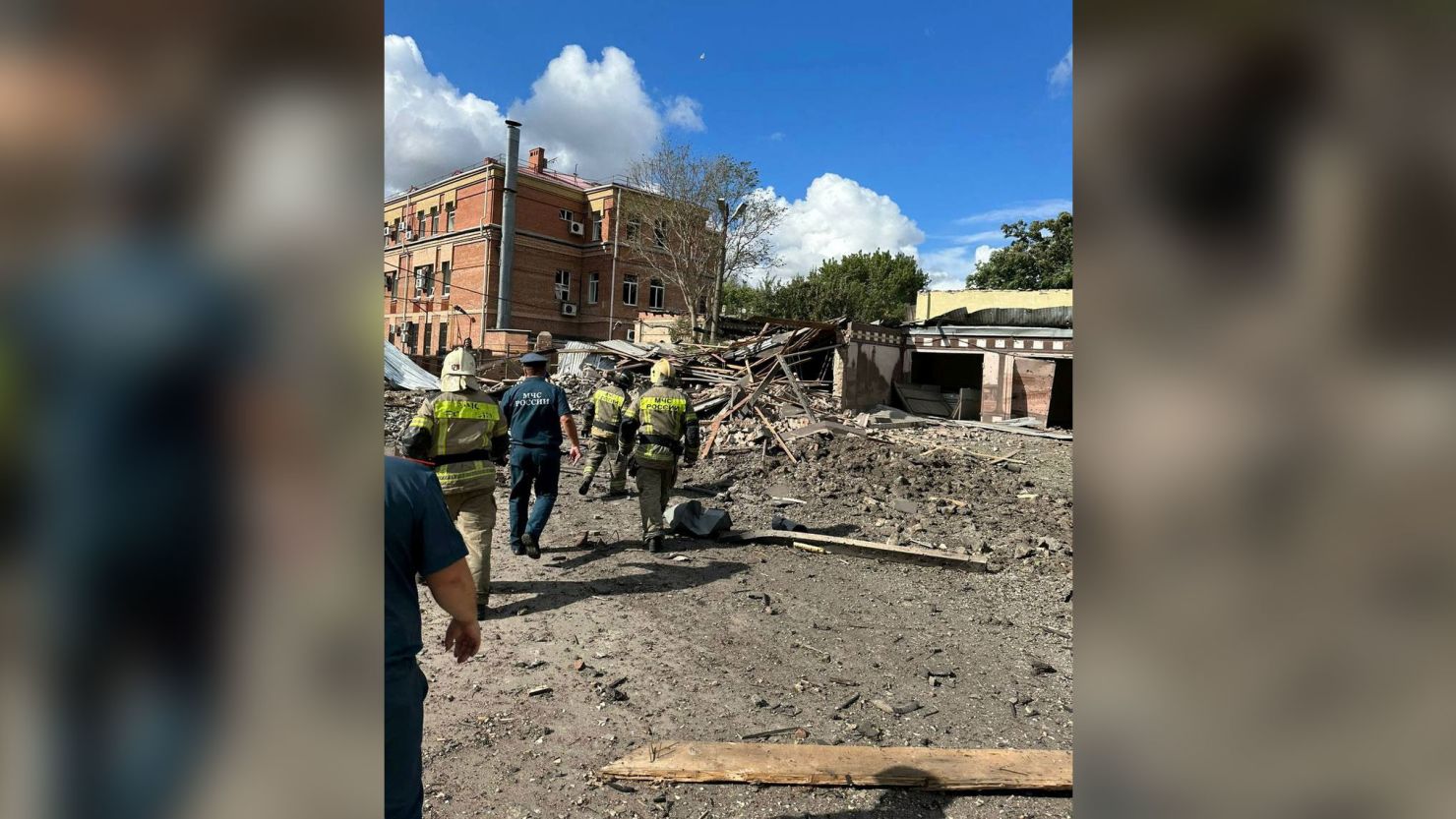
The headlines are always the same. "Drone strike damages homes." "One civilian killed." "Industry hit in southern Russia."
This is lazy reporting. It treats modern drone warfare as a series of unfortunate accidents or localized tragedies. It focuses on the smoke and the shattered glass while ignoring the terrifyingly efficient logic of the machines overhead. Taganrog is not a random target, and these are not just "drones." We are witnessing the systematic dismantling of a 20th-century industrial hub by 21st-century autonomous systems.
If you think this is about "terrorizing" a population, you’ve fundamentally misunderstood the math of the conflict. This is about the total breakdown of the Russian rear-guard and the obsolescence of traditional air defense.
The Myth of the Lucky Shot
The mainstream media loves the narrative of the "lucky strike." They suggest that a few hobbyist drones somehow evaded the "impenetrable" Russian S-400 umbrellas to hit a factory.
Let’s kill that delusion right now.
I have spent years analyzing procurement cycles and electronic warfare (EW) signatures. You don’t hit an aircraft plant in Taganrog—a city that houses the Beriev Aircraft Company—by accident. You hit it because you have solved the geographic and electronic puzzle of the most defended airspace in the Southern Military District.
The "damage to industry" reported in these strikes isn't collateral. It is a calculated strike against the A-50 Mainstay airborne early warning and control (AWACS) maintenance pipeline. When a drone hits a Taganrog workshop, it isn't just breaking a roof; it is resetting the clock on Russia’s ability to see deep into Ukrainian airspace.
Every headline focusing on a "damaged home" is doing the Russian Ministry of Defense a favor. It masks the reality that their billion-dollar air defense grids are being humiliated by $50,000 worth of carbon fiber and internal combustion engines.
The Attrition Math Nobody Wants to Face
Critics often argue that these long-range strikes are "pinpricks" that cannot win a war. They cite the sheer scale of the Russian Federation as a shield.
They are wrong.
War is an exercise in resource management and logistics. If Ukraine launches twenty drones and nineteen are shot down, but the twentieth hits a transformer or a specialized CNC machine in a Taganrog factory, who won?
- The Drone: Cost $30,000 to $100,000.
- The Interceptor: A Pantsir or S-300 missile costs between $500,000 and $2 million.
- The Target: A specialized aerospace component or energy node can be worth tens of millions and, under current sanctions, might be literally irreplaceable.
Russia is trading gold for lead. They are depleting their high-end interceptor stocks to stop lawnmower engines in the sky. When you see "industry damaged" in Taganrog, you are seeing the failure of a superpower to adapt its defensive doctrine to the reality of cheap, mass-produced lethality.
The Problem With "Air Defense"
Traditional air defense was designed to kill "fast movers"—jets and cruise missiles with massive heat signatures.
Drones are slow. They are small. They fly low, hugging the terrain to stay beneath the radar horizon. They use "waypoints" to navigate around known SAM (Surface-to-Air Missile) sites. In Taganrog, the proximity to the Sea of Azov provides a natural corridor where radar clutter from waves makes detection nearly impossible until the drone is over the city.
The "lazy consensus" says Russia will just build more radars.
The reality? You cannot build enough radars to cover every square kilometer of a border that size. The geography favors the hunter, not the house.
Why Civilian Casualties Are a Strategic Distraction
It sounds cold, but in the realm of high-stakes military analysis, we have to look at the signal, not the noise.
When a drone hits a residential building near an industrial site, the immediate outcry is about "war crimes" or "targeting civilians." While any loss of life is tragic, viewing these events through a purely humanitarian lens obscures the tactical failure occurring.
In Taganrog, the Beriev plant and other military-industrial facilities are woven into the urban fabric. When Russian EW units "jam" a drone, they don’t just turn it off. They scramble its GPS. The drone doesn't disappear; it loses its way. It falls. It hits whatever is beneath it.
The irony that most "analysts" miss is that Russian defensive measures—the jamming and the kinetic interceptions over populated areas—are often what causes the civilian damage they then use for propaganda. It is a self-inflicted wound disguised as enemy aggression.
The Taganrog Prototype: What Happens Next?
Taganrog is a blueprint.
We are moving into an era where "the front" is a decorative concept. The front is now everywhere a drone can reach, which, as we’ve seen, is now over 1,000 kilometers from the launch point.
The goal isn't to occupy Taganrog. The goal is to make Taganrog—and every other city like it—economically and militarily unviable. If workers are afraid to go to the factory, if insurance for industrial shipping skyrockets, and if the power grid is a flickering mess, the war machine grinds to a halt without a single tank crossing the border.
I’ve seen this play out in corporate logistics. One broken link in a "just-in-time" supply chain can bankrupt a firm. This is the "just-in-time" delivery of high explosives to the exact link that breaks the Russian chain.
The Hard Truth About Sanctions and Repairs
People ask: "Can't they just fix the damage?"
In a pre-2022 world, yes. But Taganrog’s industry relies on precision German, Japanese, and American tooling. When a drone detonates inside a workshop, it isn't just the walls that break. It’s the micro-calibration of the machines.
You can’t buy those on the open market anymore. You can’t "fix" a vaporized high-precision lathe with Soviet-era spare parts. The damage in Taganrog is cumulative and permanent in a way that the news cycle fails to grasp.
Stop Asking if the Strikes Work
The question "Are these strikes effective?" is the wrong question. It assumes there is a "win" state where the strikes stop.
The right question is: "How long can a centralized, authoritarian economy withstand the decentralized, low-cost decapitation of its industrial hubs?"
The answer is: Not as long as the Kremlin thinks.
The strikes on Taganrog aren't a sign of Ukrainian desperation. They are a sign of Russian vulnerability. They prove that the "Great Power" has no clothes—and no shield.
If you’re waiting for a ceasefire to "fix" this, you’re dreaming. This technology is out of the bottle. The era of the "safe rear" is dead. Taganrog was just the wake-up call that the rest of the world is too tired to hear.
Stop looking at the smoke. Start looking at the logic. The machines aren't just coming; they're already there, and they have a list.
Don't buy the narrative that this is a stalemate. It’s an eviction notice.