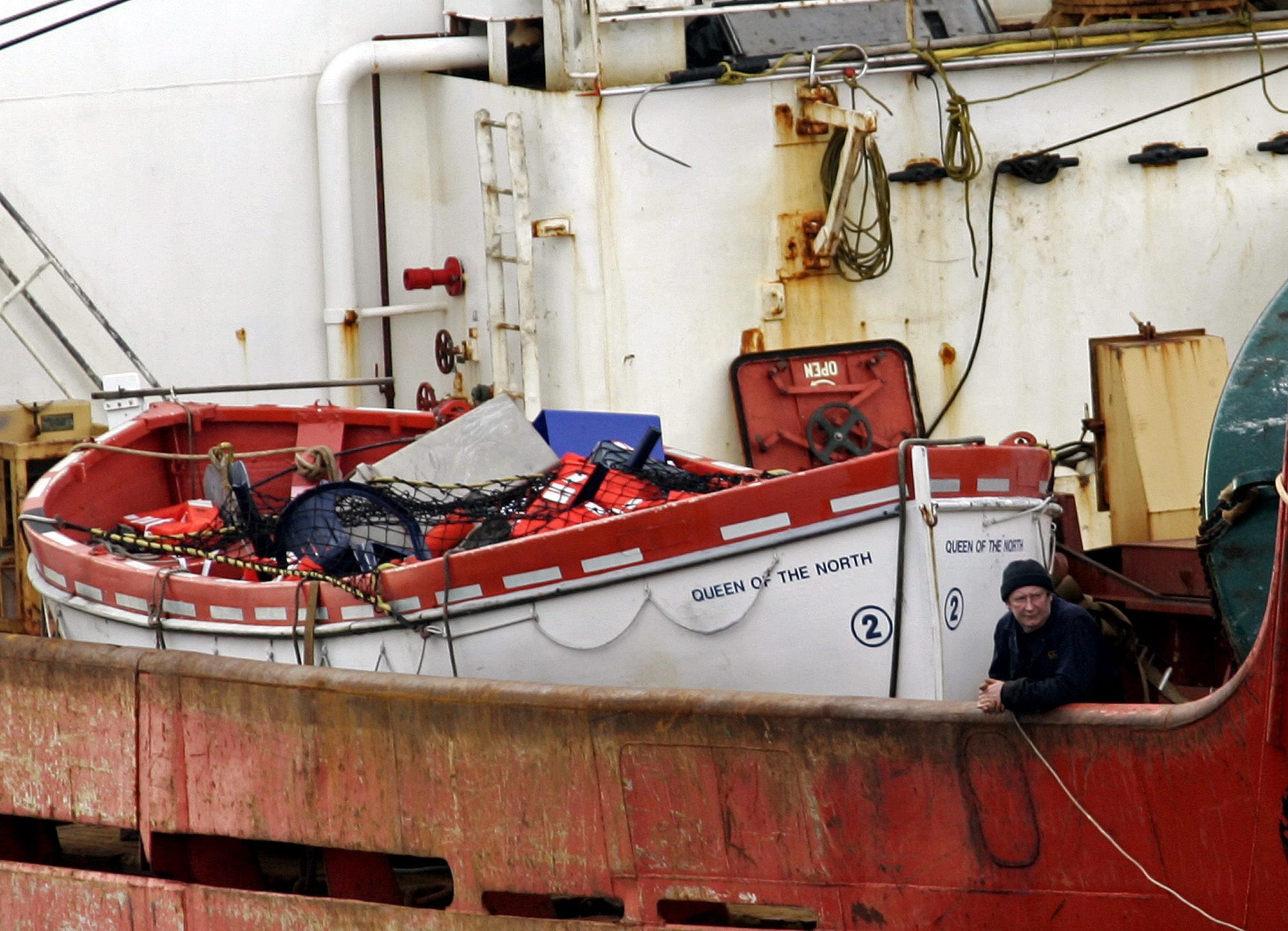
The sinking of the Queen of the North on March 22, 2006, serves as a primary case study in the breakdown of redundant safety systems and the catastrophic intersection of human error with rigid operational culture. While public discourse often simplifies the event to a "mystery" or a localized lapse in judgment, a structural analysis reveals a failure of the Bridge Resource Management (BRM) framework. The loss of the vessel was not an isolated stochastic event but the inevitable output of a degraded safety margin where multiple independent layers of protection failed simultaneously.
The Kinematics of the Collision
The technical reality of the sinking is defined by a failure to execute a critical 15-degree course change at Sentry Shoal. At 00:00, the vessel was traveling at 17.5 knots. The missed turn resulted in the ship maintaining a steady heading for 14 minutes directly toward Gil Island.
To understand the scale of this oversight, one must examine the Detection-to-Impact Window. In modern maritime navigation, situational awareness is maintained through a triad of sensory inputs:
- Visual Lookout: The physical observation of landmarks and navigational aids.
- Radar Monitoring: Active scanning for terrestrial echoes and other vessels.
- Electronic Chart Display and Information System (ECDIS): Real-time GPS overlay on digital cartography.
The failure of all three systems suggests a total collapse of the bridge environment. The crew did not just miss a turn; they ceased to interact with the navigational reality of the vessel. This is categorized in safety science as an Error of Omission resulting from a "lost mental model," where the operators believe they are in one geographical location while the physical asset is in another.
The Structural Breakdown of Bridge Resource Management
The marine industry operates on the principle of redundancy. No single person should be the sole point of failure. On the night of the sinking, the bridge was staffed by a fourth mate and a quartermaster. The breakdown can be mapped across three distinct failure vectors.
1. The Hierarchy of Silence
BRM is designed to flatten the bridge hierarchy, allowing a subordinate to challenge a superior if a deviation from the passage plan is detected. On the Queen of the North, this communication loop was severed. Evidence suggests that the interpersonal dynamics between the two bridge officers created a "silo effect." When the quartermaster is not actively integrated into the navigation process, they transition from a safety redundant sensor to a mere tool operator.
2. The Automation Bias
The vessel was equipped with an autopilot system. Automation bias occurs when human operators over-rely on automated systems, leading to a state of Active Disengagement. The "look-out" requirement mandated by the International Regulations for Preventing Collisions at Sea (COLREGs) was neglected because the perceived reliability of the autopilot created a false sense of security. The autopilot functioned perfectly—it maintained the wrong heading precisely as instructed.
3. Environmental Masking
At 00:21, the vessel struck the rocks. The environmental conditions—darkness and heavy rain—acted as a noise floor that masked the approaching shoreline. In a high-functioning system, environmental degradation should trigger an increase in active scanning. Here, it did the opposite, providing a veil that prevented visual correction of the underlying navigational error.
The Logistics of Abandonment and Hull Integrity
Once the impact occurred, the problem shifted from a navigational failure to a Survival Systems Crisis. The Queen of the North was a roll-on/roll-off (Ro-Ro) ferry. These vessels are notoriously vulnerable to "The Free Surface Effect."
When water enters the expansive, unobstructed car deck of a Ro-Ro vessel, it shifts rapidly with the ship's movement. This creates a massive destabilizing force. The physics of the sinking are dictated by the Metacentric Height (GM). As water surged onto the deck, the GM became negative, leading to a rapid list and subsequent capsizing.
The evacuation of 99 passengers and 34 crew members under these conditions was an operational success overshadowed by the loss of two individuals. The fact that the majority survived is attributable to the functional deployment of lifeboats and the assistance of the nearby community of Hartley Bay. However, the failure to account for two passengers highlights a critical flaw in the Manifest Reconciliation Process. In a crisis, the transition from a paper manifest to a physical head count is the most common point of failure in maritime search and rescue.
The Institutional Memory Gap
Twenty years post-incident, the maritime industry struggles with the "decay of lessons learned." BC Ferries implemented significant changes following the sinking, including:
- Standardized Bridge Resource Management training.
- The installation of "Black Box" Voyage Data Recorders (VDR) across the fleet.
- Stricter protocols regarding bridge occupancy and distractions.
Yet, the fundamental risk remains human. The Normalization of Deviance is a sociological phenomenon where crews gradually drift away from standard operating procedures because "nothing has gone wrong yet." Over months of uneventful passages, a 14-minute window of inattention may seem low-risk. The Queen of the North is the data point that proves the risk is never zero.
Quantifying the Unattainable Why
The former CEO’s assertion that "we’ll never know why" is a rhetorical shield rather than an analytical truth. We know the how—a missed turn, a lack of visual confirmation, and a failure to utilize radar. The why is found in the Swiss Cheese Model of System Accidents.
Each layer of safety (The Captain’s standing orders, the Second Officer’s oversight, the Fourth Mate’s execution, the Quartermaster’s vigilance, and the Radar Alarms) has holes. Usually, these holes do not align. On March 22, 2006, the holes aligned.
The "mystery" of why the two officers failed to notice the island is less about a single inexplicable moment and more about the Cognitive Tunneling that occurs in low-stimulation environments. When a task becomes overly routine, the brain enters a "standby mode." This is not a mystery; it is a known physiological limitation of human operators in highly automated systems.
Operational Imperatives for Modern Fleet Management
To prevent a recurrence of the Queen of the North catastrophe, maritime entities must move beyond simple compliance and toward High Reliability Organizing (HRO). This requires a shift in three specific areas:
- Dynamic Risk Assessment: Crews must be trained to recognize when they are entering a "High-Risk State" (e.g., night transit, poor weather, crew fatigue) and manually increase the frequency of cross-checks.
- Technological Interlocks: Modern navigation systems now include "Off-Course Alarms" that cannot be easily silenced or ignored. These systems act as a hard-coded redundancy that bypasses human ego or distraction.
- Cultural Psychology: Organizations must foster an environment where a junior crew member feels a professional obligation—not just a right—to override a senior officer when a vessel deviates from its planned track.
The legacy of the Queen of the North is a permanent reminder that in the maritime sector, the margin between a routine transit and a total hull loss is measured in minutes and maintained only through the relentless application of redundant skepticism.
The immediate strategic move for any commercial maritime operator is the implementation of a No-Blame Reporting System combined with random bridge audits. If the culture does not allow for the reporting of "near misses" without fear of retribution, the organization remains blind to the "holes" in its safety layers until they align into a tragedy. The goal is to identify the 14-minute lapse before it intersects with a landmass.


