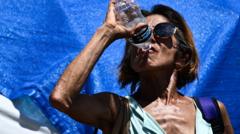
The air in the San Joaquin Valley usually carries the scent of damp earth and blooming almond wood in early March. It is a season of light jackets and cautious optimism, a time when the Sierra Nevada snowpack is supposed to be a frozen bank account, saving its riches for the lean months of July and August. But this week, the thermometer didn't just climb; it leaped.
By noon, the shade of the valley oaks felt less like a refuge and more like a taunt. The dirt, normally tacky with spring moisture, began to puff into a fine, grey powder under the tires of farm trucks. We are used to the heat out here—it is the price of admission for living in the West—but we aren't used to it now. Not like this. This is a "dangerous" heatwave, a term the National Weather Service doesn't throw around lightly, especially when the spring equinox is still a fresh memory.
When the mercury hits 90°F (32°C) or 100°F (38°C) in May, our bodies have had months of incremental warming to adjust. Our sweat glands have practiced. Our cardiovascular systems have done the metaphorical cardio. But a spike like this in the early season catches the human biology off guard. It is a physiological ambush.
The Body’s Broken Thermostat
Consider Maria. She is a hypothetical composite of the thousands of people who make the West Coast run—a landscape gardener in Sacramento or perhaps a utility worker in the high desert. Maria knows how to handle a July scorcher. She freezes her water jugs. She wears light linen. But today, she woke up to a morning that felt like a June afternoon.
Her body is still in winter mode, retaining salt and keeping blood volume at a baseline suited for 60-degree weather. When the ambient temperature rockets toward triple digits, her heart has to work twice as hard to pump blood to the surface of her skin to dissipate heat. Because she hasn't "acclimatized"—a process that typically takes two weeks of gradual exposure—she won't start sweating early enough or efficiently enough.
The danger isn't just the heat itself; it is the lack of a cooling-off period. In a standard summer pattern, the "Delta Breeze" or the marine layer rolls in at night, dropping temperatures into the 50s and giving the human heart a chance to rest. During this early-season anomaly, high-pressure ridges act like a heavy wool blanket draped over the coast. The heat gets trapped. The walls of the house stay warm. The core temperature of the human body never quite resets.
The Invisible Weight of a High-Pressure Ridge
Meteorologically, what we are seeing is an "omega block." Imagine the jet stream—that river of air high above us—meandering like a lazy snake. Suddenly, it kinks. A massive dome of high-pressure air parks itself over California, Oregon, and Washington, physically pushing down on the atmosphere.
As air sinks, it compresses. As it compresses, it heats up. This isn't the slow, baking heat of a campfire; it’s the sudden, pressurized heat of a bicycle pump. This "heat dome" doesn't just bring sunshine; it creates a stagnant vault where pollutants from morning traffic and agricultural dust sit and stew. For the millions living with asthma or chronic obstructive pulmonary disease, the heat is only the first layer of the threat. The second layer is the air they are forced to breathe.
The numbers are startling. Forecasters are predicting temperatures 15 to 25 degrees above historical averages for this time of year. In cities like Portland and Seattle, where air conditioning is often a luxury rather than a standard utility, the risk profile shifts entirely. A 90-degree day in Phoenix is a Tuesday. A 90-degree day in a Seattle apartment building designed to trap heat for the winter is a medical emergency.
The Snow That Vanishes in the Night
Beyond the immediate sting on the skin, there is a quieter, more existential crisis unfolding in the mountains. The West Coast lives and dies by its "water towers"—the snowpacks of the Cascades and the Sierras.
In a healthy year, that snow melts like a slow-release aspirin, feeding the rivers through the dry summer. When an early heatwave strikes, it triggers an "albedo flip." The sun, which is now as high in the sky as it would be in September, hits the white snow. Normally, the snow reflects that energy back into space. But as the top layer melts and becomes "ripe" (saturated with water), it turns darker and begins to absorb heat.
The melt accelerates. Instead of a steady trickle, we get a flash-flood of runoff that fills reservoirs too early, forcing managers to release water to prevent dam overflows. By the time the actual dry season arrives in August, the "bank account" is empty. The water we need for the grapes, the almonds, and the salmon is already gone, washed out to sea while we were still wearing spring sweaters.
The Psychology of the Unseasonable
There is a specific kind of dread that comes with a beautiful day that feels wrong. We are conditioned to love the sun. We are told that a "warm-up" is a gift after a long, grey winter. This makes the early heatwave a deceptive killer.
People flock to the coast or the rivers, seeking relief. But the water in the Pacific and the mountain-fed streams is still hovering near 50 degrees. This creates a lethal paradox: "Cold Water Shock." A person jumping into a river to escape the 95-degree air can experience an involuntary gasp reflex. Their lungs fill with water, their muscles cramp, and they can drown within feet of the shore. The heat drives them to the water, and the water betrays them.
We see this pattern every time the seasons blur. Our infrastructure, our biology, and our behavior are all calibrated for a world that stays within its lanes. When the lanes disappear, we are left navigating by instinct in a territory that has changed overnight.
Why This Isn't Just "Weather"
It is tempting to look at a single heatwave and call it an outlier. But the data suggests otherwise. The "shoulders" of the warm season—spring and autumn—are expanding. We are losing the buffer zones. The transition from the shivering damp of February to the blistering heat of July is being compressed into a single, violent weekend in March.
This shift impacts everything from the timing of bird migrations to the survival of "bud-break" in the vineyards. If a grapevine thinks it is June, it puts all its energy into growth. If a standard frost returns in April—as it often does—the entire crop can be lost in a single night. The heat is a false promise that the environment can't keep.
As the sun sets over the Pacific this evening, the sky will likely turn a vibrant, bruised purple—a side effect of the dust and heat trapped in the lower atmosphere. It will look beautiful on a smartphone screen. But for those watching the thermometer stay stubbornly in the 70s well past midnight, the beauty is a warning.
We are entering an era where we can no longer trust the calendar to tell us who we are or how to live. We are learning, painfully and in real-time, that the climate is not a backdrop to our lives. It is the floor we walk on. And right now, that floor is getting very, very hot.
The elderly neighbor who hasn't turned on her fan because "it’s only March" is at risk. The hiker who took two liters of water instead of five is at risk. The bridge of the nose, the back of the neck, and the rhythm of the heart are all being tested by a sun that didn't wait its turn.
The most dangerous thing about this heatwave isn't the number on the display. It is the belief that because it is spring, we are safe. We are standing in the sun, waiting for a summer that has already arrived, uninvited and ahead of schedule.