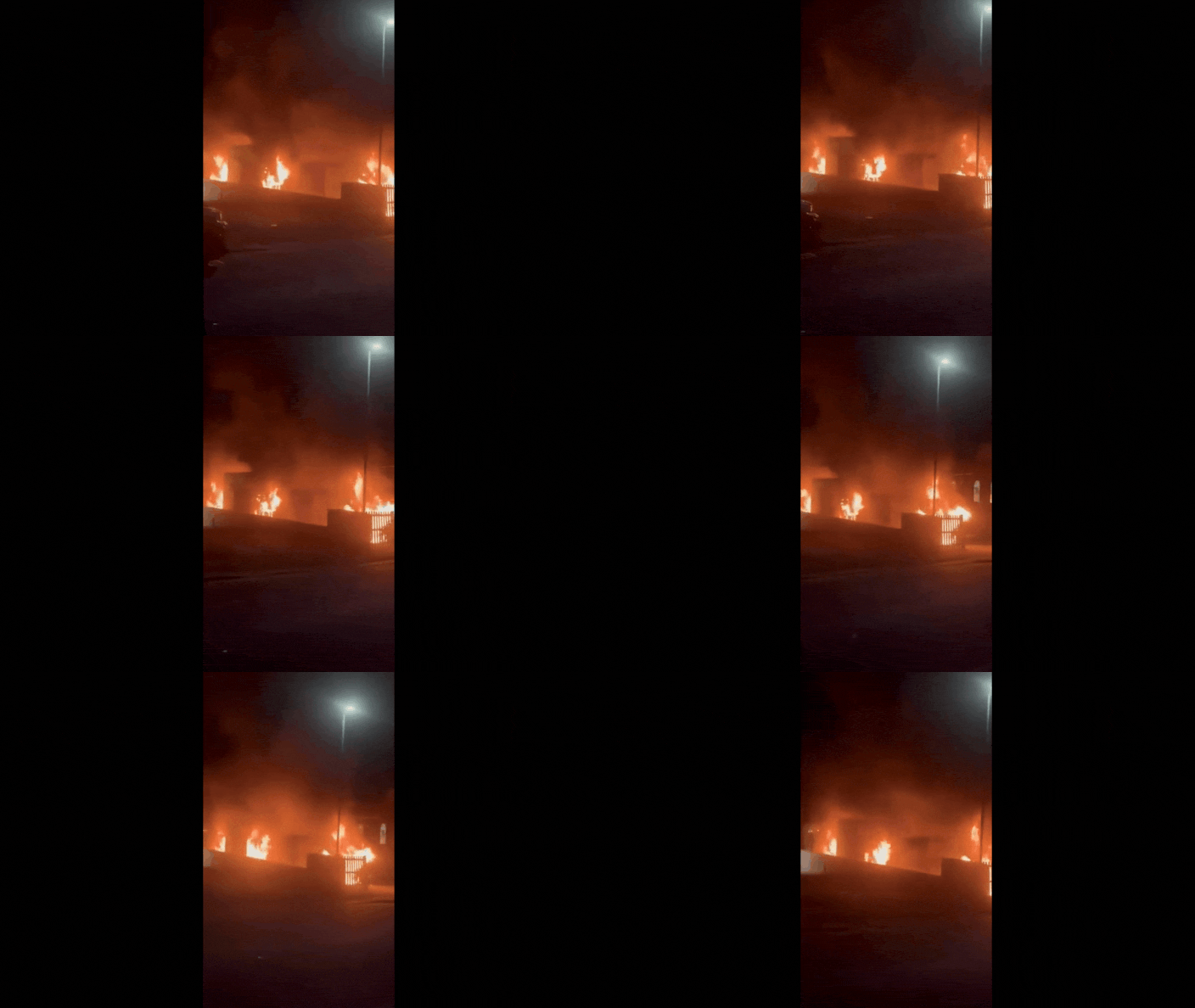
The destruction of four Hatzola Jewish community ambulances in London via coordinated or simultaneous arson represents more than a localized criminal act; it is a clinical demonstration of targeted infrastructure attrition. When specialized medical assets are neutralized, the loss is not merely the replacement cost of the vehicles, but the immediate degradation of a high-trust, low-latency emergency response network. This incident highlights a critical intersection between urban security vulnerabilities, the psychological impact of asset destruction, and the fragile logistics of community-funded emergency services.
The Triad of Asset Vulnerability
To analyze the impact of this event, one must categorize the attack through three distinct layers of institutional damage: Physical Capital Liquidation, Operational Response Latency, and the Psychological Deterrence Coefficient.
Physical Capital Liquidation
The Hatzola fleet consists of Type B or Type C ambulances, which are not off-the-shelf commercial vehicles. These units function as mobile intensive care environments. The destruction of four units simultaneously suggests a calculated attempt to maximize the "Replacement Gap"—the time between the loss of an asset and the deployment of a fully equipped successor.
- Specialized Outfitting: Beyond the base chassis (often a Mercedes Sprinter or similar), these vehicles contain integrated telemetry, oxygen delivery systems, and advanced life support (ALS) kits.
- Capital Concentration: Because Hatzola is a charitable organization, its capital is often tied up in these physical assets rather than liquid reserves. A loss of four vehicles represents a significant percentage of the local fleet's total capacity, creating a localized "equipment desert."
- Insurance Lag: While insured, the time-to-payout and the subsequent procurement lead times for medical-grade vehicles create a period of diminished capability that cannot be solved by capital alone.
Operational Response Latency
The primary value proposition of community-based ambulance services is the reduction of "Response-to-Patient" time. By operating within specific high-density neighborhoods, Hatzola often reaches patients faster than centralized NHS Trust resources during peak demand.
The removal of four vehicles from the rotation triggers a cascading failure in response metrics. When a specific geographic cluster loses 20% to 40% of its immediate response capability, the remaining units must cover a wider radius. This increases the "Turnaround Time" (TAT), as vehicles travel further between calls, leading to higher fuel consumption, increased mechanical wear, and, most critically, delayed patient interventions.
The Psychological Deterrence Coefficient
Arson is a tool of communicative violence. By targeting vehicles marked with Hebrew lettering and community identifiers, the perpetrators utilize "Symbolic Kinetic Action." The goal is to signal that even the most protected and benevolent symbols of a community—those dedicated to saving lives regardless of the victim's background—are vulnerable. This creates a secondary cost: the "Security Tax." Every future pound sterling raised by the charity must now be diverted from medical equipment toward hardening garage facilities, hiring private security, and installing high-grade surveillance.
The Logistics of the "Soft Target" Paradox
Emergency vehicles are inherently "soft targets" because their utility depends on accessibility. To maintain rapid response times, ambulances must be stationed near residential hubs rather than behind the fortified perimeters of military-grade compounds. This creates a structural paradox: the more accessible a lifesaver is to the public, the more vulnerable it is to bad actors.
The Mechanism of Arson as a Force Multiplier
Arson requires low technical expertise but yields high-magnitude results. In an urban setting like London, the thermal energy from one vehicle fire can easily spread to adjacent units if the parking configuration is optimized for space rather than fire suppression.
- Thermal Runaway: The presence of onboard oxygen canisters and combustible fuels makes an ambulance a high-energy target. Once the fire reaches the interior, the medical supplies act as accelerants.
- Logistical Fragility: Unlike a police station, which is manned 24/7, ambulance depots may have periods of low physical oversight between shifts, providing the "Window of Opportunity" necessary for a rapid-ignition attack.
Assessing the Hate Crime Framework via Pattern Recognition
While authorities investigate the "suspected hate crime" motive, a data-driven approach looks for "Signature Behaviors." Random vandalism usually targets a single unit or involves low-level property damage (graffiti, broken windows). Simultaneous or sequential ignition of four separate units indicates a "Saturation Attack."
The objective of a Saturation Attack is to overwhelm the immediate local capacity to respond to the fire itself while ensuring the total loss of the targeted assets. This level of coordination shifts the classification from "opportunistic crime" to "premeditated targeted attrition."
Risk Modeling for Community Infrastructure
Organizations must now apply a "Threat-Informed Defense" model to their logistical operations. This involves:
- Geographic Dispersion: Not housing the entire fleet in a single location to prevent a "Single Point of Failure" (SPOF).
- Kinetic Hardening: Installing fire-suppression systems within the parking bays themselves, rather than relying on the vehicle's internal systems.
- Digital Integration: Using real-time AI-monitored CCTV that triggers immediate alerts based on "Proximity Anomalies" (someone loitering near the vehicles outside of scheduled shift changes).
The Economic and Social Fallout of Asset Loss
The destruction of these ambulances imposes a direct "Public Health Tax" on the surrounding borough. When Hatzola's capacity drops, the burden shifts immediately to the London Ambulance Service (LAS).
The NHS Spillover Effect
The LAS is already operating under extreme pressure. Hatzola serves as a "Pressure Release Valve," handling thousands of calls annually that would otherwise fall to the state. When these four ambulances burn, the result is a measurable increase in the wait times for every citizen in the area, regardless of whether they are part of the Jewish community or not.
The "Opportunity Cost" of this attack is measured in minutes. In cardiac or stroke scenarios, a five-minute delay in an ambulance arrival can be the difference between full recovery and permanent neurological deficit. Therefore, the arson is not just a crime against property or a specific ethnic group; it is a systemic attack on the region's overall survival rate.
Hardening the Urban Medical Perimeter
To mitigate the recurrence of such attrition, community organizations must move toward a "Resilient Fleet Architecture." This requires a shift from viewing ambulances as mere transport units to treating them as critical infrastructure nodes that require active defense.
- Redundant Basing: Moving away from centralized depots toward "decentralized micro-hubs" makes it impossible for an attacker to neutralize a significant portion of the fleet in a single event.
- Asset Telemetry: Modern fleet management should include "Tamper Alerts" that notify operators the moment a vehicle's exterior shell is breached or if unusual heat signatures are detected while the vehicle is stationary.
- Community-State Synthesis: Increased data sharing between private community responders and the Metropolitan Police to identify "Pre-Operational Surveillance" patterns—where individuals may be scouting depots days before an attack.
The London incident serves as a stark reminder that in the modern urban landscape, the "Front Line" is not a fixed point. It exists wherever critical service assets are parked. The strategy moving forward cannot rely on the presumed "off-limits" status of medical vehicles. It must instead be built on the assumption that every asset is a target and must be defended through both physical hardening and logistical decentralization.
Organizations must immediately audit their "Concentration Risk." If more than 25% of your operational capacity is parked in a single unmonitored location, you have created a high-value, low-effort target for coordinated attrition. Redistribute the assets or fortify the perimeter immediately; the cost of proactive security is a fraction of the capital and human cost of a neutralized fleet.