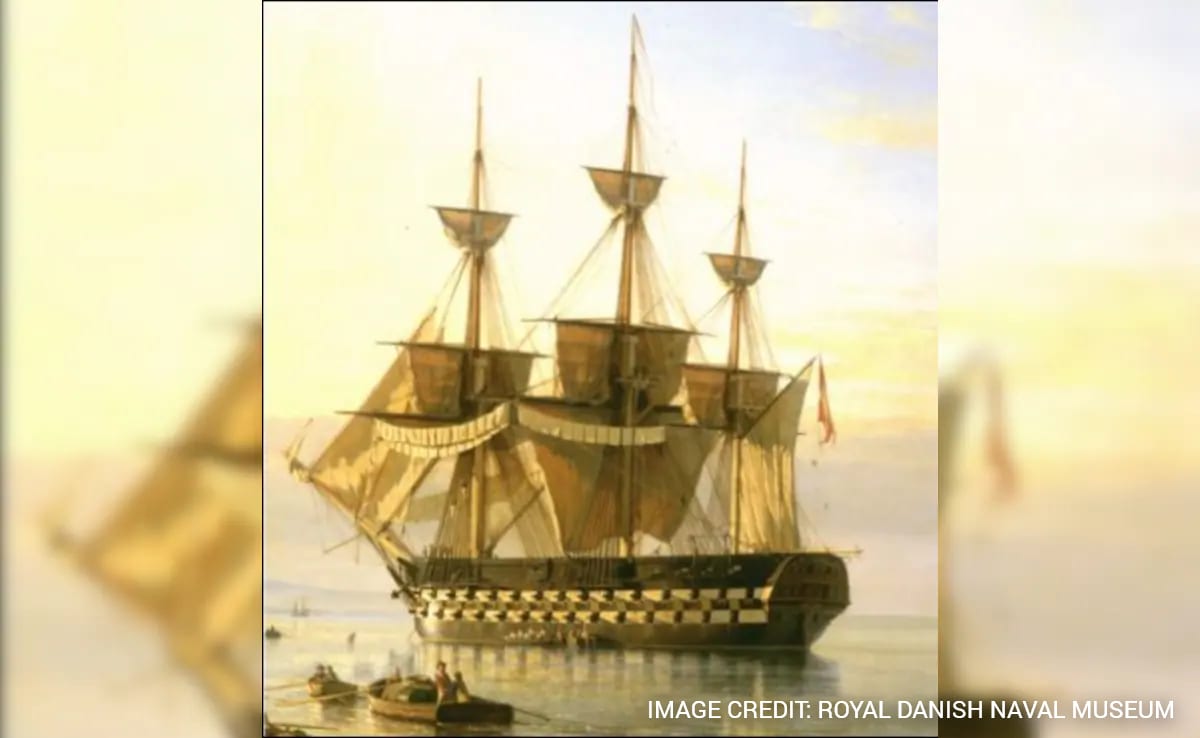
The 2026 identification of the Dannebroge wreckage in the Bay of Køge represents a forensic closure to a 225-year-old failure in naval architecture and tactical positioning. To understand why this 82-gun ship of the line was lost—and why its discovery provides critical data on early 19th-century maritime engineering—one must look past the narrative of "sinking" and analyze the thermal runaway of timber-framed warships under high-intensity bombardment. The Dannebroge did not merely succumb to enemy fire; it suffered a catastrophic breach of its internal safety protocols when an incendiary hit ignited its spirit room, leading to a structural collapse that effectively neutralized the Danish defense during the Battle of Copenhagen.
The Three Vectors of Danish Naval Vulnerability
The Danish strategy in 1801 relied on a static defense line of moored vessels, a configuration that prioritized firing stability over maneuverability. This operational choice created three specific failure points: Meanwhile, you can find similar stories here: The Cold Truth About Russias Crumbling Power Grid.
- Stationary Target Profiles: By removing the variable of movement, Danish commanders increased their hit probability for the British fleet but simultaneously allowed British gunners to achieve "bracketed" fire. Without the ability to tack or wear, the Dannebroge became a fixed thermodynamic system, absorbing energy without the means to dissipate it through repositioning.
- Logistical Proximity: Because the ships were moored near the capital to serve as floating batteries, they were often over-provisioned with gunpowder and high-proof spirits. On the Dannebroge, the placement of the spirit room in proximity to the primary ammunition hoist created a high-risk internal corridor for fire propagation.
- Command and Control Latency: The lack of mobile signaling meant that once the Dannebroge ignited, the rest of the line could not adjust their spacing to avoid the subsequent explosion's debris field.
The Chemistry of 1801 Naval Attrition
The destruction of the Dannebroge was a result of an uncontrolled exothermic reaction. In 18th and early 19th-century naval warfare, the primary threat to a wooden hull was not the kinetic impact of a round shot—which rarely sank a ship outright—but the introduction of fire into the "heart of oak."
The British fleet utilized a mix of standard round shot and "hot shot" (cannonballs heated in furnaces). When these projectiles embedded themselves in the Dannebroge’s hull, they initiated smoldering in the tar-treated oak. The ship's structural integrity was maintained by a matrix of timber and hemp, both highly flammable. Once the fire reached the spirit room, the evaporation of alcohol created a fuel-air mixture that accelerated the burn rate beyond the crew's capacity for manual suppression. To see the bigger picture, check out the excellent report by Associated Press.
Mapping the Wreckage Site: A Geospatial Analysis
The discovery of the Dannebroge in 2026 by JD-Contractor and the Sea War Museum Jutland utilized multibeam sonar and sub-bottom profiling to penetrate the silt layers of the Baltic Sea. The wreckage sits in relatively shallow water, which, while accessible, has historically complicated discovery due to high sedimentation rates and the destructive power of surface storms over two centuries.
The debris field provides a clear "scatter map" that confirms the ship’s final moments. The distribution of heavy ordnance—specifically the 82 guns—indicates the exact point of the magazine explosion. When the fire reached the powder reserves, the internal pressure exceeded the tensile strength of the oak hull. The resulting blast was not a uniform expansion; it followed the path of least resistance through the gun ports and the main hatchways, effectively "unzipping" the ship along its centerline.
Variables in Baltic Preservation
The preservation of the Dannebroge's remaining timbers is a function of the Baltic Sea’s unique chemical composition. Three variables determine the state of the find:
- Salinity Gradient: The low salinity of the Baltic prevents the proliferation of Teredo navalis (shipworm), which typically consumes wooden wrecks in Atlantic or Mediterranean waters.
- Anoxic Siltation: The rapid accumulation of fine-grain silt at the bottom of the Bay of Køge created an anaerobic environment. This lack of oxygen halted the biological degradation of the organic materials, preserving the tool marks and construction details of the late 18th century.
- Thermal Stability: The consistent cold temperatures at the seabed slowed the chemical breakdown of the iron components, such as the cannon and anchors, preventing the total oxidation that characterizes wrecks in warmer currents.
The Engineering of the Dannebroge: A High-Capacity Platform
The Dannebroge was a flagship of the Dano-Norwegian navy, representing the peak of Northern European ship design before the transition to steam. Its specifications were optimized for the narrow, shallow waters of the Great Belt and the Sound.
| Component | Specification | Operational Impact |
|---|---|---|
| Guns | 82 (Lower, Upper, and Quarterdeck) | Maximum broadside weight, but high center of gravity. |
| Hull Material | Seasoned Danish Oak | High density and resistance to rot, but brittle under high-velocity impact. |
| Crew Capacity | 600+ personnel | High casualty density when the internal fire prevented evacuation. |
| Draft | Optimized for shallow straits | Limited the depth at which the wreck eventually settled. |
The ship’s design reflects a "heavy-hitter" philosophy. However, the 1801 engagement demonstrated the limitations of this design when stripped of its sailing capabilities. In a stationary engagement, the Dannebroge's 82 guns were formidable, but the inability to rotate the hull meant that the British fleet could exploit "blind spots" in the Danish line, specifically targeting the stern and bow sections where the defensive fire was weakest.
Forensic Reconstruction of the Explosion
The 2026 dive data shows that the ship’s lower hull is remarkably intact up to the waterline of the lower gun deck, while the upper sections are nonexistent. This "bottom-heavy" preservation is the signature of a catastrophic internal explosion.
The physics of the event are straightforward: The upward force of the powder magazine detonating lifted the upper decks away from the hull. This vertical displacement allowed the lower hull to flood instantly, causing it to drop straight to the seabed. This explains why the wreck is not scattered over a wide area like a ship that broke up in a storm, but is instead concentrated in a singular "impact footprint."
Strategic Implications of the Discovery
The recovery of artifacts and structural data from the Dannebroge allows naval historians to quantify the exact metallurgical properties of Danish cannons compared to their British counterparts. Preliminary scans suggest that many of the Dannebroge’s guns remained loaded at the time of the explosion, indicating that the crew maintained a high rate of fire even as the ship burned.
This discovery also clarifies the human cost of the Battle of Copenhagen. Of the roughly 600 men on board, only a small fraction survived. The wreckage serves as a mass grave, but also as a data point for "trauma analysis" of 19th-century naval combat. The distribution of skeletal remains (where they exist) and personal effects provides a socio-economic map of the crew’s life—from the officers' quarters in the stern to the cramped living conditions of the lower-deck gunners.
Modern Recovery and Preservation Ethics
The Sea War Museum Jutland has indicated that the Dannebroge will remain on the seabed, treated as a protected historical site. This decision is driven by two factors:
- Conservation Costs: The cost of raising and stabilizing a ship of this size in a PEG (polyethylene glycol) bath would run into the hundreds of millions of dollars, with a timeline spanning decades.
- In-Situ Research: Current underwater photogrammetry and 3D modeling allow for a "digital recovery." By capturing millions of high-resolution images, researchers can create a virtual twin of the wreck that is more accessible and detailed than a physical recovery could ever be.
This approach reflects a shift in maritime archaeology toward non-invasive data collection. The use of ROVs (Remotely Operated Vehicles) equipped with LiDAR and 4K cameras allows for the mapping of the debris field without disturbing the delicate silt layers that have protected the wood for two centuries.
The Long-Term Archaeological Outlook
The Dannebroge is the most significant find in Danish waters since the Skuldelev ships. It provides a baseline for understanding the naval arms race of the Napoleonic era. While the immediate focus is on the ship’s final battle, the long-term value lies in the "technological snapshot" it provides of the year 1801—the transition point between the age of sail and the industrialization of warfare.
The wreckage serves as a reminder that the failure of a system is rarely the result of a single event but a cascade of design choices, environmental factors, and tactical constraints. The Dannebroge was a masterpiece of 18th-century engineering, but it was deployed in a manner that negated its strengths and amplified its inherent risks.
The strategic play now shifts to the digital preservation phase. Archaeologists must prioritize the stabilization of the site against illegal looting while completing the 3D mapping before the current shift in Baltic salinity—driven by climate-related changes in North Sea inflows—potentially introduces Teredo navalis into the bay. The window for capturing the Dannebroge in its current state of preservation is closing; the immediate requirement is the completion of a full-hull high-resolution scan within the next 24 months to ensure the data is secured before biological degradation begins in earnest.