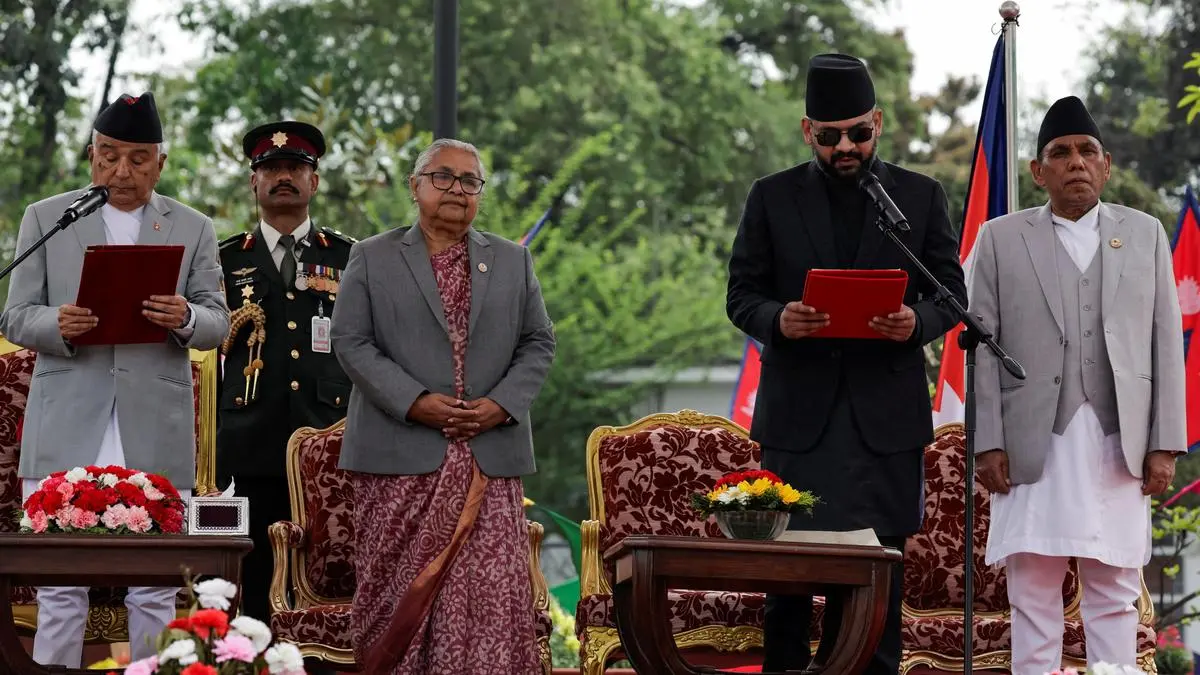
The ascension of Balendra Shah to the office of Nepal’s 47th Prime Minister represents more than a personal political victory; it is a structural disruption of the "syndicated cartelism" that has governed the Federal Democratic Republic of Nepal since 2008. To analyze this shift, one must move beyond the personality-driven narrative and examine the breakdown of traditional party gatekeeping and the emergence of a new executive operational model. This administration faces a specific triad of constraints: a fractured parliament, a debt-to-GDP ratio nearing 42%, and a geopolitical bottleneck between two competing infrastructure philosophies—India’s "Neighborhood First" and China’s "Belt and Road Initiative."
The End of Incrementalism
For three decades, Nepalese politics operated on a revolving-door mechanism between the Nepali Congress, the CPN-UML, and the CPN-Maoist Centre. This system relied on a "consensus-based" corruption model where resources were divided among the top tier of leadership to maintain stability. Shah’s appointment disrupts this equilibrium by introducing a non-aligned executive mandate.
The primary mechanism of this disruption is the Direct Accountability Loop. Unlike his predecessors, who were beholden to internal party committees and aging central memberships, Shah’s leverage is derived from high-visibility urban performance metrics—specifically his tenure as Mayor of Kathmandu. By bypassing traditional party structures, the new administration has effectively shortened the distance between policy intent and field execution. However, this creates an immediate friction point within the House of Representatives, where the Prime Minister lacks a disciplined legislative bloc.
The Economic Triple Constraint
Nepal’s economy is currently defined by three rigid variables that dictate the ceiling of the Shah administration's effectiveness.
- The Remittance Trap: Remittances account for approximately 23% to 25% of the national GDP. This creates a "Dutch Disease" effect where the influx of foreign currency keeps the Nepali Rupee artificially stable while hollowing out the domestic manufacturing base.
- Import Dependency: The trade deficit is not merely a gap; it is a structural chasm. For every $1 exported, Nepal imports nearly $10 in goods.
- Liquidity Stagnation: Despite high interest rates, private sector investment remains tepid due to policy inconsistency.
The Shah administration’s survival depends on transitioning from a "consumption-based economy" to a "production-linked economy." This requires a radical overhaul of the Special Economic Zones (SEZs) which have historically remained underutilized due to bureaucratic inertia and unreliable energy supplies. If the administration cannot secure a minimum of 7% GDP growth while curbing inflation (currently hovering near 7-8%), the populist mandate will erode within eighteen months.
Geopolitical Realignment and Infrastructure Arbitrage
Nepal sits in a state of perpetual geographic necessity. The Shah administration must navigate the Himalayan Buffer Paradox: the need for Chinese infrastructure capital without triggering Indian security anxieties.
The Southern Energy Corridor
India remains Nepal’s primary trading partner and the sole buyer of its surplus hydroelectricity. The 10,000 MW export agreement signed with New Delhi is the most critical asset on the national balance sheet. Shah’s strategy must prioritize the completion of high-voltage transmission lines (400kV and above) to ensure that the "white gold" of Nepal’s rivers can actually reach the Indian grid. Any failure here results in stranded assets and mounting interest payments to international lenders.
The Northern Logistics Route
The BRI projects in Nepal have largely remained on paper. The challenge for the 47th Prime Minister is to move from "connectivity rhetoric" to "logistics reality." This involves the Trans-Himalayan Multi-Dimensional Connectivity Network. The constraint here is technical and financial: the cost of tunneling through the Himalayas is roughly five times higher than standard plain-land rail. Shah must apply a rigorous Cost-Benefit Filter to these projects to avoid the "debt-trap" outcomes seen in other South Asian economies.
The Operational Model: Technocracy vs. Bureaucracy
The most significant internal conflict of this premiership will be the war between the Technocratic Impulse and the Permanent Bureaucracy. Nepal’s civil service is a rigid hierarchy protected by strong unions and political affiliations. Shah’s history suggests a preference for lateral entry—bringing in private-sector experts to lead specialized delivery units.
The success of this model is predicated on the Dual-Track Execution Framework:
- Track A (The Political Track): Managing the volatile coalition partners to prevent a "No Confidence" motion.
- Track B (The Technical Track): Digitizing land records, automating tax collection, and streamlining the Foreign Direct Investment (FDI) approval process.
This creates a bottleneck. If Track B moves too fast, it threatens the rent-seeking opportunities of the political actors in Track A, leading to a collapse of the government. If Track B moves too slowly, the public perceives Shah as just another "systemic actor," and his brand is neutralized.
The Revenue Optimization Function
To fund his proposed social safety nets and infrastructure goals, Shah must tackle the "Grey Economy." Estimates suggest that up to 30% of Nepal’s economic activity occurs off the books.
The strategy for formalization involves three specific levers:
- Digitization of the Customs Gateways: Implementing AI-driven scanning and automated valuation to reduce leakage at the border points.
- Tax Base Expansion: Moving away from a reliance on import duties (which currently provide over 40% of government revenue) and toward a broader internal consumption and income tax base.
- The Hydropower Royalty Reform: Ensuring that local governments receive a larger share of the royalties from large-scale hydro projects to de-incentivize local protests that often stall construction.
Risk Assessment: The Fragility of the Mandate
The Shah administration is a high-risk, high-reward experiment in "Anti-Establishment Governance." The primary risks are categorized as follows:
- Systemic Rejection: The traditional parties may unite to pass constitutional amendments that limit the powers of the executive or change the electoral system to further marginalize independent-leaning candidates.
- Macro-External Shocks: As a net importer of fuel and food, Nepal is highly sensitive to global commodity price volatility. A spike in oil prices could deplete the foreign exchange reserves (currently sufficient for about 10-11 months of imports) and force an IMF intervention.
- The Federalism Friction: The 2015 Constitution devolved power to seven provinces, but the central government has been slow to delegate fiscal authority. Shah will face immense pressure from provincial Chief Ministers to release funds that the central treasury does not have.
The strategic imperative for the 47th Prime Minister is not to please the masses with rhetoric, but to secure the "Mid-Level Bureaucracy." In the Nepalese context, the Under-Secretaries and Joint-Secretaries are the real gatekeepers of policy. By incentivizing this layer through performance-based promotions and shielding them from political interference, Shah can create a "Delivery Core" that operates independently of the chaos in the House of Representatives.
The transition from an activist-mayor to a sovereign-leader requires a shift from "demand-side politics" (asking for change) to "supply-side governance" (delivering infrastructure). The first 100 days must focus on one high-impact, non-controversial win—likely in the energy sector—to establish a baseline of competence that transcends partisan lines.
Would you like me to analyze the specific impact of this leadership change on the upcoming South Asian Association for Regional Cooperation (SAARC) summit or the potential shifts in Nepal's sovereign credit rating?


